A familiar situation: you’ve spent weeks creating truly useful content, invested resources, and produced excellent material — but what next? Post the article on your website and wait for a miracle? Launch a series of posts on social media? Send an email to your subscribers? Or maybe do everything at once and go big?
Modern brands use dozens of ways to reach their audience. Corporate blogs, Telegram channels, contextual advertising, email newsletters, partner publications—the list goes on and on. But your customers also write about your company, leaving reviews, journalists prepare reviews, and bloggers share their impressions.
As a result, mentions of your brand on the internet multiply—both those you planned for and those that are completely unexpected. Without a systematic approach, it’s easy to get lost in the flow: it’s unclear how to direct your efforts and evaluate the results.
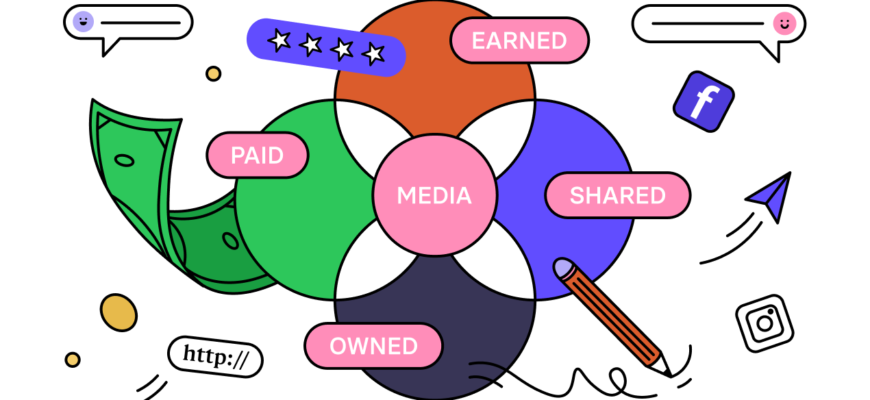
This is where the PESO communication model comes in handy. It is a practical framework that divides information distribution channels into four categories. With its help, you can bring order to your marketing communications and find the best tools to use for specific tasks.
What is the PESO model?
The PESO model is a ready-made framework for marketing. It covers the entire content lifecycle: from the initial concept to selecting the best distribution methods. The concept was developed by Gini Dietrich, founder of Arment Dietrich and Spin Sucks Pro. In 2014, she presented this system in her book Spin Sucks.

Dietrich drew attention to an obvious problem: traditional marketing and PR techniques are no longer able to cope with reality. The number of channels is increasing, and companies need a clear way to navigate them. Years later, the PESO communication model remains one of the most practical tools for planning content strategy.
The essence of the approach is its comprehensiveness. You formulate a key message, and PESO helps you convey it through various channels, connecting the necessary tools at the right moment. Let’s say you are launching a new product: first, you prepare an expert article for your blog, then adapt it for social media, simultaneously negotiate its publication with an industry publication, and then increase its reach with targeted advertising.
The model solves two practical problems. First, it allows you to classify all the ways in which a brand interacts with its audience and understand where to focus your main efforts. Second, it helps you build a balanced strategy that leads to concrete business results, whether that means increased sales, greater brand awareness, or attracting leads.
What does the abbreviation “Peso” stand for?

The model name is an acronym formed from four English words. Each one represents a separate category of communication channels that the brand works with. Let’s take a closer look at each letter.
Paid (paid advertising)
This includes all formats that you pay for: targeted and contextual advertising, sponsored integrations with bloggers, banners on partner sites. For example, you are launching a new product line and want to quickly reach the right audience — you set up advertising on social networks with precise targeting by interests and geography.
The main advantages of paid channels are instant visibility and measurable results. You know exactly how many people saw the ad, how many clicked on it, and how many ultimately made a purchase. The downside is obvious: as soon as the budget runs out, the traffic stops.
Earned (free communications)
These are free publications that appear thanks to the brand’s reputation and the work of PR specialists. A journalist writes a review of your product, an industry publication gets a comment from the CEO, a blogger mentions the company in a selection — all of this is earned media.
This type of communication has two important advantages:
- It inspires more trust because the information is disseminated by independent authors rather than the brand itself.
- Expands the audience by attracting readers, subscribers, and viewers from other platforms.
There are also some challenges. First, preparing a high-quality news story takes time and effort—you need to find an interesting angle, build relationships with the editorial team, and wait for publication. Second, you have no control over the final text: the journalist may emphasize certain points differently than you would like.
It is precisely these placements that are often used to evaluate the effectiveness of a PR manager—these results are clear and easy to calculate.
Shared (social platforms)
This category includes all platforms where users can freely communicate and share content: social networks, forums, review sites, and video hosting sites. Both official brand publications and user-generated content are taken into account.
Imagine: a customer bought something from you, was satisfied, and posted the unboxing on their Telegram channel. Or, conversely, they encounter a problem and write an angry post. This is not full-fledged advertising or even material from a journalist — it’s just a person wanting to share their experience. Such user-generated content (UGC) also belongs to shared channels: reviews on marketplaces, reviews on blogs, recommendations in thematic communities.
The main advantage of social platforms is that they help build a loyal community around a brand. When people discuss your product, share life hacks, and help each other, it creates an emotional connection that is difficult to buy with money.
The downside is that you have no control over what users write. Negative reviews can spread across the internet faster than any advertising campaign.
Owned (own sites)
These are resources that are wholly owned and controlled by the brand: corporate website, blog, landing pages, email newsletters, own podcast or media.
Why don’t Facebook company pages or Telegram channels count? Because you don’t control the rules of the game. Tomorrow, the social network may change its algorithms, update its design, or introduce new restrictions for business accounts—and there is nothing you can do about it. And if your business is related to alcohol or tobacco, your opportunities for promotion on social media are minimal.
On your own website, you set the rules. Want to implement detailed analytics to track how visitors scroll through articles? Go ahead. Need a custom design or interactive format? No restrictions.
Gini Dietrich recommends starting to work on content on your own platforms. First, you create material for your website or blog, and then adapt it for other channels: you make excerpts for social media, prepare news stories for the media, and launch advertisements with links to the original. This way, you attract an audience from different sources to a fully controllable resource. However, if the platform is new, you will have to build your audience from scratch, and that takes time.
Why is the PESO model necessary in marketing?
Working with content without a clear system is like trying to put together a puzzle blindfolded: you seem to be doing something, but you can’t see the big picture. The PESO model in marketing solves this problem — it provides a structure that helps you consciously manage all communication channels.
It enables any business or marketer to accomplish the following tasks:
Identify blind spots in your advertising strategy
Let’s say you already have a working brand: your team actively seeks media coverage, runs a Telegram channel, and maintains an Instagram page. Everything seems to be under control. But at the same time, your corporate blog has been empty for months, and the idea of launching a podcast has remained on your “someday” list. But these are additional channels and points of contact with your audience. PESO helps you see which channels you are using and which ones you are undeservedly ignoring.
At the same time, the model does not encourage grabbing at everything — especially if the team is small. Rather, it provides an opportunity to make an informed decision: what to add and what to leave out for now.
Systematize channels and weed out ineffective ones
The easiest way to understand what the PESO model is for is in practice. Take a sheet of paper and write down all the communication channels your brand uses, dividing them into four categories. Then rate each one on a scale of 0 to 3: how much traffic it brings, how it affects sales, and how engaged the audience is.
Sort the list in descending order—at the bottom, you will find channels that consume resources but do not provide a return. You may find that a Facebook page, which takes several hours a week to maintain, generates fewer leads than a single monthly email newsletter.
Adapt messages to the specifics of each channel
The same content works differently depending on the platform. A post for Telegram requires conciseness and a catchy first sentence. A blog article allows you to explore the topic in more depth and add SEO optimization. An advertising banner should grab attention in a second and contain a clear call to action.
PESO reminds us that it is not enough to create good content—you need to package it correctly and choose a relevant CTA for each point of contact with your audience.
How to use the PESO marketing model?
A common mistake is to create content first and then frantically search for a place to publish it. The PESO marketing model suggests the opposite approach: first, figure out who you want to reach and through which channels, and only then start producing advertising materials. Let’s break down this process step by step.
Define your target audience
Without understanding your audience, all further efforts will be in vain. You need to have a clear idea of who will see your ad, open your email newsletter, or click on the link in your post.
Vague phrases such as “men aged 30-50 with average income” do not work — this description covers a huge part of the population. Break your audience down into segments and write down specific characteristics for each one: interests, fears, tasks that people want to accomplish. Without such detail, you risk showing ads for a fitness club to people who don’t exercise at all, and promo codes for food delivery to those who only cook for themselves.
What to pay attention to: what media and Telegram channels your audience reads, which social networks they are most active on, what queries they enter into search engines, and what difficulties they encounter in everyday life.
For example, if you offer a CRM system for real estate agents, your potential customers are likely to be members of professional chat rooms, subscribers to real estate blogs, looking for ways to automate routine tasks, and more likely to visit Telegram and LinkedIn than other platforms.
Decide on your promotion channels
Once you have a clear picture of your audience, choosing channels becomes logical rather than random. Start with soft, unobtrusive formats—don’t push sales right away. Your primary goal is to generate interest and build trust.
Let’s imagine that you have established that your potential customers regularly read niche online publications and follow several opinion leaders on Telegram. A sensible first step would be to get mentions in these media (earned channel) and launch your own expert channel where you will share useful content (shared channel).
Only when your audience is already familiar with your brand does it make sense to include paid promotion: targeted advertising that will drive traffic to your website or landing page.
Prepare the content
Now that you know who you will be showing your content to and where, you can start creating it. The format of your content depends directly on your audience’s habits and the specifics of your channel.
If your target audience doesn’t read long texts and is used to consuming quick content, there’s no point in printing 15,000-character longreads. It’s better to make a short, dynamic video or a series of compact posts with specific benefits. Conversely, for a B2B audience, in-depth analytical material will work better than an entertaining video.
Share links to published articles
To use the PESO model effectively, think of it as a funnel. You take one central idea and adapt it to different formats, nudging your audience toward the desired action at each stage.
How it works in real life: earned and shared channels work on brand awareness—a potential customer comes across an article about you in an industry publication or sees a recommendation on an expert’s Telegram channel. After that, paid tools come into play—retargeting “reminds” the person about you and leads them further. Owned platforms put the finishing touches on the process: on the website or in an email newsletter, the user receives the final argument and places an order.
Consider the specifics of the business: in B2C, this cycle can take several days, and in B2B, several months. A customer choosing a CRM system for a company will not make a decision after a single interaction; they need time to compare options and consult with their team.