
France has a population of about 67 million, a high income level, and a culture of buying almost everything online—from insurance to cheese delivered right to your door. The market is mature and financially robust, yet not as overheated as, say, the U.S. market.
For businesses expanding into Europe, this is one of the most logical starting markets. And contextual advertising in France is usually the first channel that actually generates leads within the first few weeks.
You’re probably already familiar with how PPC and pay-per-click work. So what follows isn’t a primer, but rather an analysis of how things work differently in France compared to the post-Soviet market. Where do people search? Which campaign formats deliver results? How much does it cost? And why can’t you just “translate your ads into French and launch them”?
Features of contextual advertising in France
In short, the French market differs from what we’re used to in terms of audience search behavior, attitudes toward data, and consumer culture. These three factors determine almost everything: from what kind of content performs well to how analytics should be set up.
Search and Consumer Culture
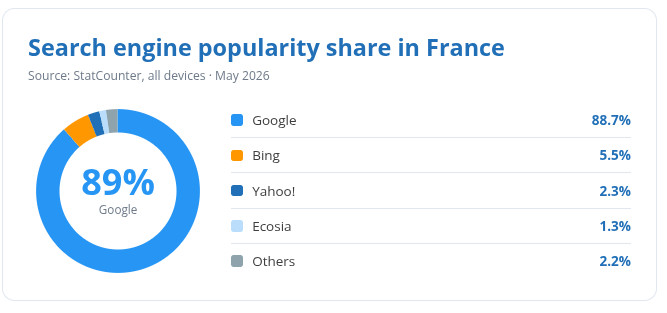
Google accounts for about 90% of search traffic here, so Google Ads in France reach nearly the entire active audience. But there’s a catch: the French have a strong demand for privacy, and some users deliberately stick with the local search engine Qwant, which positions itself as “search without surveillance.” Qwant’s market share is small (around a few percent), but it’s a barometer of sentiment—the French audience is sensitive to how their data is handled.
And a word about consumer culture. The French value restraint and specificity. Aggressive slogans like “BUY NOW WITH A 90% DISCOUNT!!!” are less effective than a calm, well-reasoned offer. Incidentally, this is evident even in the design of local online stores—minimalism, an emphasis on quality, and no visual clutter.
GDPR, CNIL, and Data Protection
This is where France really stands out. The GDPR—the EU-wide data protection regulation—is enforced particularly strictly here, overseen by the CNIL, and the fines are far from nominal. In practice, when setting up Google Ads for France, there are a few things you need to keep in mind.
- A proper cookie banner that offers a real choice: users should be able to opt out just as easily as they can opt in.
- Google Consent Mode v2 is enabled—without it, Google Ads loses some conversion data for users in the EU.
- A transparent privacy policy in French.
- For large companies and projects that actively handle personal data, a designated Data Protection Officer (DPO) is responsible for data protection.
It sounds like red tape, but in reality, it has a direct impact on your bottom line. If consent settings are configured incorrectly, conversion tracking breaks down, automated strategies receive inaccurate data, and optimization for CPA or ROAS stalls. To be honest, a good half of the “non-performing” ads from newcomers to the French market are actually due to broken analytics caused by incorrect data protection practices.
Important: GDPR compliance isn’t just a “box to check for lawyers”; it’s the foundation of advertising analytics in France. First, you need proper consent and tracking; then you can scale your budget. Not the other way around.
Localization
The most common and costly mistake is to run your ads through a machine translator and assume you’re done. The French language is demanding: native speakers can instantly spot machine translation and lose trust. An ad with a clumsy phrase looks like a scam—and in France, where security is taken seriously, that spells the end of conversions. That’s why the text must be written by someone who understands local phrasing.
Next are details that also relate to localization: prices in euros, dates in the dd/mm/yyyy format, phone numbers with the +33 code, and references to familiar payment methods like Carte Bleue and delivery via Colissimo. When a French person sees a familiar payment system and clear shipping options on the landing page, the “can I trust you?” barrier drops significantly.
And one more thing about seasonality. The holiday calendar has its own rhythm: the Soldes sales (the winter and summer ones, by the way, are regulated by the government in terms of dates), Christmas, and the back-to-school season in September. If you’re planning your advertising budget for the year, be sure to factor in these peak periods in advance.
Keywords for a French audience
You can’t simply translate the terminology from Ukrainian. The French phrase their queries in their own way, actively using abbreviations and Anglicisms mixed in with French terms. Some people search for “assurance,” others for “mutuelle,” and these reflect different intentions.
What to keep in mind when compiling a list of keywords:
- Authentic French phrasing, not a direct translation from Ukrainian or English;
- Local abbreviations and niche slang;
- Regional differences (Paris, Lyon, and Marseille search in slightly different ways).
Negative keywords are just as important. Without them, your budget will be wasted on terms like “gratuit” (free), “emploi” (job/vacancies), competitors’ names, or irrelevant regions such as Belgium and French-speaking Canada—especially if you only operate in France. Negative keywords are, in essence, a filter that blocks clicks you don’t want to pay for.
Here’s a quick example. An online store launched an ad campaign targeting the keyword “montre” (watch)—and half of its budget was spent on searches for “montre comment faire” (show me how to do it), because “montre” is also the verb “to show.” Once they added negative keywords, the cost per lead dropped by nearly half in just one week.
Which Google Ads formats perform best in France?
In short, Google Display Ads in France aren’t just a single button—they’re a suite of tools designed for different purposes. Let’s take a closer look at what each one is best suited for.
- Search campaigns. The foundation for most projects. They help you reach people with a clear intent to buy. It makes sense to start testing demand with these.
- Google Shopping (product listings). A must-have for any online store. This requires a properly configured feed in Merchant Center with prices in euros and descriptions in French.
- Performance Max. Hybrid format: Google automatically distributes impressions across Search, Display, YouTube, Gmail, and Maps, optimizing for the specific campaign objective. It drives strong conversions once data has been accumulated, but requires clearly defined objectives and carefully selected ad groups.
- Google Demand Gen. Visual formats for the top of the funnel—YouTube Shorts, the Discover feed, and Gmail. Generates demand where people aren’t yet actively searching for your product. Ideal for brands and visually appealing niches (fashion, home decor, travel).
A typical workflow looks like this: Search and Google Shopping capture high-demand traffic, Performance Max scales up what’s already paying off, and remarketing in the Display Network and Demand Gen bring back those who left to think it over.
Let’s say you sell designer furniture. Search captures the query “canapé design sur mesure,” Shopping displays specific models with prices, and Demand Gen on YouTube reminds those who browsed the catalog but didn’t buy about your brand. Each format does its part.
Cost per click for contextual advertising in France
Let’s start by distinguishing between two concepts that are often confused: the advertising budget (the money paid to Google for clicks) and the cost of a specialist’s services.
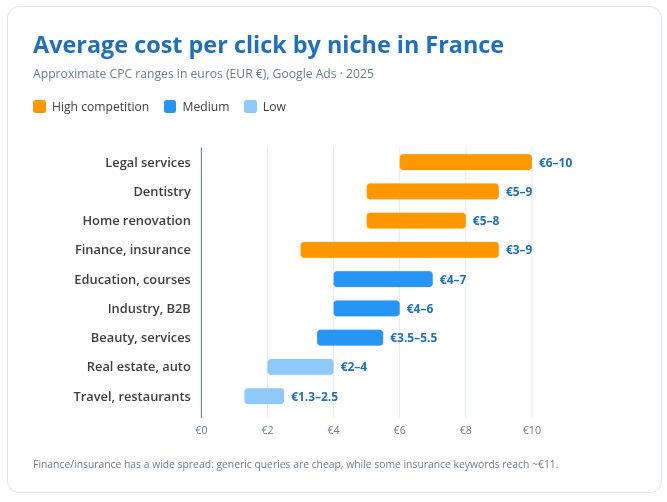
Let’s start with the budget. The cost of contextual advertising in France is determined by an auction: you pay per click (CPC), and the amount depends on the niche, competition, ad quality, and landing page. According to recent benchmarks, the average CPC in Google Ads in 2025 was about $5.26, but this is a global figure, and France is usually cheaper than the U.S. To understand the range: for online education, the average CPC in the US reached $9.35, while in France it was around $0.77. The difference is significant.
Approximate CPC ranges by niche in France (in euros, very rough estimates):
- E-commerce and retail: ~€0.20–1.00 per click on non-branded search terms; product ads are often cheaper.
- Services and B2B: ~€1–3.
- Insurance, finance, and legal services: €3–8 and up—these are the most expensive niches; insurance in France consistently has the highest CPC among all industries.
As for the initial overall budget, for most niches, a reasonable minimum—enough to build up data and allow automated strategies to learn—starts at around €1,000–1,500 per month. You can start with less, but you’ll have limited data, and you’ll have to make every decision based on intuition.
Note: A “cheap click” and a “cheap customer” are not the same thing. Sometimes a CPC of €3 can bring in a more profitable customer than a CPC of €0.50. Focus on CPA and ROAS, not just the cost per click in isolation from sales.
What factors determine the cost of setting up contextual advertising in France?
Now, let’s talk about the specialist’s work. The cost of setting up contextual advertising in France depends on the scope of the work, not on the “number of campaigns.” The same budget can be set up in a couple of days using a template, or over two weeks with in-depth analysis—the results will be different.
The price is influenced by:
- The complexity of the niche and the number of product categories (a single product or a catalog with thousands of items);
- Is text localization and semantic refinement required in French?
- Analytics status—whether goals, Consent Mode, and conversion imports are configured;
- Set of formats: search only, or also Google Shopping, Performance Max, and Demand Gen;
- Is ongoing maintenance and optimization required, or is this a one-time, turnkey setup?
They typically operate under one of the following models: a flat fee for setup, a monthly maintenance fee, a percentage of the advertising budget, or a combination of these. Which model is most beneficial for you depends on the size of your budget and how aggressively you plan to scale your business.
Why should you hire an agency to set up your Google Ads campaign for France?
You can hire a freelancer, or you can figure it out on your own. But the French market is less forgiving than it seems. A broken GDPR consent form, machine-translated ads, missing negative keywords, incorrectly compiled keywords—each of these small issues quietly eats away at your budget on its own, and together they can drive a campaign into the red.
A contextual advertising agency in France handles all of this for you: proper data management, real-time localization, well-structured campaigns, and continuous optimization tailored to your CPA and ROAS goals. You don’t get a “set it and forget it” solution, but rather a managed flow of leads that can be scaled.
Ready to test the demand for your product in the French market? You can order a turnkey contextual advertising campaign in France—from niche analysis and keyword research to launching and managing your ad campaign. Contact us, tell us about your business and your goals, and we’ll provide a strategy and a quote tailored to your needs.