
Advertisers often underestimate Canada. And they shouldn’t. It’s a country with high purchasing power, a high average transaction value, and an audience that’s accustomed to finding products and services through search engines.
Someone in Toronto who needs a plumber or a new mattress does exactly the same thing as someone in Kyiv—they open Google and type in a search query. The difference is that fewer advertisers are competing for that click in Canada than in the U.S., and the user has more money to spend.
And this is where it gets interesting. Contextual advertising in Canada is a way to reach a customer at the exact moment they’re ready to buy. Not “sometime in the future,” but right now, when demand is at its peak. You pay only for clicks on the ad (hence the term PPC, pay-per-click), not for the ad being displayed. That’s why your budget is used in a highly targeted way.
Below, we’ll take a closer look at how Google Ads works in Canada: how the local market differs from others, which campaign types deliver results, how much it costs, and how to calculate the return on investment.
Why do businesses need contextual advertising in Canada?
Let’s start with a simple question: Why should you enter the Canadian market in the first place?
- Speed. SEO takes months to pay off, while Google Ads in Canada can generate your first leads on the very day the campaign launches. Let’s say you’ve opened an eyebrow lamination studio in Vancouver. Your website is ready, your technicians are hired, but you have zero clients. A search campaign closes this gap within a day—an ad for the query “brow lamination Vancouver” starts running immediately after approval.
- An affluent audience. The average transaction value in niches such as dentistry, legal services, or home renovation in Canada is significantly higher than in CIS markets. A single client can recoup an advertising budget in a week with just a few dozen clicks.
- Measurability. Every hryvnia (or every Canadian dollar) in the budget is transparent. You can see how much each click cost, how much each lead cost, and which campaign generated a sale. This isn’t like a billboard on the highway, where you can only guess at the impact.
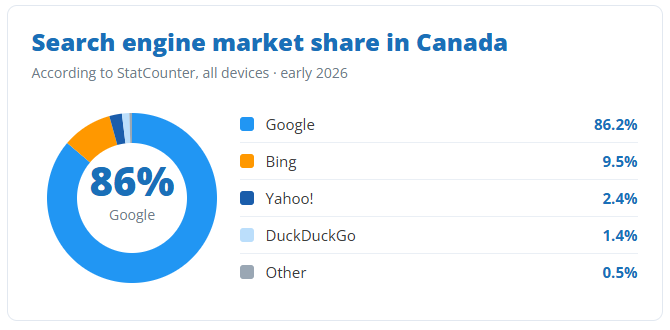
Important: Google accounts for about 80% of the global paid search market. For a Canadian audience, this means that you can reach nearly all potential customers through a single advertising platform—Google Ads. Bing is also available in Canada and sometimes offers lower costs per click, but it cannot replace Google as the primary channel in terms of traffic volume.
Key Features of Google Ads for Canada
This is where the main pitfalls of running advertising campaigns in Canada lie. Without understanding these nuances, you won’t be able to turn a profit.
Two official language zones
Canada is bilingual. English and French are both official languages, and about one-fifth of the population speaks French as their first language, mainly in Quebec.
If you run campaigns exclusively in English, you’re essentially ignoring Quebec. Yet it’s a massive market, encompassing the population of Montreal and the province as a whole. The French auction is less competitive—there are significantly fewer advertisers there, so the cost per click in French-language campaigns is often 20–40% lower than in English campaigns for the same keywords. And conversion rates are higher: people are more likely to click on an ad in their native language.
The practical conclusion is simple. English and French are two separate campaigns, two landing pages, and two sets of ads. This isn’t machine translation, but proper ad localization done by native speakers. The local audience spots machine-generated “Franglish” instantly and moves on.
Note: Starting June 1, 2025, in French-speaking Quebec, using French in commercial advertising will no longer be just a good idea—it will be a legal requirement (Bill 96). If your business operates in Quebec, ad copy and landing pages must be available in French, and the French text must be no less prominent than the text in any other language. Ignoring this is risky—fines for violations can run into the thousands of dollars.
Geotargeting by Canadian province
Canada consists of ten provinces and three territories, and demand varies across them. Advertising plastic windows in Toronto versus a small town in Manitoba is like night and day in terms of cost per click and traffic volume. Effective geotargeting filters out regions where the product isn’t available and boosts bids where it is sold.
Here’s a simple example. A local cleaning company operates only within the Greater Toronto Area. There’s no point in paying for ads across the entire country—we set a radius around the city and include the neighboring suburbs. This way, the budget isn’t spread too thin; instead, it’s targeted precisely.
Privacy Policy
Canadian data protection laws are stricter than many people realize. The federal PIPEDA law regulates the collection of personal data, while CASL (Canada’s Anti-Spam Legislation) governs the sending of commercial messages. This is important when it comes to working with leads: you cannot follow up on a lead with emails or text messages without the user’s consent. At the level of advertising campaigns themselves, this means carefully configuring forms, consent processes, and analytics to ensure that data collection is legal.
Which Google Ads campaigns work best in Canada?
Google Ads isn’t just about text ads in search results. Different formats are best suited for different objectives.
- Search campaigns. The foundation. Ads are displayed in response to specific user queries—such as “buy office chair Toronto” or “emergency dentist near me.” This is the most valuable traffic: the user has already identified a need. Search campaigns are usually the best place to start, especially in the service industry.
- Google Shopping. Indispensable for online stores. Listings display product photos, prices, and names right in the search results—users can see exactly what they’re clicking on before they even visit the site. Traffic from Google Shopping is often cheaper than search traffic, and the quality of leads is higher because users have already seen the price.
- Performance Max. A campaign that automatically allocates your budget across all Google platforms—Search, the Display Network, YouTube, Gmail, and Maps. It uses machine learning and requires solid conversion data and high-quality creatives. It works great for e-commerce, but it’s difficult for beginners to manage on their own—there’s too much automation that needs to be “fed” the right signals.
- Display advertising. Banners on Google partner sites. It generates fewer direct sales, but it’s effective for building brand awareness and bringing audiences back.
- Retargeting. We reach out to people who have already visited the site but didn’t submit a request. Someone looks at a tour to Banff, closes the tab—and a day later sees an ad with the same offer. In terms of cost per conversion, retargeting almost always outperforms cold traffic.
- Google Demand Gen. A format designed for visually appealing niches—fashion, travel, and beauty. Ads run on YouTube Shorts, Discover, and Gmail, capturing the audience’s attention during the “browsing but not actively searching” stage.
Tip: Don’t launch everything at once. It’s better to start with one or two formats, collect conversion data, and only then scale up. Spreading your budget across five types of campaigns at the same time is a surefire way to lose track of what actually worked.
What should you consider when setting up contextual advertising for Canada?
Setting up contextual advertising in Canada isn’t just a matter of “pressing a button to get started.” It’s a series of steps, and skipping even one of them will lead to significantly worse results. Here’s how the process works at our agency:
- Niche analysis and audit. We’ll figure out what you’re selling, to whom, in which regions, and what your average order value is. If you already have an advertising account, we’ll review its history and see where your budget has been spent.
- Semantic research. We identify a core set of keyword queries: commercial, informational, brand-related, and language-specific. At the same time, we compile a list of negative keywords—such as “free,” “job openings,” and “reviews”—to avoid paying for irrelevant clicks.
- Geotargeting and language targeting. We set up regions (the entire country, specific provinces in Canada, and cities like Toronto, Vancouver, or Montreal) and split campaigns into English and French.
- Advertisements and localization. We write copy tailored to each market segment. The French version is produced by native speakers, without machine translation.
- Landing page. We make sure the landing page matches the ad, loads quickly, and is properly optimized for mobile (since more than half of all traffic in Canada comes from smartphones).
- Analytics. We set up Google Analytics, goals, conversion tracking, and call tracking if needed.
- Launch, training, and optimization. The first few weeks are the busiest: we refine search queries, adjust bids, and test ads.
A word about the landing page. Sometimes the ad is perfect, clicks are coming in, but there are no leads. It’s almost always the landing page’s fault: a confusing offer, slow loading times, a form with ten fields. Google Ads in Canada brings people to the door—but if it’s a mess behind the door, they’ll leave. That’s why we always evaluate the page in conjunction with the campaign.
The cost of contextual advertising in Canada
The total cost of pay-per-click advertising in Canada consists of two parts: the advertising budget (which you pay directly to Google) and the fees charged by a specialist or agency for setup and management.
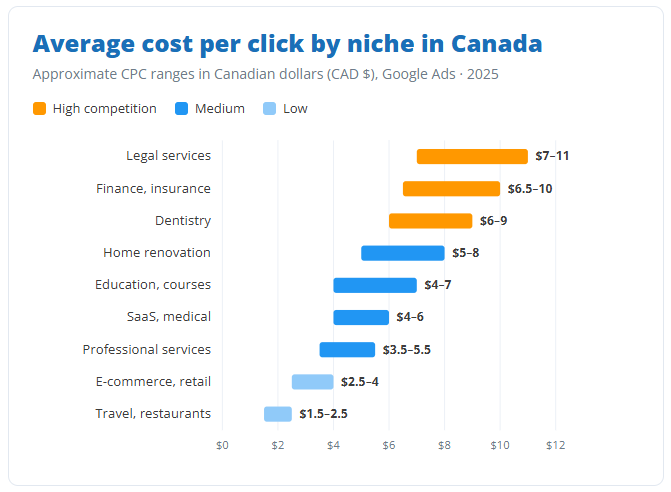
Here’s a rough guideline for your advertising budget. The average cost per click in Canada is about one-third lower than in the U.S. In less competitive niches like e-commerce, CPC can hover around CA$1–2, while in expensive and competitive niches—such as legal services, insurance, and real estate—a click can easily reach CA$7–10 or more. Google’s auction is structured so that the cost per click depends not only on the bid but also on the quality of the ad and the relevance of the landing page: the higher the quality, the cheaper the same click costs.
As for our services: our rates for setting up contextual advertising in Canada start at approximately 12,000 UAH for a search campaign of moderate complexity. For a large online store with a Google Shopping feed and a French-language version, the price will be higher—there’s more work involved.
Important: It’s a good idea to set aside a minimum advertising budget of CA$500–800 per month. A smaller amount in a competitive niche simply won’t provide the system with enough data to learn and optimize—the campaign won’t have time to gain momentum, and you’ll mistakenly conclude that the ads aren’t working.
A very rough initial budget estimate: take your target number of leads per month, multiply it by the estimated cost per lead in your niche, and add a 20% buffer for testing. This will give you a range to work with.
Why should you hire an agency to run contextual ads in Canada?
In theory, you can set up Google Ads on your own—the interface is user-friendly, and there are plenty of guides online. In practice, most DIY campaigns end the same way: the budget is spent, there are few leads, and you’re left feeling disappointed. It’s not because you’re not smart. It’s because there are so many details, each of which quietly burns through your budget.
A contextual advertising agency in Canada is valuable because it has already learned the hard way using other people’s budgets. Here’s what you get in practice:
- knowledge of market specifics—bilingualism, Quebec requirements, and the nuances of geotargeting by province;
- the right campaign structure from the start, without a month of trial and error;
- regular optimization—cleaning up search terms, adjusting bids, and conducting A/B tests on ads;
- transparent reporting that focuses not on clicks for the sake of traffic, but on leads and ROI.
It makes sense to run PPC ads in Canada when bid prices are high and mistakes are costly. If you’re spending CA$2,000 a month, the difference between a “haphazardly set up” campaign and a “well-optimized” one translates to at least double the number of leads. Over the long term, this is exactly what makes the agency’s services pay off.
How do you choose a contractor? Look at three things. First, does the agency have experience specifically with the Canadian market? Second, are they willing to show case studies and talk in terms of return on investment, rather than just saying, “We’ll drive a lot of traffic”? Third—how do they manage advertising campaigns in Canada after launch: advertising requires constant attention, and a “set it and forget it” approach doesn’t work here.
Tip: At your first consultation, ask the contractor a direct question: “How will you measure the results, and what tool will I use to view them?” If the answer mentions cross-channel analytics, conversion tracking, and ROMI, that’s a good sign. If they only talk about “lots of clicks and impressions,” you should be wary.