Ask three contractors what the price of PPC advertising is, and you will hear three different answers. One will say 5,000 hryvnias, another will say 50,000, and the third will say “it depends on the niche,” and they will be right. The problem is that the word “price” hides different costs: what goes to Google for traffic, what the specialist receives, and how much a single lead costs. Below is a breakdown of each expense category with figures for the Ukrainian market, a calculation formula, and examples.
What makes up the cost of PPC advertising?
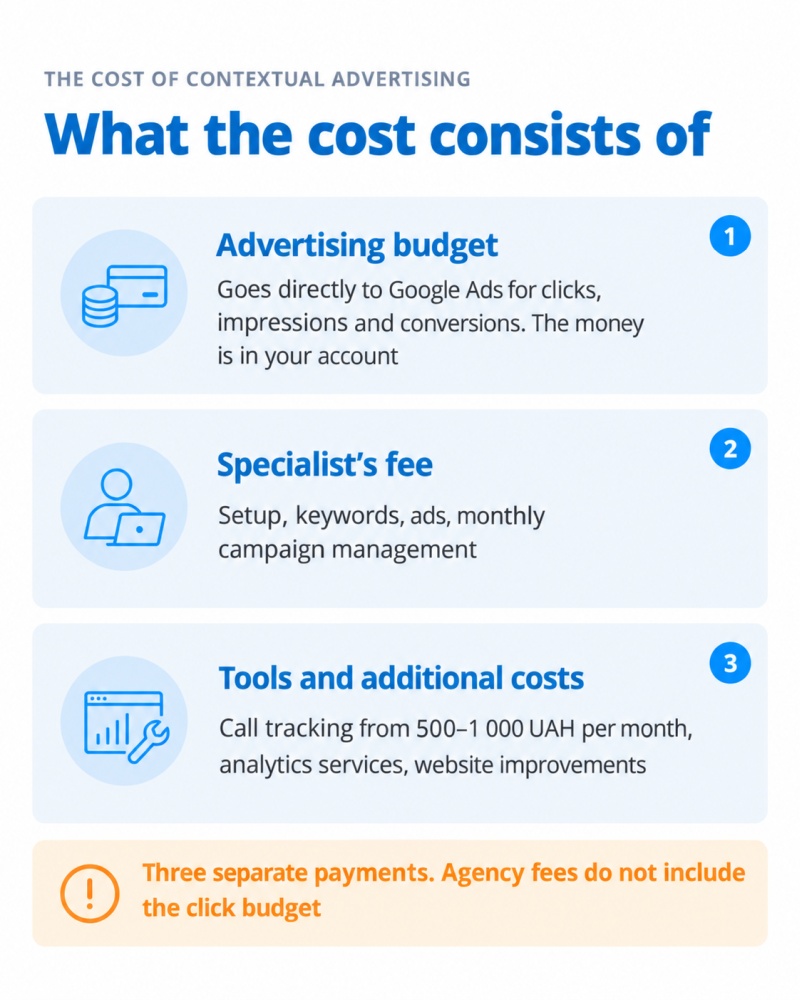
The total cost of PPC advertising consists of three independent payments. They often get mixed up, which leads to resentment: “I paid the agency 15,000, but there was almost no traffic.” That is because the traffic budget is a separate expense. So, this includes:
- Payment for traffic. This goes directly to Google Ads for clicks, impressions, and conversions. The contractor does not touch it—everything remains in your account.
- Payment for the specialist’s work. Campaign setup, keyword research, ad copywriting, and monthly management. The recipient is a freelancer, an agency, or an in-house PPC specialist.
- Tools and additional expenses. Call tracking (from 500-1,000 UAH per month), analytics services, and sometimes landing page improvements. This expense category is forgotten most often.
How the cost per click is formed in Google Ads: the advertiser auction
Google does not sell traffic according to a price list. Every impression is raffled off in an auction in fractions of a second, and all advertisers whose keywords matched the user’s query participate in it. The winner is determined not just by the bid.
Ad Rank = bid × Quality Score (plus the impact of extensions and context). The second multiplier is a score from 1 to 10: it includes relevance to the query, expected CTR, and how user-friendly the landing page is. Therefore, an advertiser with a score of 8 and a bid of 15 UAH will outbid a competitor who has a score of 4 and a bid one and a half times higher.
The actual CPC (cost per click) is almost always lower than the maximum bid: you are charged exactly enough to beat the closest neighbor in the auction, plus a minimum increment. This is why the cost of Google PPC advertising for two companies in the same niche can differ by a factor of two—one company’s ads and website simply answer the query better.
You cannot “buy” the Quality Score. It grows only through relevance: having the keyword in the headline, a landing page strictly tailored to the keyword, and fast loading speeds on mobile. This is the cheapest way to lower your cost per click—and an underrated one at that.
Average cost per click in Google Ads by niche in Ukraine
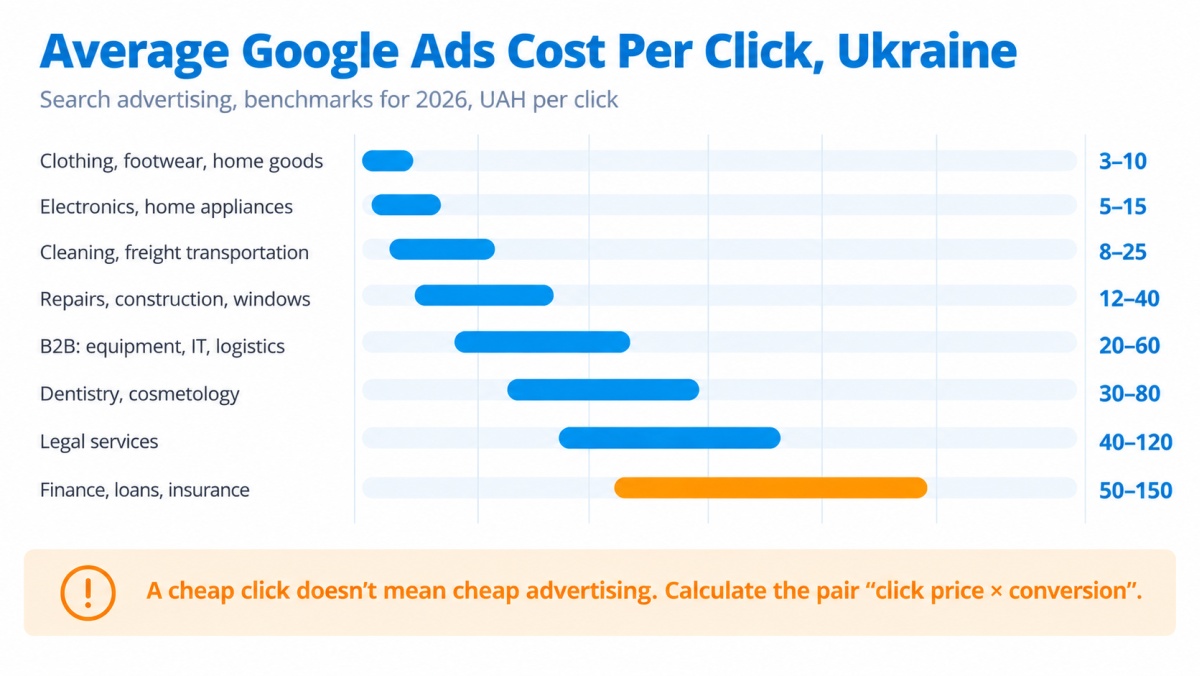
The figures below are benchmarks for 2026 for the search network. The variance within a specific topic is significant: geo-targeting, specific search queries, and seasonality can shift the CPC by 2–3 times in either direction. Look at the range as a starting point, not as a promise.
| Niche | Average cost per click, hryvnias | Comment |
|---|---|---|
| Clothing, footwear, home goods | 3–10 | High traffic, low average order value, competition driven by volume. |
| Electronics, home appliances | 5–15 | Strong marketplaces in search results pull the market up. |
| Renovation, construction, windows, doors | 12–40 | Expensive leads due to poor landing page conversion rates. |
| Cleaning, freight transport, household services | 8–25 | Local demand, heavily dependent on the city. |
| Education, courses, language schools | 10–35 | Seasonal peaks in August–September and January. |
| Dentistry, cosmetology, private clinics | 30–80 | High competition in Kyiv and regional centers. |
| Legal services, notaries | 40–120 | One of the most expensive segments. |
| Finance, loans, insurance | 50–150 | Maximum competition in the market. |
| B2B: equipment, IT services, logistics | 20–60 | Few clicks, long sales cycle, high average order value. |
| Real estate, developers | 25–70 | Expensive clicks, but deals worth millions. |
A cheap click does not mean cheap advertising. A construction company with a CPC of 12 UAH and a website conversion rate of 1% gets a lead for 1,200. A dental clinic with a 60 UAH click and an 8% conversion rate gets one for 750. You should calculate the “cost per click × conversion rate” pair, not just the bid itself.
What affects the price of Google PPC advertising besides the niche?
The niche sets the order of magnitude for the figures. Then, factors that you can influence come into play.
- Geography and display region. A click for the query “apartment renovation” in Kyiv costs 1.5–2 times more than in Lviv or Poltava. Nationwide targeting across Ukraine smooths out the variance but also brings junk traffic from regions outside your service area.
- Query type. Commercial keywords containing words like “buy,” “price,” or “order” cost more than informational ones, but they convert into buyers. Branded queries (your own company’s name) are the cheapest, around 1–3 UAH.
- Competition in the niche at a specific moment. Right before New Year’s, on Black Friday, and during peak seasons, bids increase by 20–50%: more participants enter the auction.
- Device. Mobile traffic usually costs less, but the conversion rate is also lower—especially where forms are long.
- Bidding strategy. Manual bidding provides control, while automated bidding (“Maximize conversions,” “Target CPA”) offers stability after the learning phase. Initially, automated strategies overspend while accumulating data.
- Time of day. At night and on weekends, there are fewer competitors, making clicks cheaper, but leads “cool down” until Monday.
By the way, a fresh account with no history pays more. The system doesn’t yet know how people behave after clicking on your ads, so it acts cautiously. The first 2–4 weeks are a period when the price of Google PPC advertising is objectively above normal, and this is not a mistake by the contractor.
Minimum budget: what amount makes sense to start advertising with?
Technically, there is no minimum starting amount in Google Ads. You can top up your account with 500 UAH and show something. The real question is whether this will be enough to draw any conclusions at all.
A practical benchmark: a minimum of 10–15 conversions per month. Anything less, and it is impossible to understand what drives results, plus the automated strategies won’t have enough time to learn. Hence the simple logic (amounts in hryvnias):
- A niche with a CPC of 5 and a 2% conversion rate: one lead ≈ 250, 15 leads ≈ 3,750. It’s realistic to start with 5,000 per month;
- A segment with a CPC of 30 and a 3% conversion rate: a lead ≈ 1,000, a dozen and a half ≈ 15,000. It’s not worth entering with less than 15,000–20,000;
- Legal services with a CPC of 80 and a 4% conversion rate: a lead ≈ 2,000, the minimum threshold is from 30,000.
For small businesses in Ukraine, a meaningful test begins with 6,000–10,000 hryvnias per month on the search network. An online store using Google Shopping can start with 4,000–5,000, since product traffic is cheaper.
The test period is at least 4–6 weeks. In two weeks, the auction, the algorithm, and your audience simply won’t have enough time to “sync up.” If you only have enough money for a month, it is better to narrow down the geo-targeting and keywords, but allow the campaign to run long enough to draw valid conclusions.
How to calculate your PPC advertising budget before launch?
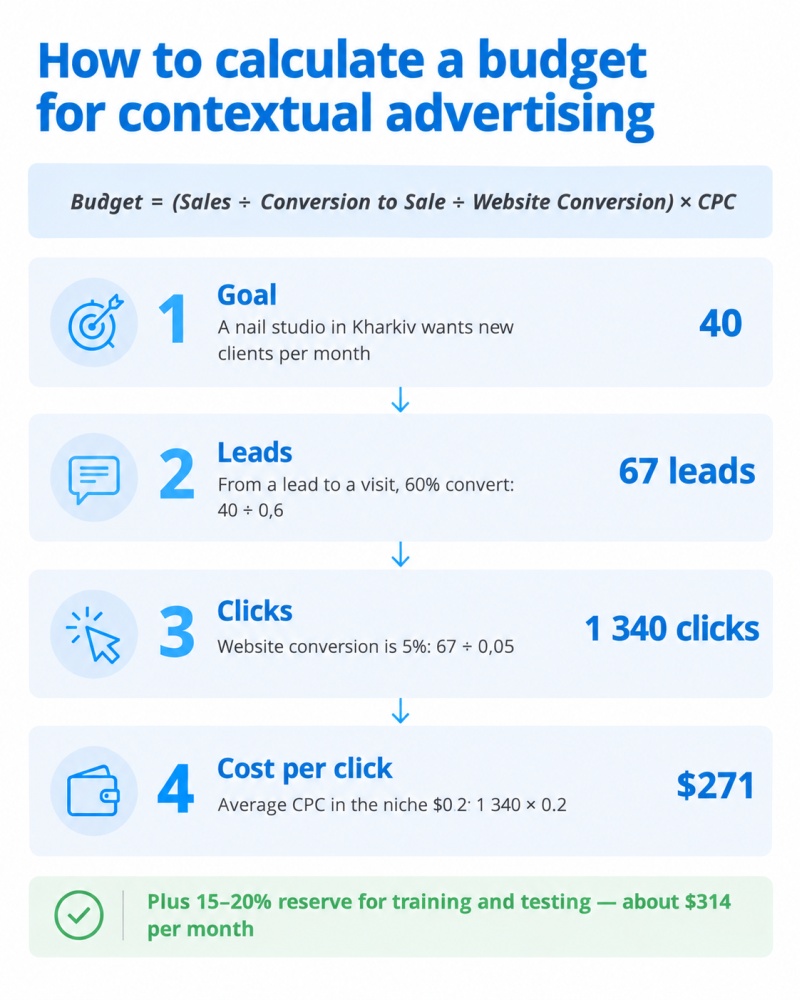
The calculation takes 20 minutes and saves you from the biggest mistake—expecting 50 leads when you’ve only budgeted for 8. The formula works backward: from the desired number of sales to the required amount for clicks.
Budget = (Desired number of sales ÷ Conversion rate from lead to sale ÷ Website conversion rate) × CPC
Let’s break it down with an example. Suppose a nail salon in Kharkiv wants 40 new clients per month.
- About 60% of leads actually show up for their appointment (the rest change their minds or can’t find the time). We need 40 ÷ 0.6 ≈ 67 leads.
- The website’s conversion rate from click to lead is 5% (normal for local services with a booking button). 67 ÷ 0.05 = 1,340 clicks.
- The average CPC in this niche in Kharkiv is about 9 UAH. Total: 1,340 × 9 ≈ 12,060.
Add a 15–20% buffer for learning and testing—making the final ad budget around 14,000 per month. Plus the specialist’s fee and VAT when funding the account (more on this below).
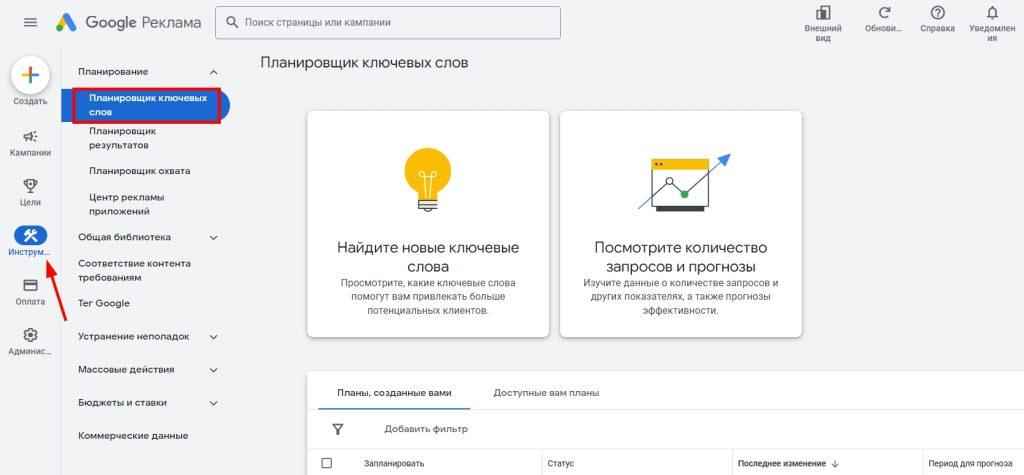
Where do you get the conversion rate if the website is new and there is no data? Use conservative estimates: 1–2% for an online store, 3–5% for services with a simple form, 8–12% for a landing page with one clear call to action. You can adjust them later based on actual performance. Check the bids for your target queries in the Keyword Planner—this tool is free and shows the top-of-page bid range for each keyword and region.
Working the math backwards is also useful: if the budget is already set (say, 8,000), divide it by the expected cost per lead to get an honest forecast—8,000 ÷ 250 = 32 leads in a best-case scenario. If you are not satisfied with that number, you don’t need to change the contractor; you need to change either your investment amount or the website itself.
How much does setting up PPC advertising cost?
Setup is a one-time job done before launch: website audit, keyword research and filtering, negative keywords, ad campaign (AC) structure, ad copywriting, and setting up conversions and analytics. To do this with high quality, a minimum of 5–10 working days is required. At the same time, the cost of setting up PPC advertising depends directly on who is doing it and the size of the project.
| Provider | Setup price, thousands of UAH | What is typically included |
|---|---|---|
| Beginner freelancer | 3–7 | 1–2 search campaigns, basic keyword list of up to 100 keywords. |
| Experienced freelancer | 8–20 | Full structure, negative keywords, conversions, sometimes remarketing. |
| Agency, small business | 15–40 | Landing page audit, search + GDN + remarketing, reporting. |
| Agency, online store | 30–80 | Product feed, Performance Max, hundreds of ad groups. |
In dollars, the benchmarks are roughly as follows: a freelancer is $200–500, and an agency is $500–1,500 per launch. The upper limit for large e-commerce projects goes beyond $2,000, and this is justified when the feed contains 5,000 products and a dozen categories with varying profit margins.
What should raise red flags in a price quote. “Setup for 1,500 hryvnias in one day”—this is most likely an auto-generated campaign with no negative keywords that will drain your funds on irrelevant queries. “Free setup when ordering management” is a standard practice, but check to make sure the cost isn’t just spread across the retainer fees for the first few months.
Ask the contractor one question: “What conversions will you set up, and how will I see where a lead came from?” If the answer is vague, the price doesn’t matter, because you won’t be able to measure the result.
What determines the cost of managing PPC advertising?
Campaign management is the ongoing monthly work after launch: adjusting bids, filtering search queries, testing ads, redistributing budgets across different areas, and reporting. Without supervision, a campaign degrades in 2–3 months: new junk queries appear, competitors change their bids, and seasonal trends shift. The cost of managing PPC advertising depends on the payment model, and each has its own pitfalls.
Fixed retainer
The most common model in Ukraine. A freelancer charges 5,000–15,000 UAH per month, while an agency charges 12,000–35,000 and higher for large projects. The upside is predictability. The downside is that there is no incentive for the specialist to scale your budget; they would have to do more work for the same money.
Percentage of ad spend
The commission is usually 10–20% of the click spend, often with a minimum threshold (for example, no less than 10,000). This makes sense for budgets starting at 50,000–100,000, where the workload grows alongside the spend. With a budget of 15,000, the percentage model benefits neither you nor the contractor—few will do serious work for 2,250 UAH a month.
Pay for performance (CPA, per lead)
You pay a fixed amount per lead—say, 300 UAH per call. It sounds ideal, but the contractor assumes the risk and builds it into the rate: paying a retainer for the same amount of work would actually be cheaper. Additionally, disputes over lead quality are inevitable. This model works well where results are clear and measurable—but struggles in B2B.
Service packages and tiers
Many agencies sell tiered packages: “Starter” (one campaign, monthly report), “Standard” (search + remarketing + weekly reporting), “Pro” (all campaign types, analytics, A/B landing page tests). Prices range from 6,000 to 40,000 per month. Packages are easy to compare, but read the details: “up to 3 campaigns” and “up to 50 keywords” often turns out to be less than even a small store needs.
Clarify who owns the ad account. The correct setup is that it belongs to you, and the contractor gets access via a manager account (MCC). If the campaigns are running on the agency’s end, breaking the contract means losing your entire history and statistics, and the new specialist will have to start from scratch—paying the “newbie tax” in the auction all over again.
The cost of placing PPC ads by campaign type
The final price for placing PPC ads depends not only on the niche but also on where the ads are shown. Inside the platform, there are multiple tools, each with its own cost per click (all amounts below are in hryvnias) and specific purpose.
- Search ads. Expensive and the “hottest” traffic—the person is currently searching for what you are selling. CPC ranges from 3 to 150 depending on the topic. The foundation for services and B2B.
- GDN (Google Display Network). Banners on Google partner websites, YouTube, and in Gmail. It is 5–15 times cheaper than search, but the audience’s intent to buy is also lower. Suitable for reach and brand recall, rather than as the sole sales channel.
- Google Shopping (product ads). A card showing a photo, price, and store name right in the search results. Costs 1.5–5 hryvnias, and the conversion rate is higher than search—the person has already seen the price and clicked anyway. A must-have format for online stores, but requires uploading a product feed to Merchant Center.
- Performance Max. An automated campaign type: Google allocates the budget across search, shopping, GDN, YouTube, and Discover on its own. Clicks start at 60 kopecks, and leads are cheaper than in pure search, provided the account already has 30+ conversions per month for learning. On an empty profile, Performance Max spends blindly for the first few weeks.
- Remarketing. Showing ads to people who have already visited your website. One of the cheapest clicks (0.5–3 UAH on the GDN) and at the same time highly converting. Allocating a separate 10–15% share to bring back previous visitors is a rule that almost always pays off.
A typical budget breakdown for an online store with a traffic spend of 30,000 UAH/month: 40% on shopping ads, 30% on search for commercial queries, 15% on Performance Max, and 15% on remarketing. For services: 70% search, 20% remarketing, 10% GDN. These are starting proportions, which should be reviewed after two months based on actual results.
Cost of setting up various Google Ads tools

Remarketing

Advertising in CMN

Video advertising on YouTube
What should be added to the amount when funding a Google Ads account in Ukraine?
This is where even experienced entrepreneurs stumble. An ad budget of “10,000” for clicks and the amount charged to your card are not the same thing. It is important to account for:
- VAT. A 20% VAT is added to payments for Ukrainian accounts. If you plan on 10,000 for clicks, you will pay 12,000. Conditions differ for registered VAT payers, so check with your accountant on how to handle the paperwork.
- Account currency. It can be managed in UAH or USD—and you cannot change it after creation. Hryvnia is more convenient for reporting, while USD is sometimes chosen by companies with international clients. When funding via card, the exchange rate is set by your bank, not Google.
- Payment method. Manual payments (prepayment)—funds are deducted as you spend, making it easy to control limits. Automatic payments—the system charges your card when a threshold is reached, bringing a risk of “unnoticeably” spending more than planned.
- Funding through an agency. Some agencies process payments through their own accounts with closing documents and zero commission. This is convenient for sole proprietors (FOPs) and legal entities, but you should ask if there is a hidden markup.
Calculation summary: if you need 14,000 for clicks, budget 16,800 UAH for funding. Plus the management fee and tools. That is how you get the real price of Google PPC advertising for a specific month.
How do you know if your ads are paying off?
Clicks and impressions are intermediate metrics. You need to track three key indicators, all of which can be found in our PPC advertising calculator.
- Cost Per Lead (CPL) = advertising spend ÷ number of leads. A store spent 20,000 and received 80 orders—the lead cost 250. Compare this with your profit margin: if you make 400 UAH from one order, the advertising is profitable. If you only make 150, you are taking a loss, and increasing your ad spend will only multiply that loss.
- ROAS (Return On Ad Spend) = advertising revenue ÷ advertising spend. You invested 20,000 and generated 100,000 in revenue—your ROAS is 500%, or 5:1. This metric is useful for online stores that have e-commerce tracking enabled in analytics. Important note: ROAS calculates revenue, not profit. With a 20% margin, a ROAS of 5:1 means the project barely broke even.
- ROI (Return on Investment) = (profit − expenses) ÷ expenses × 100%. Take the same scenario: 100,000 in revenue, 20% margin = 20,000 in profit, total spend including management fees is 28,000. ROI = (20,000 − 28,000) ÷ 28,000 × 100% ≈ −29%. The advertising is operating at a loss, even though the ROAS looked impressive.
To be honest, most “the ads aren’t working” arguments are settled at this stage. Usually, the leads are coming in at a reasonable price, but the problem lies in the sales team taking 24 hours to process them, or a landing page that takes 8 seconds to load on mobile.
Freelancer, agency, or DIY?
Three paths, and each comes with different risks.
- Setting it up yourself (DIY). You save on specialist fees—$0 for the launch. But the first 2–3 months of learning are paid for separately: irrelevant search queries, incorrect match types, and wasting money on “broad” keywords. In our experience, this “tuition” costs 5,000–15,000 UAH in wasted budget, which ends up being more expensive than a one-time setup by a freelancer. Justifiable only for a local business with one simple service.
- Freelancer. Cheaper than an agency by 30–50%, and usually dives deeper into the project—they manage 5–10 clients, not 40. There is only one risk, but it’s a major one: a single point of failure. If they get sick, take on another project, or stop replying, your campaigns are left unattended. Always verify case studies with actual numbers (not just screenshots of clicks, but the actual cost per lead) and ask for account access under your own name.
- Agency. More expensive, but you pay for the safety net: backup specialists, a dedicated manager, proper paperwork, and sometimes proprietary analytics tools. For a small business with an ad budget of up to $500, this is overkill—the agency fee will rival the ad spend itself. However, for an online store turning over $10,000 or more a month, it is almost mandatory: they need data feeds, Performance Max, CRM integration, and a person who can hold it all together.
An in-house PPC specialist becomes more cost-effective than an agency at around $2,000–$3,000 in ad spend per month. A salary of 30,000–60,000 UAH versus a 15–20% commission—do the math for your own numbers.
How to reduce the price of PPC advertising without losing leads?
The points below have been tested on dozens of projects: each provides savings of 10% to 40% while maintaining the same number of leads.
- Clean up your search queries every week. The “Search terms” report shows you exactly which phrases drove clicks. For the first month, up to 30% of it will be garbage: “free,” “DIY,” “reviews,” and competitors’ names. Every negative keyword you add is money saved.
- Narrow your geo-targeting to your actual delivery or service area. A store that only delivers within Kyiv but advertises across all of Ukraine is paying for clicks from people who will never buy.
- Improve your Quality Score. Put the keyword in the headline, use a dedicated landing page for that ad group, and improve your page load speed. Increasing your score from 5 to 8 lowers your CPC by 20–30% for the very same position.
- Stop chasing the number one spot. The difference in click volume between the first and third positions is usually minimal, but the difference in price is often double.
- Move branded queries to a separate campaign with low bids. Clicks for your own company name should cost 1–3 UAH, rather than competing against generic keywords.
- Set up bid adjustments by time and device. If 80% of your leads come in between 9 AM and 7 PM on weekdays, reduce night bids by 50% instead of turning them off completely.
- Launch remarketing before you scale your search campaigns. Bringing back people who have already visited is 3–5 times cheaper than acquiring new ones.
- Improve your website, not just your ads. Increasing your conversion rate from 2% to 3% cuts the cost per lead by a third without touching a single setting in the ad account.
And the most unintuitive tip: do not change everything at once. Google’s automated strategies relearn after every major tweak, and a week of “performance drops” after edits is completely normal. Make 1–2 changes a week, measure the results, and then move forward.
Frequently asked questions about the price of PPC advertising in Google Ads
-
Technically, yes. In practice, $100 with a CPC of 20–30 UAH will generate 130–200 clicks and 4–8 leads—which is too few to draw any conclusions. To test an expensive niche, budget at least $300–$500; for cheaper niches, $100–$150 will suffice.
-
The most common reasons are: a new competitor entered the auction, the busy season started, your Quality Score dropped due to a slow website, or the automated strategy expanded your reach to less relevant search queries. Check the “Auction insights” report—it shows who is pushing you out and by how much.
-
It is realistic for a single campaign with 20–30 keywords for a local service. But for an online store with 500 products—no. For that money, you will get a template-based setup without negative keywords or conversion tracking.
-
A one-time setup without ongoing support holds up for 1–2 months before performance starts to drop. If you don’t have the budget for management, negotiate at least a monthly audit for 2,000–4,000 UAH. That is enough to clean up junk queries and adjust bids.