
The Italian market is characterized by high purchasing power, a well-developed online shopping sector, and significantly less competition on Google Ads than, say, in Germany or the UK. If you have a product or service that Italians want, contextual advertising in Italy is arguably the fastest way to test demand and start receiving inquiries within the first few weeks.
Below, we’ll break down how it all works: which campaign formats are effective, why you can’t just “run ads through a translator,” how much it costs, and what to look for when choosing a contractor.
What should you keep in mind when setting up contextual advertising in Italy?
Before you commit your budget, there are three things you should understand about the local market. They explain why some advertisers make money here, while others lose money by doing things “as usual.”
Helpful tip: In Italy, success depends on localization and precise targeting, not the size of your budget. A small but well-optimized account often outperforms a large one that’s been hastily put together.
Market heterogeneity
Italy is a long country with diverse regions. The north (Milan, Turin, Bologna) is all about money, industry, B2B, and active e-commerce. The south has a completely different pace of life, average spending, and shopping habits. An ad that works perfectly in Milan might fall flat in Palermo—and vice versa.
Geotargeting isn’t just an option here—it’s a necessity. Running the same campaign across the entire country is a surefire way to overspend. Here’s what’s important to keep in mind when setting up regional targeting:
- Break down your campaigns by major markets. Milan, Rome, and Turin should be treated separately—competition is higher there, the cost per click is different, and audience behavior varies.
- In the geolocation settings, select “presence” (people who are physically located in the region) rather than “presence or interest.” Otherwise, the ad will be seen by people who are simply searching for Italy online from another country.
- Adjust your bids by city. If leads from Milan are more expensive but of higher quality, that’s perfectly fine—you should allocate a larger portion of your budget to that city.
- For local businesses (restaurants, clinics, service providers), limit the display radius to your actual service area.
Linguistic features
Italians are more likely to buy from someone who speaks their language, understands their holidays, mentions delivery “throughout Italy,” and accepts their preferred payment methods. A cold, obviously “foreign” offer doesn’t work as well here. And this is where most of those who try to enter the market on their own fall short: they take Ukrainian or English ads, run them through a translator—and wonder why their CTR is in the gutter.
Ad localization isn’t just translation. It’s about adapting the content to the way Italians actually search for and phrase their queries. Here are a few examples to illustrate:
- Italians frequently use abbreviations and colloquial forms in their search queries—machine translation simply doesn’t recognize them.
- The word “sconto” (discount) is more effective in the offer than the formal “riduzione,” even though a translator might use the latter.
- The names of product categories in Italian often don’t correspond to a literal translation—for example, “suit” can be either “abito” or “completo,” depending on the context.
- Regional differences: In the North and South, the same things may be called by different names.
That’s why keywords in Italian should be compiled by someone who understands the language and verifies the actual meaning in Google, rather than relying on machine translation. Ad copy also needs to be rewritten from scratch—incorporating local triggers, mentions of free shipping, warranties, and familiar payment methods. By the way, setting up contextual advertising correctly in Italy almost always starts with language and semantics, not with the “Launch” button.
Practical tip: Before launching your campaign, type your target keywords directly into google.it and see what your competitors are advertising and which keywords they’re using. It’s a free and very useful way to gather intelligence.
Competitors
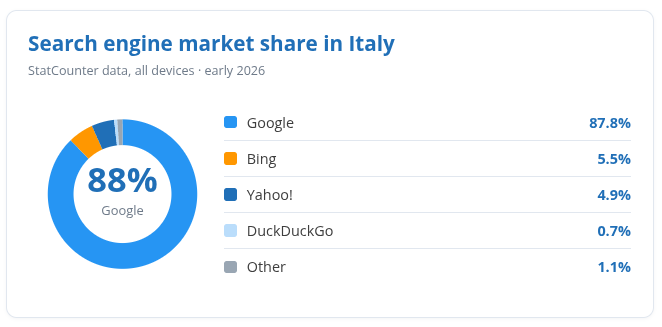
The third point concerns how search results and competition work here. Almost all search traffic comes through google.it, and it’s mobile: most searches are from smartphones. This means that ads and landing pages must load properly on mobile devices. A slow site or poor mobile layout—and you lose half your audience before they even click.
Now, about the auction itself. In highly competitive niches (legal services, insurance, finance), competition is fierce, and the cost per click is steep. But Italy is far from being the most expensive market in Europe: the average CPC here is lower than in Germany or the UK. And in many niches, the auction is much less competitive than you might expect—especially in B2B and niche product categories where major players simply haven’t made it yet.
And here’s another important point. A mature market favors those who do their work carefully. Google rewards relevance: the higher the quality of your ad and landing page, the lower your CPC will be for the same position. At the same time, the share of zero-click queries is growing—when a user gets an answer right in the search results and doesn’t click anywhere. The conclusion is simple: you need to compete for clicks more strategically—with your ad copy and offer, not just by blindly increasing your bid.
Let’s say two competitors are vying for the same search query. The first has an ad with a literal translation that links to a slow website. The second has localized text and a fast mobile page. Interestingly, the second competitor often pays less per click, even though their ad ranks higher. This is how the auction system “rewards” quality.
Remember: a high bid alone won’t win the auction. Ad relevance and landing page quality lower the cost per click—and often it’s these factors, rather than budget size, that determine who comes out ahead of the competition.
Which Google Ads formats perform well in Italy?
There’s no such thing as “the one right campaign.” Different goals call for different tools. Let’s take a look at the main ones.
Search advertising
Search campaigns target high-demand traffic—people who are typing a query into Google right now and are ready to buy. For services and B2B, this is almost always the starting point: there’s no cheaper way to generate leads. The key is to select the right keywords in Italian and not forget about negative keywords (otherwise, your budget will start draining away on junk traffic).
Let’s say you sell industrial equipment. A search query like “macchine per imballaggio prezzo” is a warm lead—the person is already comparing prices. But “come funziona imballaggio” comes from someone who’s just curious, and it’s not always wise to pay for that kind of click.
Performance Max
A hybrid format that automatically distributes impressions across Search, Display, YouTube, Gmail, Maps, and Google Shopping. For eCommerce, PMax often becomes the go-to solution: you upload a product feed, set a conversion goal—and the algorithm searches for buyers across all platforms at once.
But there’s a catch. PMax thrives on large amounts of data. Until an account has enough conversions, it operates “blindly” and can burn through your budget. That’s why launching it on an empty account without any analytics is a bad idea. First, we gather signals; then we scale up.
Google Shopping
A must-have for online stores. Product cards featuring photos, prices, and product names appear directly in search results. Conversion rates for these ads are typically higher than for text-only ads because users can see the product before they even click. To get started, you’ll need to set up Merchant Center and create a well-organized product feed in Italian.
Contextual Media Network
These are banners on Google’s partner sites. CMC doesn’t work very well with a cold audience, but it’s excellent for remarketing. A user visits the site, looks at a product, and leaves—and the banner gently brings them back. It’s inexpensive and effective, as long as you don’t target everyone indiscriminately.
Google Demand Gen
A format designed for demand that hasn’t yet materialized into a search query. Demand Gen runs visual ads on YouTube Shorts, Discover, and Gmail—a format that resonates more with social media users. It works well for brands with strong visual appeal: fashion, interior design, and travel.
Important: Don’t try to do everything at once. Spreading your budget across five formats right from the start is a common mistake. It’s better to start with one or two campaigns focused on a specific goal, reach break-even, and only then add the rest.
The cost of contextual advertising in Italy
There are three different amounts here that are often confused: cost per click, advertising budget, and setup fee. These are not the same thing.
Cost per click
On average, CPC in Italy is lower than in the U.S. and most Western European countries—about a quarter cheaper than the U.S. rate. But there is a huge variation across different niches:
- low-cost niches (food service, everyday goods) — from €0.20 to €0.50 per click;
- mid-range segment (e-commerce, services) — approximately €1–2.50 per click;
- High-end niches (legal services, finance, B2B) — starting at €4–6 and up.
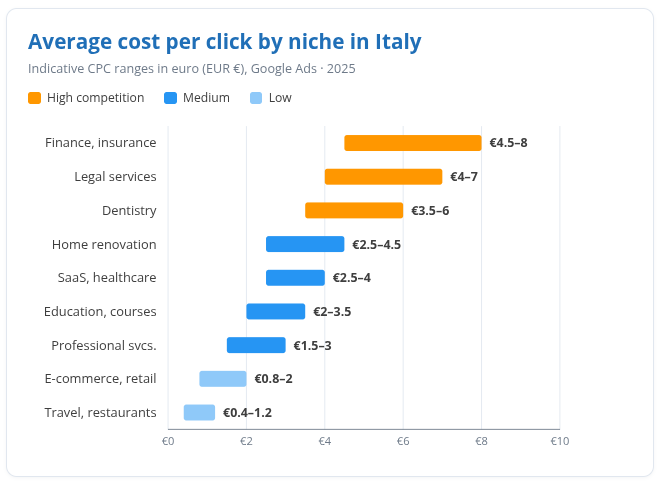
And one more thing. In Milan, Rome, and Turin, the cost per click can be 30–50% higher than the national average—simply because there are more bidders in the auction there.
Important: A low CPC doesn’t mean anything on its own. You could pay €0.30 per click and blow through your budget, or you could pay €3 and still turn a profit. You need to focus on the cost per acquisition (CPA) and return on investment, not just the cost per click in isolation from conversions.
Advertising budget
The minimum advertising budget required for campaigns in Italy to gather enough data and begin optimizing is approximately €500–1,000 per month (excluding agency fees). Below this threshold, Google’s algorithms simply have nothing to learn from: few clicks mean few conversions, which means there are no statistics to draw conclusions from.
For an online store with a wide product range, the initial budget is typically higher—starting at €1,500–2,000 per month—especially if Google Shopping and Performance Max are included.
Setup and maintenance costs
This is where the price of contextual advertising in Italy varies significantly depending on the contractor and the complexity of the project. A one-time setup for Google Ads contextual advertising in Italy typically starts at a couple hundred euros for a simple project and can reach several thousand euros for a large e-commerce site with numerous campaigns.
Here’s a rough idea of what it looks like:
Project type | What’s included | Setup fee |
|---|---|---|
Services / Local Businesses | Search, basic remarketing | from ~€200–400 |
Average eCommerce | Поиск + Google Shopping + PMax | ~500–1200 € |
Large retailer / B2B | A complete set of campaigns, analytics, and feeds | from ~€1,500 |
Ongoing management (monthly support) is typically billed separately—this includes work to lower your bid price, testing, and optimizing bids and strategies. To be honest, it’s the ongoing management, not a one-time setup, that most often determines whether you’ll turn a profit or not.
If you’d like to know the cost of setting up contextual advertising in Italy for your specific project, we’ll provide a custom quote after a brief discussion about your niche, target geography, and objectives.
Where can I order contextual advertising in Italy?
There are many contractors on the market, and not all of them are equally reliable. Here’s what you should look for before hiring someone to set up your ads in Italy:
- Understanding the language and the market. Ask directly who is gathering the semantic data. If the answer is “through a translator,” that’s a red flag.
- Transparent analytics. A good agency doesn’t just show clicks and impressions—it shows leads, their cost, and return on investment. You need to see how much money came in and went out.
- Experience working with your business model. E-commerce and B2B require different approaches. Case studies in a related niche are a major plus.
- Reasonable promises. “We guarantee the number one spot and three times more sales in a week”—this is usually a sign that they aren’t being entirely honest with you.
- Clear contracts and reporting. Deadlines, scope of work, and report formats—everything must be specified in advance.
A reputable contextual advertising agency in Italy doesn’t sell you “configuration for the sake of configuration.” It is accountable for tangible results—leads, inquiries, and return on investment—rather than just pretty graphs in your dashboard.
And here’s another point that’s often overlooked. Ask what happens after the campaign launches. Who manages the account, how often are updates made, and what happens if the campaign doesn’t break even.
How does our agency run Google ads in Italy?
To help you understand what you’re paying for, we’ll walk you through the process step by step. Launching an ad campaign isn’t just a matter of “pressing a button and letting it run”; it’s a series of several stages.
- Brief and Analysis. We analyze the niche, the product, and the competition in Italy, and review search results on google.it. We determine which formats are best suited to your goals.
- Semantics and Localization. We compile Italian keywords and negative keywords, and adapt ad copy for the Italian language and local triggers.
- Structure and setup. We organize campaigns by objectives and regions, set up geotargeting, and enable analytics and conversion tracking. Without proper tracking, everything else is pointless—the algorithm simply won’t know what to consider a success.
- Launch and testing. We’re getting started, collecting initial data, and filtering out junk traffic.
- Optimization. We lower the cost per click, fine-tune bids, and test creatives and ad groups. This is an ongoing process, not a one-time task.
Important: The first 2–4 weeks after launch are a learning period. Don’t expect a perfect ROI from day one, and certainly don’t panic. The true picture becomes clear once enough conversions have been accumulated.