
The U.S. market is alluring. It offers a high-spending audience, a high average order value, and a willingness to shop online in almost any niche. But getting started is expensive—and in a literal sense, too. Contextual advertising in the U.S. doesn’t work the way advertisers in Ukraine are used to: here, the bid levels, auction logic, and a host of account-specific nuances are different—details that newcomers often overlook until their first charge.
This guide will be helpful for anyone looking to enter the U.S. market using Google Ads. We’ll break down the actual cost per click, discuss which campaigns to run, explain how to set up your account, and explain why you shouldn’t simply apply the same strategies used in the local market.
What are the key features of contextual advertising in the U.S.?
The first thing that stands out is the cost. Contextual advertising is more expensive in the U.S. The average cost per click across niches in 2026 hovers around $5.26, and in highly competitive sectors (legal services) it reaches $8.58 per click. By comparison, in Ukraine, similar search queries can cost tens of times less.
But a high cost-per-click isn’t a death sentence—it’s a reflection of demand. For that price, you gain access to an audience that’s accustomed to solving problems by making a purchase and rarely haggles. The conversion rate to leads is also higher: the average rate for Google Ads in 2025 is around 7.5%.
Other things to keep in mind:
- Intense competition in commercial niches. Dozens of advertisers with substantial budgets are vying for search terms like “emergency plumber near me.”
- English Language and Cultural Context. Listings and websites must be written in grammatically correct, natural English—preferably with input from a native speaker or an editor. An American can spot machine-translated listings in a second—and won’t click on them, which, in a competitive market, takes a toll on your budget.
- Strict privacy requirements. The California Consumer Privacy Act (CCPA) and similar regulations impact data collection, cookies, and remarketing.
- Mobile traffic. More than half of all visits come from smartphones, so the landing page must load quickly.
Important: A high cost-per-click doesn’t necessarily mean the ad is unprofitable. A $7 click that brings in a customer with an average order value of $300 is more profitable than ten $0.50 clicks that didn’t convert. Focus not on the cost per click, but on the cost per lead and the overall return on ad spend.
What is the cost per click for contextual advertising in the U.S.?
The most common question is about the cost of pay-per-click advertising in the U.S. To be honest, there’s no single figure: it all comes down to a real-time auction. The cost per click depends on keyword demand, the number of competitors, the ad’s quality score, and the device the user is searching from.
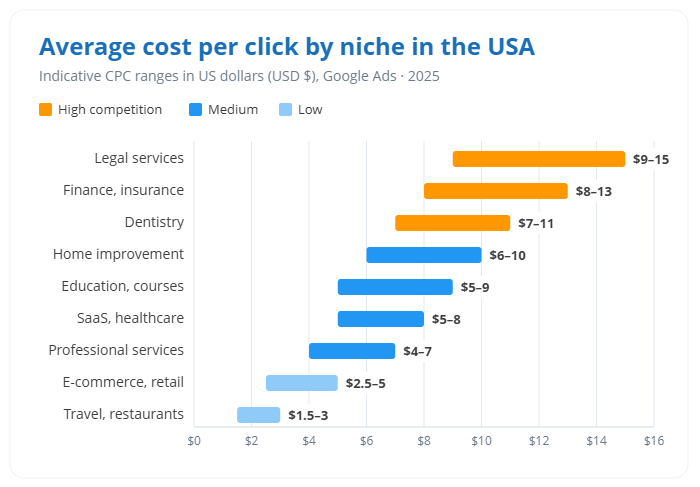
Here are some benchmarks for the average CPC for early 2026 (data for the U.S. market):
- Legal services and insurance — $8–9 and up. Searches for “injury attorney” and similar terms are generally the most expensive.
- Dental care and home repairs — about $7.85.
- Education — approximately $6.23.
- SaaS, healthcare, professional services—around $5.
- E-commerce and retail — $3–4 per non-branded search (often cheaper on Google Shopping).
- Travel, restaurants, entertainment — $1.6–2.1.
Let’s say you sell online English courses. In the education niche, the cost per click is about $6. With a 5% landing page conversion rate, each lead will cost you around $120—and that’s before factoring in lead quality. Do you see the scale of this? A $300 “test” budget in the U.S. won’t yield any statistics—you’ll run out of money before you’ve accumulated enough data to draw conclusions.
When it comes to food delivery or tourism, however, the situation is more favorable: the budget will generate three to four times as many clicks. The niche makes all the difference.
Which Google Ads tools work well in the U.S.?
Here’s the good news—Google Ads offers a wide range of tools:
- Search Engine Advertising. The Classic and the Foundation. Ads are shown to people who are actively searching for your product or service right now. This is the “hottest” traffic and, as a rule, the best way to generate leads for services. It’s critical to select the right keywords and equally important to choose the right negative keywords, since clicks on ads are very expensive.
- Display advertising network (DAN). Banners on millions of websites, in apps, and on YouTube. Clicks are cheaper here, but the audience is less engaged. DAN is great for brand awareness and for bringing back visitors who have already been to your site.
- Performance Max. An automated format that automatically distributes impressions across Search, Display, Shopping, Gmail, and YouTube. Google handles the optimization for a specific goal—such as sales. It works well when you already have conversion data and your analytics are set up. Launching PMax “from scratch” without tracking set up is a risky move.
- Google Shopping. A must-have for online stores. Product listings with photos, prices, and titles appear directly in search results. Clicks are typically cheaper than those from search ads, and purchase intent is high.
- Google Demand Gen. A format for the top of the funnel: visual ads on YouTube Shorts, Discover, and Gmail. Ideal for generating demand where people aren’t yet actively searching for you.
- Retargeting. It reaches out to visitors who viewed your website but didn’t submit a request. In the competitive U.S. market, this is one of the most cost-effective tools—you can re-engage an audience that’s already been warmed up at a lower cost.
Tip: Don’t try to launch everything at once. Start with Search and Remarketing—these deliver quick and clear results. Add Shopping if you have products. And enable Performance Max later, once you’ve accumulated conversion data; otherwise, the algorithm will be learning from scratch at your expense.
How do I set up my account to run ads in the U.S. market?
But this is where things get specific—the kind of details you won’t find in general guides. Setting up contextual advertising in the U.S. for an advertiser from Ukraine isn’t about strategy; it’s about the basic technical aspects—the account and payment.
When entering the U.S. market, you need to carefully configure your geotargeting and payment profile to ensure your campaigns pass moderation without being blocked. Here are some common challenges:
- Payment profile. It is recommended that the account currency match the market currency (USD). This simplifies both analysis and trading with U.S. rates.
- Payment methods. Google accepts credit cards, but sometimes requires prepayment: you top up your balance in advance, and the system deducts funds as you use the service. New accounts almost always start with prepayment—post-payment is granted later, as trust builds.
- Account moderation. New accounts are subject to review. If anything looks suspicious (a sudden surge in activity with a large budget, an unprofessional website, or the absence of a privacy policy), the campaign may be rejected and the account suspended.
Let’s say you deposited $2,000 into a new account right away and launched your ads at the maximum bid. To the system, this is a red flag—there’s a high risk of triggering a manual review. It’s much safer to ramp up gradually: start with a modest budget for the first few days, then scale up.
By the way, the website needs to be ready as well. A privacy policy page, a cookie banner that complies with CCPA requirements, and contact information including a U.S. phone number (+1) and address—these aren’t just formalities, but requirements without which your ads simply won’t be approved.
What should you consider when setting up contextual advertising for the U.S.?
Once your account is set up, it’s time to start customizing it. There are three key factors to consider: who to target, which keywords to use, and how much to spend.
Geotargeting is a whole other topic. The U.S. has fifty states with varying purchasing power, laws, and even slang. Dental advertising in California and Ohio involves two different campaigns in terms of cost per click. That’s why targeting is almost never set up to cover “the entire country at once”: it’s broken down by state, city, or a radius around a specific location if the business is local.
The logic behind keywords is the same as always, but with a language-specific twist. You need to gather semantic data in English—specifically American English—since while “trousers” will be understood, people will search for “pants.” Group queries by meaning, separate branded and non-branded terms, and distinguish high-intent transactional queries (“buy,” “order,” “near me”) from informational ones.
Negative keywords save you money better than any other setting. Without them, you’re paying for irrelevant clicks: someone searches for “free,” “cheap,” “jobs,” or “DIY”—and is unlikely to make a purchase. At the start, the list of negative keywords is small, but you expand it every week by reviewing your search query report.
When it comes to bidding, Google offers several strategies:
- Manual bid management—full control, but it takes time and experience.
- “Maximum Clicks” — to drive traffic right from the start.
- “Target CPA” — the system maintains the desired cost per acquisition.
- “Target ROAS” — for stores where the return on every dollar invested is important.
In practice, a new account often starts with manual bids or “maximum clicks,” collects data for a couple of weeks, and then switches to automated strategies based on CPA or ROAS. Switching to automation too early is a common mistake, because the algorithm simply has nothing to learn from.
What budget should you set aside for pay-per-click advertising in the U.S.?
The advertising budget for the U.S. market is planned in reverse—based on customer value, rather than on how much we’re willing to spend.
It’s simple math. Let’s take the professional services niche: the cost per click is about $5, and the landing page conversion rate to a lead is 6%. That means each lead costs approximately $83 (5 ÷ 0.06). If you close three deals out of ten leads, then each customer costs about $277—that’s the CPA per deal. The rest is simple: how much do you earn per customer? If the average deal brings in $1,500, the advertising pays for itself with room to spare.
Here are the metrics you should track from day one:
- CPC stands for cost per click. It indicates how much traffic costs.
- CPA — cost per action (lead or sale).
- ROAS is the ratio of advertising revenue to advertising costs. It is a key metric for e-commerce.
- Conversions and their quality. A hundred cheap leads with no sales are worse than ten expensive but targeted ones.
A healthy ROAS for most accounts is 2–4x or higher. In other words, for every dollar you spend, you earn back two to four dollars. If it’s lower than that, it’s time to review your bids, ads, or the offer itself.
Note: Without analytics, advertising in the U.S. is like playing blind. Set up conversion tracking (Google Tag, goals, and offline data import, if available) before you launch your campaign, not after. Otherwise, in a month’s time, you’ll have spent your budget and have no idea what actually worked.
What is the minimum budget required? For testing in most commercial niches, a realistic starting budget is $1,000–$1,500 per month. In a market where a click costs $5–$8, a smaller budget simply won’t yield statistically significant data for drawing conclusions.
Do you need an agency to set up contextual advertising in the U.S.?
Can you do all this on your own? Technically, yes. But the U.S. market is too expensive to learn from your own mistakes. Every week of “testing” with expensive clicks costs hundreds of dollars that go toward learning rather than sales.
A contextual advertising agency in the U.S. handles what would take a beginner months to accomplish: a well-structured campaign, a set-up account with no risk of suspension, English-language ads that don’t look like translations, and continuous data-driven optimization. Essentially, you’re paying to ensure your budget starts working from day one, rather than from the third month.
What typically affects the cost of setting up contextual advertising for the U.S.:
- Scope of work: a single search campaign or a combination of search, Google Shopping, Display Network, and remarketing.
- The size of the advertising budget and the number of channels.
- Do you need a turnkey solution for website development, landing pages, and analytics?
- The scope of our collaboration can be a one-time setup or ongoing management with monthly optimization.
There are also various payment models: a fixed setup fee, a monthly maintenance fee, or a percentage of the advertising budget. It’s important not to confuse these two expense categories. The agency’s fee and the actual pay-per-click budget are separate: the former can be paid in hryvnia, while the latter goes directly to Google in dollars.
And one more thing. A low price for a service in this market is cause for concern. Running a campaign effectively on a high-cost auction platform requires an expert’s time, testing, and analysis. When the price of contextual advertising for the U.S. market is suspiciously low, it usually means the campaign is running on “autopilot” without any real optimization—which means the budget is being wasted, all while a polished report hides the truth.