Hello! Today we will discuss a topic that seems simple at first glance, but in practice regularly throws up surprises. We are talking about launching a second website in Google Ads — a second online store in the same or a related niche. It would seem that you can just take the same approach. But this is where many people get burned: the second project gets blocked, and all the enthusiasm to continue working disappears.
In my experience, I have often encountered situations where a client came to me with a blocked second store and asked, “Sergey, what went wrong?” That’s why I decided to compile everything you need to know before you click the “start” button into one article.
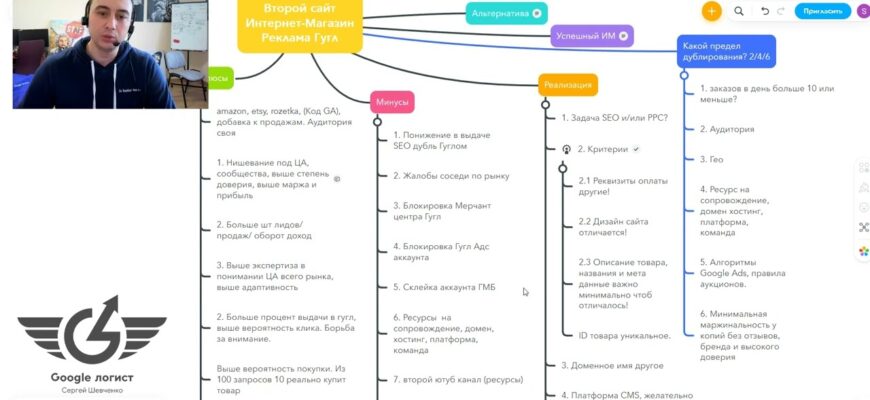
Here’s what we’ll go through step by step:
- The pros and cons of duplicating an online store — some points appear on both lists, and I will explain why this is the case.
- Practical implementation — how to quickly set up a second store, what must be different about it, and what can be left to your discretion.
- The limit of duplication — how many sites can actually be launched: 2, 4, 6? And what does this number depend on?
- An alternative to duplication — what a successful online store looks like from the inside, what elements it consists of, what percentage of traffic and conversions is considered normal. This will help you understand whether it is better to finish the first project first, rather than start a second one.

In short, launching a second online store in Google Ads is a working strategy for increasing sales. But without understanding the nuances, it can easily turn into a headache. For example, one of my clients launched a clone of his electronics store, simply changing the domain and logo. Three days later, both accounts were banned. Another client thought through the differences in the product range, texts, and structure, and has been running Google Ads for two projects in parallel for six months now.
So let’s get into the details — so that your second website brings in sales, not problems. Let’s go.
Advantages of launching a second website on Google Ads
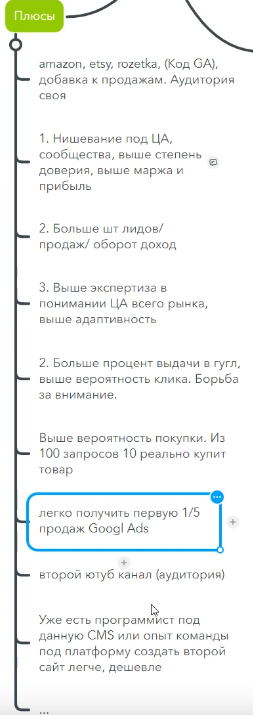
Let’s start with the pleasant stuff—the advantages. Why bother with a second website for Google advertising?
An additional source of sales and your own audience
If you already sell on marketplaces such as Amazon, Etsy, Rozetka (which, incidentally, has also appeared in Poland) or any other platforms, you are surely aware of their main limitation.
No marketplace allows you to install your Google Analytics code inside it. This means that the entire audience you attract to the platform does not actually belong to you. What’s more, the marketplace happily shows your buyers to your competitors — your neighbors on the platform. You paid for traffic on Etsy, but the potential customer went to another seller. It’s frustrating, isn’t it?
With your online store, the situation is fundamentally different. The audience belongs to you to a much greater extent, and you don’t share it with anyone else within the same platform.
Yes, there are caveats — Google indirectly uses data in one way or another, there’s no getting around that. But considering that Google accounts for 90–95% of search traffic in the US, Ukraine, and most European countries (you can check out my blog posts from last year — there’s a breakdown by country), your own website remains your territory.
Niche targeting, community building, higher trust
One of the most significant advantages is the ability to tailor a second online store to a specific segment of the target audience. When you build a community around a project, trust grows. And trust means the ability to sell not at the minimum price, but at the upper end of the market. Average plus a percentage on top. Higher margins, higher profits.
Motorcycles are a great example. It would seem to be a single niche. But take a closer look: classic road bikes, touring bikes, sports bikes (racing bikes), cross bikes (enduro bikes), cruisers (biker bikes), and choppers.

Think of the typical image of a cruiser biker and compare it to a sports bike owner. They are completely different worlds, with different lifestyles and values. Putting them all on one website is not a great idea. It is much more effective to create a separate project where a specific community will feel its uniqueness and distinctiveness. You pay attention to them, and they repay you with loyalty and a willingness to pay more.
More leads, sales, turnover, and revenue
It’s obvious—that’s why we’re doing this. A second website = another channel for attracting orders. But let me warn you right away: a common trap is when people think, “I’ll launch a second store, and my sales will double.” That’s not always the case. There are some nuances here that we’ll come back to a little later.
Deeper understanding of the target audience and the market as a whole
When working on your second project, you inevitably begin to understand your niche better. You have the opportunity to tailor your offer more precisely to a specific segment of buyers—and move away from the single argument of “we are cheap and good.” This, by the way, is a weak position. You should have at least 3–5 reasons why someone should buy from you.
For example: a unique community, exclusive bundles and product combinations, additional services or conditions that competitors do not offer. Always think about how to stand out from your market neighbors — that is where the main profit lies.
A higher percentage of Google search results means a higher chance of getting a click.
The most enthusiastic audience is found on Google search. A person types in “Buy a corner fireplace insert with such and such specifications, Kyiv” — and the query shows that the need has been identified and the likelihood of purchase is high. And if they enter a specific model and brand, the purchase is practically a certainty.
Let’s say your Google Ads campaign for this query already receives 85–90–95% of possible impressions (this metric can be seen in Google reports — the percentage of impressions received). It’s difficult to jump higher. But even with such coverage, not all users will click on your ad — each person scans the results diagonally and chooses something for themselves. But if your first site and second site in Google Ads are in the same results, the probability of getting a click on at least one of them increases significantly. It’s a simple battle for attention.
Higher likelihood of purchase
At one of Google’s conferences, they shared some interesting statistics: out of 100 people who enter the query “Buy a hair dryer,” only about 10 will actually make a purchase. The figure may vary slightly depending on the niche, but the order of magnitude is about right. And here’s the thing: those 10 people will buy from someone in the search results.
When you have two websites listed in your Google Ads campaign instead of one, the likelihood that some of these buyers will end up with you increases significantly. Some will click on the first store, others on the second. As a result, you get more buyers from the same search results.
To understand the scale: a good conversion rate for an online store is 1–2%, depending on the niche and the cost of the product. That is, out of 100 targeted visits, you get 1–2 orders. Weaker competitors may have a conversion rate of 0.5% — they need 200 visitors to make one sale of the same product. So, the second website on Google allows you to increase the total flow of targeted visits, and therefore the number of orders, even with the same conversion rates.
Easy to get first sales (about 1/5 of potential)
Those who have been working with Google Ads for a long time know one pleasant detail: Google gives a kind of “newbie bonus.” New advertising accounts get their share of traffic quite easily — from search, the display network, and Performance Max. Google is interested in maintaining diversity in search results and preventing a situation where one or two players take everything.
In practice, it looks like this: even if you set up your Google advertising account not perfectly, but at a solid B level, you will get the first 15–20% of your target traffic without much effort. And if the website itself is well-designed, sales will follow.
Roughly speaking, a new project will relatively easily achieve one-fifth of what a well-established, optimized account generates. But then, in order to grow, serious work needs to be done on the quality of campaigns, bids, feed, and account structure. However, the first results will be encouraging.
A second YouTube channel as an additional tool
A nice bonus when launching a second online store is the ability to create a separate YouTube channel for it. This is not just another platform for content. A separate channel linked to the second site allows you to work with your audience in a targeted manner.
For example, your first store sells general tourist equipment, while the second is specialized in mountain trekking. On your second YouTube channel, you publish route reviews and analyses of high-altitude equipment, and this audience is much more receptive because the content directly appeals to their interests. The combination of a niche channel and a niche store builds trust and increases the likelihood of sales.
You already have a team and experience with CMS
Last on the list of advantages, but far from least in importance: if your first online store is already up and running, you probably have a programmer familiar with your CMS and a team that has gone through all the initial difficulties—setting up payment systems, integrating delivery, and refining templates.
Every month, you spend resources on maintaining your first project: you oil the gears to keep the machine running. And here’s the good news — launching a second website on the same platform will be significantly cheaper. The basic groundwork has already been laid, typical tasks have been solved, and the team knows what to do. But — and this is important — there’s no room for complacency. In the sections on disadvantages and criteria, we will analyze where exactly you need to be careful so that this advantage does not turn into a trap.
Disadvantages of launching a second website on Google Ads
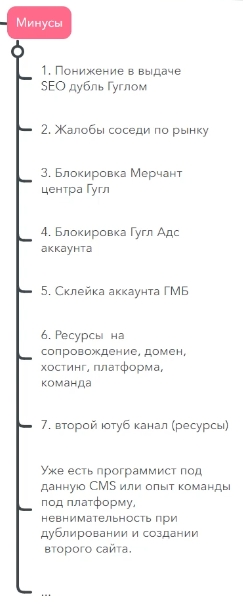
Now let’s talk about the pitfalls. The pros are great, but without understanding the risks, you can mess things up. Let’s take a look at the main cons that I encounter in practice.
Lower SEO rankings (duplicate content for Google)
If the second site is hastily made—copying the first store, changing the logo and colors, but leaving the content the same—you can’t expect organic traffic. Google is excellent at recognizing duplicates and simply won’t show such a site in SEO results.
As is usually the case, you may never have deliberately engaged in SEO for your first online store, but you conscientiously filled out product cards, wrote descriptions, and collected reviews. Users mentioned the store on social media, and natural links appeared. And Google rewarded you with 10–15% of sales from organic traffic.
It is logical to assume that the same will happen with the second site. But no — if you simply copy everything exactly as it is, this site will not appear in organic search results. Google will consider it a duplicate and lower its ranking. This video is more about Google Ads advertising, but it would be wrong to ignore the SEO component — it is an important source of traffic for businesses.
Competitors’ complaints
This is a factor that many people do not take into account at all. It is particularly relevant for the Ukrainian market; it is less common in European countries, but it does happen.
The situation is as follows: competitors see a new online store in the search results, start digging — they call the numbers, place test orders, talk to suppliers. And they find out that behind two different websites with different addresses, phone numbers, and team photos is the same owner. Next — a complaint to Google.
The result is that one of your Google Ads advertising accounts may be blocked. I have encountered such situations in practice, and it is always an unpleasant surprise. Therefore, it is important to understand this risk in advance and know how to deal with it.
Блокировка Google Merchant Center
If the second site is a complete copy of the first, there is a high probability that Google will block Merchant Center. Algorithms compare feed data, page content, contact information, and if they see identical stores, they block them. We will discuss how to avoid this in detail in the section on implementation.
Google Ads account suspension
This happens less often than Merchant account suspension, but the consequences are much more serious. For regular online stores with duplicate content, Google tends to target the Merchant account. But there are situations when a Google Ads account can be suspended, and this is related to sensitive niches.
A typical scenario: a programmer says, “I have a ready-made website template. I previously created a cosmetics store for another client, and I can quickly adapt it for you.” They make the changes, you launch your Google ads. And then it turns out that the code, meta data, or some hidden pages still contain references to medical topics, cosmetic procedures, or equipment. Google finds this, classifies the website as a sensitive niche, and blocks not the product in the feed, not the merchant, but the Google Ads account itself. And that automatically means the domain is blocked. Start all over again.
So even if the programmer is 100% sure, check it anyway. What may seem like a minor detail to a developer who has never dealt with Google moderation could cost you the entire project.
Linking your Google My Business account
An inconspicuous but extremely unpleasant drawback, especially for the Ukrainian market. Since the start of active military operations, Google has blocked the ability to edit data in Google My Business for Ukraine. New reviews are not being moderated, and changes are not being saved.
If you moved or changed your phone number six months ago and decided to update your information, the point may simply disappear from Google Maps. My advice: don’t touch anything. It’s better to set up call forwarding to your new number and leave your old address as it is until Google removes the restrictions.
How does this relate to the second site? When launching a new project, Google may merge two business profiles into one. In practice, I have encountered the following situation: two completely different businesses in Kyiv—different companies, different owners—simply rent the same warehouse space.
Google took them and combined them into one card because these companies once overlapped. Putting them back together is no easy task, and in the current circumstances, with the ban on editing for Ukraine still in place, it is practically impossible.
If a location on Google Maps is important for your business, take this risk into account. We will discuss how to reduce the likelihood of sticking together further in the section on implementation. If you do not need a physical location, you can skip this point.
Additional resources for support: domain, hosting, team
It’s simple: a second online store means additional expenses. Domain, hosting, platform updates, team work. Yes, if both projects run on the same CMS, the costs will be lower than if you were to build everything from scratch on a different system. But “lower” does not mean “free.”
Expenses will still increase compared to maintaining a single store. Let’s say you spend $5,000 per month on technical support for your first project. The second one will add another $2,000–3,000 — and that’s the minimum, not including content and marketing. So, do the math, estimate the economics, and only then decide whether it’s worth launching a second website.
Resources for the second YouTube channel
In the pros section, we mentioned that having a separate YouTube channel for your second website is great for building trust and sales. But let’s be honest: running a full-fledged channel takes time, effort, and budget. In essence, you are creating a second brand — with separate visuals, its own content plan, and regular releases. Two channels that look like independent projects need to be promoted in parallel. This doubles the workload for the team.
Why do I still single out YouTube as a separate item in both the pros and cons? Because a channel that inspires trust directly affects the profitability of the business and the effectiveness of advertising investments. We will return to specific figures in the section on alternatives.
Programmer’s carelessness when duplicating the site
This point is also a pro (the team’s experience with CMS) and a con — and that’s no accident. Having a ready-made programmer and a well-established platform simplifies the creation of a second website, but complacency and carelessness when copying can lead to your Google Ads account being blocked. Above, I already gave an example with a template from a cosmetics store — when the programmer did not clean up the old data and the new project was sanctioned for a sensitive niche.
Please note: I deliberately include some points in both lists — both pros and cons. Because in real business, there is no black and white. The same circumstance can work for you or against you — it all depends on the country, niche, specific situation, and how carefully you approach the matter. This is a living process, and there are no universal recipes here.
Implementation: how to launch a second website correctly
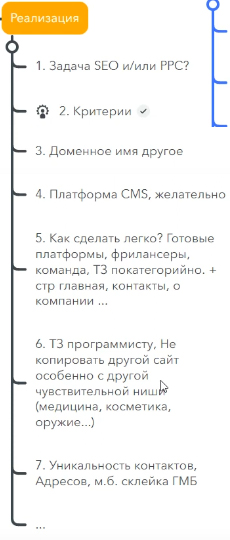
Let’s move on to practice. We’ve discussed the pros and cons — now let’s figure out how to launch a second website so that it generates sales rather than blocks.
Decide on your goal: SEO, PPC, or all of the above?
The first question you need to ask yourself is: why do you need a second online store? Is it just for paid Google Ads advertising? Is it just for SEO promotion? Or do you want to use both channels and also connect Facebook and email marketing?
Most owners will, of course, say, “I want everything at once.” I understand, but then it is important to differentiate between approaches. Below, I will provide recommendations and criteria that are fundamentally important for Google Ads advertising.
If you want to get traffic from organic search results, hire a separate SEO team and give them the following task: “There is a second project, and we need to make it unique from the point of view of search engines.” A good SEO specialist will tell you what to change and how to change it so that the second site gets its share of organic sales.
Criteria for Google paid advertising: what should be different

And here’s the most important part. Let’s break down the points that must be different on the second site for Google advertising:
- Payment details. Your old Google Ads account has one set of payment details, and your new account has another. If the details match, you risk getting blocked. Google will link the two accounts together, and then any problem with one of them will affect the other.
- Website design. Two stores should not look like identical twins. In practice, I have repeatedly seen owners simply change the logo and color scheme, while the structure, layout, and fonts remained identical. The result was Google Ads being blocked. The second project should be visually perceived as a completely different store.
- Product descriptions, titles, and metadata. Three separate items, each of which is important. A product description is the text on the page that the buyer sees. The product title is what is displayed in the card header. And metadata (meta title, meta description) is information that is read by Google, Bing, and other search engine robots. Metadata does not always match what the visitor sees visually on the page, but it is what search engines use to judge the content. All of this must be different from the first site. I know what you’re thinking: “I have 5,000 products, I’ll go crazy before I finish redoing everything.” Don’t panic prematurely — we’ll discuss how to do this relatively quickly and without unnecessary headaches.
- Product IDs. Internal product identifiers on the second website must be different from those on the first. What is a product ID? It is an internal number, a product code in your project. Think about it: Amazon and Rozetka have different internal codes for the same product because they are different platforms. Your second online store is also a different project. Change the numbering, and this will significantly reduce the likelihood of being blocked by Google Merchant Center.
At the same time, some data will inevitably coincide: MPN (manufacturer codes), categories, color, technical parameters, price. This is normal — if there is only one supplier, there is no way around it.
By the way, in my experience, half of all businesses have a poorly filled out Merchant Center. If you simply enter all the information sent by the supplier accurately, you will already be selling through Google Ads better than many of your competitors.
Another domain name
This seems obvious, but there are some nuances. The second site must be hosted on a separate domain — not on a subdomain of the first, but on a different domain name. Moreover, the domains should not be similar. For example, if the first store is motostore.com.ua, you should not name the second motostore-shop.com.ua. Google will easily link them together.
How different the names should be depends on your strategy. If you openly position both projects as part of the same group of companies, that’s one approach. But if the goal is to look like two independent stores, then the domain names should be completely different: different words, different structure, no common roots.
Another CMS platform (preferable, but not required)
The ideal option is to use a different CMS for the second site. For example, if the first store is written in WordPress, the second can be hosted on Prom.ua or another platform. Why is this better? Because it eliminates the temptation to copy. The programmer will not be able to physically transfer pieces of code, templates, and structure from the old project to the new one—the platforms are different, and everything will have to be done from scratch.
But if for some reason you decide to keep the same CMS, be extra careful. When both projects are on WordPress, programmers naturally want to make their lives easier by copying the theme, transferring plugins, and duplicating the structure. As a result, Google robots will see two identical sites — not only in terms of visuals, but also in terms of hidden code elements that ordinary users don’t notice. But Google does.
What should you do? Write up the most detailed technical specifications possible for the programmer and include a separate clause stating: no copying from the first project. Discuss this verbally and put it in writing. Because for the developer, “quickly doing it based on what’s already done” saves time, but for you, it could potentially lead to your Google Ads account being blocked.
How can you quickly fill your second website with unique content?
This is where most business owners start to panic: “I have 5,000 products, and it will take a whole team 2-3 months to rewrite all the descriptions and titles!” Don’t worry — in practice, it’s much easier if you approach it wisely.
Consider this: 5,000 products typically represent 15–20, or at most 50, product groups. Within each group, the products have very similar names and descriptions. The name usually consists of two or three parts: the actual name, a reference to the brand or series, and a characteristic. The description also contains blocks of text that are the same for the entire category.
As soon as you see this, the task of “rewriting 5,000 cards” turns into “creating 50 change templates by group.” In practice, I would advise starting even simpler.
Here is a step-by-step plan:
- Export all products from the website to an Excel spreadsheet (Excel, not Google Docs, to prevent unnecessary information from entering the Google ecosystem).
- Divide products into groups and subgroups — you will see 2–3 levels of nesting.
- Using the Pareto principle, select five priority groups that generate the most revenue. Each group should contain 10–20 items. This will be your starting pool for launching Google Ads.
- For each of the five groups, tell the marketer or freelancer how the descriptions and titles should differ from the first site. For example: “In all products in this category, replace the word ‘fireplace insert’ with ‘fireplace insert,’ add 3-5 words to the description, and change the sentence structure.” A new combination, and the content is already unique.
- You can make the other groups unique later, bit by bit, as needed.
Here’s a handy tip: outsource this task to a freelancer from a freelance marketplace. Pay for a specific project, get the result, check it with a programmer and the Google Ads team, and that’s it. No need to hire a separate person or distract existing employees. In practice, this is faster, cheaper, and less stressful. By the way, my YouTube channel has specific recommendations for making product descriptions in the Google Merchant Center feed unique — I’ll try to add a link in the description for this video.
And don’t forget about the service pages! Home, contacts, delivery, and payment — the texts on these pages should also be different from the first store. Any competent Google Ads setup team will tell you this. Basically, you need to spend time on 4–5 main pages and draw up technical specifications for key product categories. This significantly reduces the amount of work compared to rewriting each card manually.
Do not copy someone else’s website (put this condition in writing for the programmer)
I have already touched on this topic in the section about disadvantages, but I would like to dwell on it in more detail here, because in practice, it is this point that leads to the most painful consequences.
When you assign a programmer the task of creating a second website, include a separate item in the technical specifications: do not copy templates, themes, or content from other projects. Don’t just say it verbally — put it in writing. Why is this so important?
A real-life example. A client ordered a second online store on a different CMS—everything was fine, the platform was different from the first project. But the programmer decided to save time and used a website he had previously created for another client as a basis. That project was medical-themed—cosmetology, active ingredients, specific terminology. Visually, there was nothing suspicious about the new website — screwdrivers, tools, everything was clean.
But traces of the old project remained in the metadata, description, and hidden descriptions for Google robots: names of medical drugs, references to procedures and active ingredients. Google saw this, compared screwdrivers with medical terminology in the code, and blocked everything: the Google Ads account, domain name, and Merchant. Start the project from scratch.
Which niches require special caution? Anything related to health: medical equipment, pharmaceuticals, cosmetology, testing, clinics. This also includes weapons, hunting, and safety products.
Google moderation is stricter in these areas than in others, and any accidental trace of sensitive content in the site code can result in Google Ads being blocked. If the programmer has not worked on similar projects before, that’s great—the risk is lower. But it’s still worth checking: go through the metadata, review the page descriptions, and make sure there is nothing unnecessary in the code. Five minutes of checking can save months of work.
Unique contacts and addresses (protection against merging in Google)
Another practical point, which I already mentioned in the section on disadvantages: if the contact details on two websites match, Google may merge two business profiles in Google My Business into one listing. And separating them back again is less than enjoyable, especially now that there are restrictions on editing in Ukraine.
Case study: A client has two stores located in the same building. The addresses differed only in the room number—same building, same workshop, but room 12 and room 14. This was not enough for Google: the system considered the addresses to be identical and merged the profiles. What followed was correspondence with support, proving that these were different legal entities, different companies. The process was long and nerve-wracking.
What should you do? If you are launching a second website on Google Ads and need a location on Google Maps, make sure that the addresses differ not only in the office number. Different streets and different areas are ideal. Phone numbers, email addresses, and details should be unique for each project. The fewer similarities there are in the contact details between the two stores, the less likely Google is to merge them into a single profile.
What is the limit for website duplication?
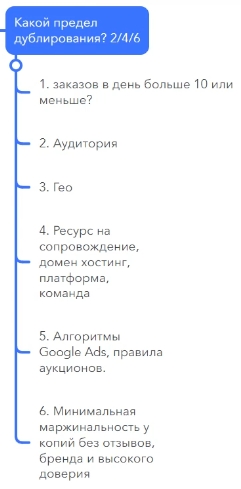
We’ve discussed the pros, cons, and implementation — now for the important question: how many sites can be duplicated? We’ve launched the second one, but is it worth launching a third or fourth? Let’s figure out what this depends on.
How many orders per day (more or less than 10)?
Remember the statistic that out of 100 people who enter a search query, only about 10 will actually make a purchase? So, at some point, you will hit a ceiling: the costs of customization, maintenance, and support for another duplicate site will start to eat up more money than it brings in net profit. Therefore, the first question you should ask yourself is: Does your first store generate more than 10 orders per day or less?
Of course, this figure is approximate — you need to take into account turnover, margins, and whether you work with B2B or B2C. But as a guideline: if your first project consistently generates more than ten orders per day, launching a second site on Google Ads will most likely be a good idea.
And here’s another practical tip. You don’t have to transfer your entire product range to your second online store. Look at your first project through the lens of the Pareto principle: most likely, 10–15% of your products account for 60–80% of your sales and profits. Use these products as the basis for your second project — make them unique and tailor your communication to a different audience segment.
Let’s recall the example with motorcycles: sport bikes and cruisers appeal to different people, different lifestyles, different heroes. They are not interested in hanging out in the same place, and they prefer to shop in different places. Tailor your second project to this division.
Audience size in the country
Market capacity directly affects how many duplicate sites it makes sense to launch. For small European countries with a population of 5–10 million, more than two projects is already too many. For large markets such as Germany, France, or Ukraine (25–30+ million), you can consider a second and possibly a third site.
An interesting observation from practice: clients who first launched and promoted a second website on the Ukrainian market, and then entered Germany or France with a similar scheme, brought the project to profitability faster. The reason is that in Ukraine, competition for duplication is higher, and buyers are more demanding about how one store differs from another. If you have gone through this school, it will be easier in Western European markets.
Geography
This factor is often underestimated, especially in Ukraine. There is a stereotype that money and buyers are only found in large cities. But practice shows the opposite. Take, for example, the sale of franchises: they often sell better in regional centers with a population of 10–30 thousand people than in cities with a million inhabitants, where the market is oversaturated.
The same applies to online stores: your second website can be tailored to the audience of small towns, where competition is lower and purchasing power is quite sufficient.
In Poland, for example, the situation is even more striking: residents of small towns earn comparable incomes to those in large cities and are eager to shop online. Consider geography when launching your second project in Google Ads—it may be the key to your growth.
Support resources (domain, hosting, team)
We have already discussed this, but it is worth repeating in the context of duplication limits. Each new project entails additional monthly expenses: domain, hosting, CMS updates, programmer and marketer services. These costs are still justified for the second website. But with the third or fourth project, there comes a point when the cost of support begins to outweigh the profit that the website generates. Calculate the economics in advance — before launch, not after.
Google Ads algorithms and auction rules
Few people think about this, but they should. Imagine: there are 15–20 competitors in your niche who advertise using the same keywords. You launch a second website on Google Ads — and it’s profitable because you get more clicks from the overall search results.
But as soon as a third or fourth project with the same semantics appears, a different story begins. The overlap of keywords between your own projects reaches 30–50%, and you are effectively competing with yourself in the Google Ads auction.
Each project begins to overpay for clicks—by 2%, 5%, or even 10–15% more. You yourself are heating up the auction, increasing the final sale price for each of your own stores. A logical question arises: why pay more for something you could get cheaper?
Minimal margin for copies without reviews, brand, and trust
When you simply copy a project—changing the name and design, but essentially offering nothing different from your competitors—you end up in a price war. Your only arguments are: “we’re cheap” and “we offer good quality.” But everyone says that. It doesn’t work if you want to earn a decent margin.
The new store has no reviews, no recognizable brand, and no accumulated trust. The buyer looks at two unfamiliar stores and chooses the cheaper one. This means you are forced to lower your price, and your margin drops to a minimum. To avoid this, the second online store must have at least three reasons why it is worth buying here: a unique community, exclusive bundles, special service, expert content — something that sets you apart from your market neighbors.
A successful online store: when is duplication unnecessary?
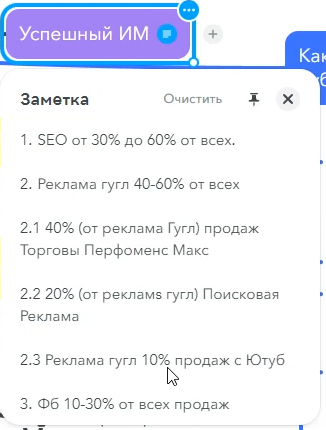
Before rushing to launch a second website, it is worth honestly evaluating the first one. Perhaps it would be wiser to invest resources in its development. Here are the parameters I would pay attention to.
SEO accounts for 30% to 60% of all sales.
If your online store already receives 30–60% of orders from organic search results, that’s a great sign. It means that the project is moving in the right direction, Google trusts it, and the content is working.
In this situation, the question of whether to create a second website for Google Ads advertising should be considered very carefully. It may turn out that it is more profitable to invest in strengthening SEO on the first project and bring the organic share to 50–60% than to spread resources on a duplicate that will start from scratch and without a single review.
Google advertising — 40–60% of all sales
So, a third of sales come from organic traffic — we’ve figured that out. Now for the next benchmark: a successful, well-established online store gets around 40–60% of all orders from Google Ads. Let’s break this figure down into its components to understand what it consists of.
Shopping campaigns and Performance Max account for about 40% of all sales from Google advertising. This is the cheapest tool for getting orders for a well-established project. Previously, this role was performed by Smart Shopping campaigns, but now they have been replaced by Shopping and Performance Max. Let me remind you why Performance Max is so good: it shows your products not only in Google search results (image + price, as in classic shopping ads), but also on partner websites. The reach is wider, and the cost of attracting a buyer is one of the lowest.
Let’s look at some specific figures. Let’s say you have 200 sales per month, 100 of which come from Google advertising. Then approximately 40 orders should come from shopping campaigns and Performance Max. The figure may vary, but the proportion is roughly the same.
Search advertising accounts for another 20% or more of sales from Google Ads. To those 40 orders from shopping campaigns, we add at least 20 sales from search. In some niches, search advertising can generate 40-50% of all orders from Google Ads. What should definitely be included in the search? Brand and model traffic (when a person searches for a specific model), queries with an identified need, and advertising based on competitors.
It is best to run each direction in separate Google advertising campaigns so that you can track effectiveness and calculate how profitable it is to receive orders from each source.
What exactly should be considered? The cost of a “dirty” lead, the cost of a targeted lead (confirmed by the sales department), and separately — the cost of sales, taking into account returns. Returns are tricky, especially if you work in several countries. For example, you launch Google ads in 16 European countries, and Italy will consistently lead in returns — 15–20%. Italians like to order, try on, see in person, and send back. This needs to be factored into the economics.
YouTube — 10% of sales. A separate indicator that speaks to the maturity of the project. If you have managed to achieve 10% of orders from YouTube, it means you are doing something very right. Namely: shooting videos with answers to the classic 15–20 questions that buyers ask over and over again.
“How to choose an enduro bike?”, “What is the difference between a cruiser and a sport bike?”, “What kind of fireplace insert should I put in the corner?” — Your sales department repeats the same questions dozens of times a week. Record these answers on video, post them on your YouTube channel, and insert them into product cards and category pages on your website. The effect is twofold: the workload on the sales department drops by a third, and page conversion rates increase. Instead of 0.5% of purchases from 100 visits, you get 1–1.5%.
And one more important point. What is the second largest search engine in the world after Google? Many would say Baidu. No. It’s YouTube. People search there for answers before making a purchase: what to choose, why, what to look for. And then they go to Google to place their order. If you are present in both places, your chances of making a sale are exponentially higher.
Plus bonus: 4–6 hours after uploading the video, Google will already recognize its text (in Ukrainian, Russian, English — it doesn’t matter). This text is a ready-made article for the site, which only needs to be polished and beautifully formatted. Google can also show your video in zero search results — at the top of the page, with a link to the specific minute where the answer to the user’s query is found. This is a powerful additional source of traffic that many competitors simply ignore.
Facebook — 10–30% of all sales
Facebook should not be overlooked either. In a successful online store, it accounts for 10–30% of orders. There are, of course, exceptions — niches where visuals are everything and Google text advertising is ineffective. In such cases, Facebook can be the main sales channel, but that is a separate story for a separate conversation.
Let’s return to our example: 200 sales per month, 10% of which come from Facebook. If you have achieved this figure, the project is already well established, and you can start thinking about launching a second online store or a second project in a related niche. You have accumulated expertise, your channels are working, your team understands the processes — you have the foundation for scaling.
Alternative to launching a second website
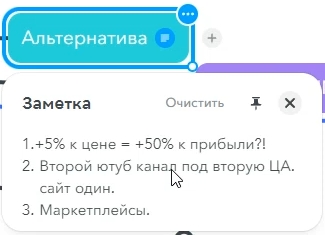
Before investing time and money in creating a second online store, let’s look at the situation from a different angle. Perhaps there is an easier way to increase profits.
+5% to the price = +50% to the profit?
It sounds like magic, but let’s look at some specific figures. Let’s say you sell a product for $100 — the lowest price on the market. At the same time, your competitors are happily selling the same product from the same supplier for $105–108. Let’s break down the economics.
The cost price of the product is $80. Your markup is $20. But of that $20, you have to pay for Google Ads advertising, team salaries, logistics, utilities, and returns processing. The result is a net profit of $10 per sale. Ten percent.
Now imagine that you raised the price by just $5, to $105. The cost price remained unchanged, and operating expenses stayed the same. But net profit increased from $10 to $15. That’s a 50% increase in profit for a price difference of only 5%.
By the way, Google research confirms this pattern — specific figures depend on the country and niche, but the order is comparable.
The question is: why would a buyer pay those extra $5? This is where it gets interesting. People are willing to pay more when they get something more than just a product. Let’s go back to our motorcycle example.
Let’s say you sell enduro bikes and give customers free access to a club when they make a purchase: monthly trips, training, a community of like-minded people. Or you run a Telegram channel where you analyze new products from foreign markets, share insights and reviews — and it’s clear that this is your passion. The buyer senses your expertise, trusts you, and happily pays $105 instead of $100.
Essentially, this is a way out of the rat race of price competition. Instead of launching a second website on Google Ads and spreading your resources across two projects, you strengthen the first one — you add value, build trust, and earn more from each sale. Perhaps this is exactly what your business needs right now.
Marketplaces as an alternative to a second website
Another option that should not be overlooked. Instead of creating a second online store for Google Ads advertising, you can enter the marketplace. Amazon, Rozetka (which, incidentally, already operates in Poland), and other platforms offer an opportunity to test a new market with minimal investment.
We listed the products, set up delivery (Nova Poshta already provides logistics from Ukraine to Poland and back) — and look at the result. The entry threshold is significantly lower than when launching a full-fledged second website, and you get feedback from the market faster.
But remember the main rule that applies to both your own stores and marketplaces: the one who earns the most is the one who has the highest level of trust. Not the one who is cheaper. Not the one who has more items in their catalog. But the one whom the buyer trusts.
Results
We have covered a broad topic: from the pros and cons of duplicating an online store in Google Ads to specific implementation criteria, scaling limits, and alternatives. All the points I have made are not the ultimate truth, but rather experience gathered from real projects. In some cases, my clients made mistakes, in others they found successful solutions — and I have tried to convey both to you.
If you have your own experience launching a second website in Google Ads, please share it in the comments. Maybe you’ve found a way to do something more effectively, or encountered a nuance that I haven’t touched on. Subscribe to the channel, share this material with your colleagues, and see you in the next episodes!