
Google accounts for over 90% of the search market in Austria. Bing and local search engines split the remainder, so the question of “where to advertise” doesn’t really come up here. The real question is: how to set up campaigns so that each click generates a lead, rather than just burning through your budget.
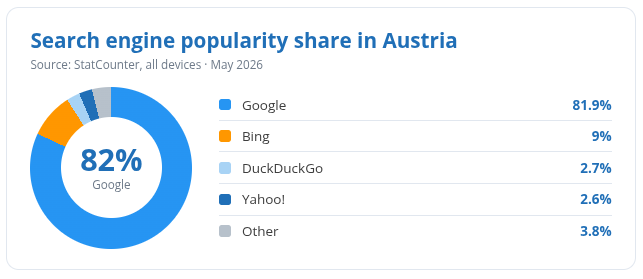
The Austrian market is compact, with a population of about 9 million. However, purchasing power is among the highest in Europe—in terms of CPC, the country ranks among the top ten most expensive markets in the world. For advertisers, this means two things. First: every click is expensive, and configuration errors can significantly impact the budget. Second: customers here provide a quick return on investment—the average order value and LTV are high in virtually any niche, from dentistry to B2B services.
Features of Google Ads Contextual Advertising for Austria
Contextual advertising in Austria works according to the same mechanics as everywhere else: auctions, bids, and quality score. What differs is the context—the language, competition from the DACH region, legal requirements, and audience behavior. That’s what we’ll discuss.
German—but not quite the same
Ads for Austria are written in Hochdeutsch, but adapted to Austrian vocabulary. There are plenty of examples: January is “Jänner” here, not “Januar”; tomatoes are “Paradeiser,” not “Tomaten”; potatoes are “Erdäpfel.” If you’re advertising grocery delivery and use “German as spoken in Germany,” some of the meaning will simply be lost on the audience.
Ad localization isn’t just a formality. Austrians are wary of “German-style” phrasing: text written by a native speaker for the German market comes across as foreign. The best approach is to have ads proofread by native speakers living in Austria. At the very least, check the semantics using the Keyword Planner with the geographic setting “Austria,” not “German-speaking countries.”
Competition from the entire DACH region
Companies from Germany and Switzerland often participate in auctions targeting Austrian users. Delivery to Vienna from Munich takes a day, so German online stores are actively running ads targeting Austria. As a result, bids are higher than one might expect for a market of 9 million people.
Strangely enough, this works in the favor of local businesses. The .at domain, an Austrian address in the ad, prices in euros with local VAT, and the phrase “Lieferung in ganz Österreich” boost CTR and conversion rates—users are more likely to click on ads from “their own.”
Legal Requirements: DSGVO, Impressum, Datenschutz
Austria is part of the EU, so the GDPR (known as the DSGVO in German) applies here. Moreover, the Austrian regulator is considered one of the strictest in Europe. What to check before launch:
- the website has an Impressum with the company’s full contact details;
- the Datenschutz page describes what data is collected and why;
- there is a proper cookie banner with a genuine opt-out option (Consent Mode v2 for Google is mandatory);
- the application forms include a checkbox for consent to data processing.
Without Consent Mode configured, Google Ads will lose conversion data for EU users starting in 2024. Campaigns will “go blind”: the algorithm won’t know which clicks led to inquiries, and optimization will break down. Check this before launching your campaign, not after you’ve spent your first budget.
What ad formats work in Austria?
Google Ads in Austria isn’t limited to search. There are many formats, and the choice depends on your specific goal.
- Search ads are the foundation for capturing high-intent traffic. A user types in “Installateur Wien Notdienst”—and sees your ad first. The conversion rate to leads for such queries in the DACH region hovers between 3.5% and 5.5%, and for emergency services, it reaches up to 10%.
- Google Shopping is a must-have for e-commerce. Product listings display photos, prices, and the store name directly in the search results. For an online store in Austria, product campaigns often account for more than half of all transactions from paid traffic.
- GMPN (Google Display Network) — banners on Google’s partner sites, including major Austrian media outlets such as derStandard.at and krone.at. CPC is low (€0.20–0.80), but the audience is less engaged. The main use is remarketing: bringing back those who visited the site but left without making a purchase. The conversion rate for remarketing campaigns in the DACH region is 3–5 times higher than for standard campaigns.
- YouTube is the world’s second-largest search engine and a powerful reach channel. It’s suitable for launching a new brand or product when there isn’t yet direct demand.
- Performance Max is an automated format that allocates the budget across Search, Display, YouTube, Gmail, and product ads. It works well under one condition: the algorithm receives high-quality conversion data. Without end-to-end analytics, PMax turns into a black box that spends money on unknown targets.
How do you set up contextual advertising for Austria?
Setting up contextual advertising in Austria isn’t just a matter of “creating an account and launching ads.” The project consists of three layers: sequential work stages, well-thought-out geo-targeting by city and state, and—for online stores—a separate e-commerce component. Let’s break each one down in order so you understand what goes into the result and what you’re paying the agency for.
Work Phases
- Briefing and niche analysis. We analyze demand using the Planner tool, review competitors in search results, and evaluate landing pages. At this stage, we’ll be honest: if the website isn’t ready for traffic, it’s pointless to run ads to a page without prices or a contact form.
- Semantic research. We identify key search queries in German with Austrian-specific terms, cluster them into groups, and define negative keywords. The latter is especially important: without negative keywords, the budget gets wasted on queries like “kostenlos” (free) and “selber machen” (do it yourself).
- Setting up analytics. Google Analytics 4, goals for form submissions and calls, Consent Mode, and—if necessary—end-to-end analytics integrated with CRM. Without this step, optimization is impossible in principle.
- Creating campaigns. Account structure, ads (ad copy reviewed by a native speaker), extensions—addresses, details, prices, quick links.
- Launch and testing. The first 2–4 weeks are for collecting statistics. We monitor which search queries generate leads and which ones burn through the budget.
- Optimization. Adjusting bids, refining search queries, A/B testing ads, and reallocating the budget to ad groups with the best ROI.
Launching from scratch takes 3 to 7 business days. After that, ongoing monthly management is required, because an ad campaign left unmonitored will lose effectiveness: competitors adjust their bids, Google updates its algorithms, and seasonal trends shift demand.
Geotargeting
Austria is divided into nine federal states, and the differences between them are significant. Vienna accounts for a quarter of the country’s population and has the highest competition in the auction. Graz, Linz, Salzburg, and Innsbruck are smaller cities where clicks are 20–40% cheaper.
City-based targeting solves several problems:
- local businesses (clinics, auto repair shops, restaurants) don’t pay for clicks from regions where customers won’t physically travel from;
- with a limited budget, campaigns are first tested in a single city and then scaled up;
- Different regions have different bid rates: it makes sense to set separate adjustments for Vienna and Carinthia.
Practical example. A cleaning company operates in Vienna and Lower Austria. Instead of a single nationwide campaign, we run two: “Vienna” with higher bids and a 15-km radius from the city center, and “Niederösterreich” with lower bids. We add negative keywords for cities where we don’t operate. This results in budget savings of about 25% while maintaining the same number of leads.
One additional detail: tourist regions (Salzburg, Tyrol) experience seasonal spikes in demand. Advertising for hotels and ski services requires monthly bid adjustments—summer in Salzburg and December each present different competitive challenges.
Key Considerations for E-Commerce Ad Setup
For online stores, Google Ads contextual advertising in Austria is built around a combination of product campaigns + Performance Max + remarketing.
Austrians actively shop online, but they have their own habits. Popular payment methods include bank transfers and EPS, not just credit cards. Klarna and payment on account (Kauf auf Rechnung) significantly boost conversion rates. Shipping: If a German competitor takes 3–4 days to deliver, but you can deliver within Vienna in one day—highlight this in your ad.
What to set up for e-commerce:
- a product feed in Merchant Center with prices in euros and correct taxes;
- product campaigns broken down by product margin;
- Dynamic remarketing—users see exactly the products they viewed in the banners;
- transaction tracking that includes the order total, so the ROAS strategy optimizes revenue rather than the number of orders.
By the way, regarding ROAS: for Austrian e-commerce, a rate of 400–800% is considered normal—for every euro invested, 4–8 euros in revenue is generated. A rate below 300% is a reason to review the campaign structure or the store’s financials.
The Cost of Contextual Advertising in Austria
The total cost of contextual advertising in Austria consists of two parts: the advertising budget (paid to Google) and fees for specialists’ services.
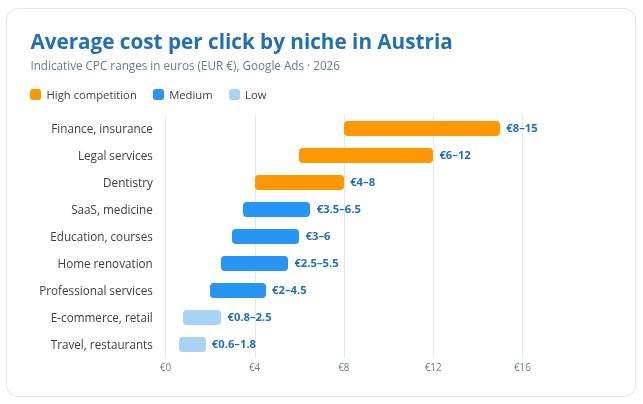
Here are some budget guidelines. The average cost per click in search ads is €0.80–2.50 for B2C and €2.50–8.00 for B2B. In high-cost niches, the figures are higher—legal services, loans, and insurance can reach up to 15 € per click. And this can be justified: a single client for a law firm can bring in as much as 10,000 €.
Let’s look at an example. A repair technician in Vienna pays about €2.80 per click. With a 6% website conversion rate, each lead costs approximately 47 €. If every third lead turns into an order with an average order value of 3,000 €, the advertising pays for itself many times over.
The minimum operating budget for search campaigns in Austria is €600–800 per month per city and per service category. Any less than that, and there won’t be enough data to even determine whether it’s worth launching the campaign. For e-commerce with product campaigns, budget 1,000–1,500 €.
The cost of setting up contextual advertising in Austria through agencies starts at 300–500 € for a basic launch (one campaign, limited keywords) and can reach €1,500 or more for a comprehensive project involving multiple campaign types, a product feed, and analytics setup. Monthly management fees are typically 10–20% of the advertising budget or a flat rate of 250–400 €.
It can be cheaper—a freelancer will charge less. The question is who will be accountable for the results in three months and whether the freelancer knows the difference between “Jänner” and “Januar.”
Common Mistakes When Launching a Campaign in Austria on Your Own
Let’s break down the most common issues clients face after attempting to run campaigns on their own or working with contractors who lack experience in the Austrian market.
- Targeting “Austria + Germany + Switzerland” in a single campaign. Bids, ad copy, and competition vary across the three countries. Such a campaign drains the budget toward expensive Switzerland and shows Austrians “German” ad copy.
- Keyword selection lacks Austrian-specific terms. By selecting keywords based on German search volume, we lost a portion of the local demand.
- No negative keywords. The very first weeks of testing reveal hundreds of irrelevant queries. Without regular cleanup, 20–30% of the budget is wasted on them.
- Lack of conversion tracking. Ads are running, money is being spent, but it’s unclear which keywords are generating leads. There’s nothing to optimize.
- Ignoring the GDPR. The risk here is twofold: fines from regulators and the loss of data for Google’s algorithms.
Why should you hire an agency to run contextual ads in Austria?
You could figure it out on your own—the Google Ads interface is open to everyone. However, learning the ropes on your own budget—given Vienna’s high ad rates—can be expensive: a couple of months of trial and error can easily cost €2,000–3,000 without yielding any results.
A contextual advertising agency in Austria approaches this challenge differently. PPC specialists have already gone through the trial-and-error phase on other clients’ projects, know the actual bid rates for specific niches, stay on top of Google’s updates, and—crucially for this market—work with native speakers when crafting ads.
What you get in practice:
- a website audit and an honest forecast before launch—including scenarios where it’s too early to run ads;
- campaigns tailored to the Austrian market: language, geographic targeting, payment habits, and legal nuances;
- Transparent reporting—you retain access to your ad account, and all metrics are visible at any time;
- Continuous optimization: bid adjustments, keyword targeting, ad testing, and budget reallocation toward what drives leads.
If you’ve decided to run contextual ads in Austria, start with a free consultation. Send us your website and describe your niche: we’ll calculate a forecast for clicks, leads, and budget tailored to your industry. The decision is yours—the numbers will speak for themselves.