
Spain has a population of nearly 50 million, a high rate of online shopping, and an audience accustomed to searching for products and services online. For businesses entering this market or looking to grow faster, contextual advertising in Spain is often the quickest way to attract their first customers. Not after six months of SEO, but within the first week of launch.
You already know this—otherwise, you wouldn’t be looking for someone to handle the setup. Below, we’ll explain how the Spanish advertising market works, which Google Ads formats deliver results in Spain, how much it costs in euros, and what to look for when choosing a contractor.
Why does contextual advertising work so well in Spain?
Let’s start with the good news. The cost per click in Spain is significantly lower than in the U.S. or the U.K.—according to various estimates, the average CPC is roughly half that of the U.S. For most European niches, the cost per click hovers around a couple of euros, and in less competitive niches, it drops to €1. This means that with the same media budget, you get more clicks, and therefore more opportunities for leads and conversions.
The second point is consumer behavior. Spaniards are active online shoppers, and e-commerce is growing year after year. People compare prices, read reviews, and order delivery. The demand that can be captured through advertising already exists—it doesn’t need to be created from scratch. 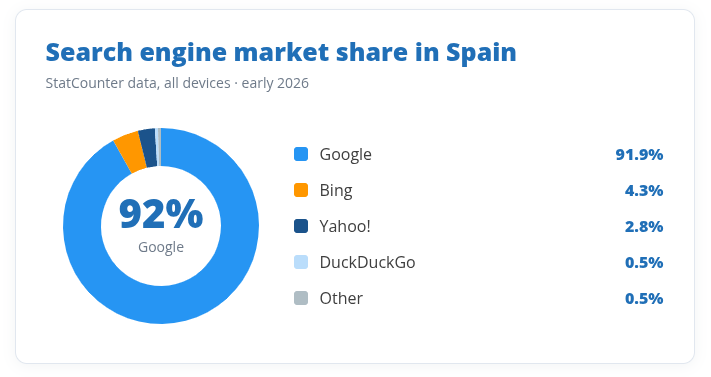
And the third factor is Google. The search engine holds an overwhelming market share in the country, with its main domain, google.es, processing millions of queries every day. Competitors like Bing get only a very small slice of the pie. When it comes to paid search, Google Ads in Spain is, in essence, the primary channel—not just one among many.
What should you consider when setting up contextual advertising in Spain?
The main pitfall is the language. Castilian Spanish is understood everywhere, but in some regions, people seek out and communicate in their own languages: in Catalonia (which includes Barcelona)—Catalan; in the Valencian Community—Valencian; in the northwest—Galician; and in the Basque Country—Basque. Ads written in “standard” Spanish may be less effective in Catalonia than texts that take local nuances into account. Native speakers can sense insincerity instantly.
Next up are legal restrictions. Google’s advertising policies in Spain are, in some cases, stricter than what advertisers from other countries are used to. For example, advertising weight-loss products is heavily regulated here, and there are specific rules regarding healthcare, finance, and alcohol. Your ad could be rejected, and your account could be suspended, if you’re not aware of these restrictions in advance.
A couple more things to keep in mind:
- Seasonality. The Rebajas (official sales) in January and July reshape retail demand. Tourism-related businesses thrive during the summer peak. Advertising budgets should be adjusted in advance to account for this, rather than after the fact.
- Competition varies by region. In Madrid and Barcelona, the bidding is more intense and the cost per click is higher, while in the provinces, it’s more relaxed.
- Trust in local businesses. Spaniards are more likely to click on ads that include a local address, phone number, and landing page content in their native language.
Let’s say you sell furniture and run the same ads nationwide. Chances are, in Barcelona you’ll end up paying too much per click and missing out on leads—simply because you didn’t take the language and local competition into account. A minor detail? Over time, that adds up to tens of thousands of euros in lost revenue.
Which Google Ads formats perform best in Spain?
Google Display Advertising in Spain isn’t just about text ads in search results. Different tools are designed for different objectives, and the best results usually come from combining several of them.
- Search advertising. The foundation for most projects. When a user enters a query, they see your ad at the top of the search results. Here, everything depends on the account structure and semantic optimization: keywords should be grouped by type (brand, category, informational, location-based), and a specific bidding strategy should be selected for each group. And be sure to use negative keywords, otherwise your budget will be wasted on irrelevant impressions.
- Google Shopping. For online stores, this is practically a must-have. With product photos and prices displayed right in the search results, users can see exactly what they’re buying before they even click. Given the rapid growth of e-commerce in Spain, product listings often account for the majority of sales.
- Performance Max. A smart campaign that automatically distributes impressions across Search, Display, YouTube, Gmail, and Maps. It works well when you already have a history of analytics and high-quality conversion data. Beginners often launch it too early—and then wonder why PMax is eating up their budget without delivering results.
- Retargeting. Reaching out to visitors who have already been to your site but didn’t make a purchase. In niches with long decision-making cycles (real estate, B2B, high-end equipment), retargeting often delivers the best return on investment—you’re targeting a warm audience rather than paying for a cold one.
In addition, we’re using a contextual media network (CMN) for reach and brand awareness, as well as Google Demand Gen—a format designed to generate demand, with a focus on visuals in feeds.
Important: There is no “magic” format that works for everyone. A clothing store needs Shopping and PMax, while a law firm needs standard search ads with remarketing. Putting together the right mix of campaigns is half the agency’s job.
In which regions of Spain does advertising yield results?
Geotargeting in Spain is a whole different story, and it shouldn’t be taken lightly. Regional targeting allows you to show ads exactly where your customers are, rather than wasting money on irrelevant locations.
The logic is simple. If your business is based in Valencia, there’s no point in paying for clicks from Bilbao. And if you operate nationwide but shipping to the Canary and Balearic Islands is more expensive, that’s a good reason to run separate campaigns with different bids and ad copy.
Major cities deserve special attention:
- Madrid is the largest and most competitive market—a capital city with high purchasing power, but also an expensive auction;
- Barcelona is the second-largest city, with its own distinct language (Catalan) and a large influx of tourists;
- Valencia is a growing market; competition is less intense, and the cost per click is usually lower than in Madrid.
By the way, a common mistake is targeting “people who are in OR interested in the region.” It sounds logical, but in practice, this attracts a ton of irrelevant impressions from people who simply read something about Spain while in another country. For local businesses, it’s almost always better to target physical location. It’s just one click in the interface—but the difference in traffic quality is huge.
How do we set up advertising campaigns for Spain?
If you’ve decided to run contextual advertising in Spain, it’s important to understand exactly what the process entails. That way, you won’t feel like you’re paying for a “black box.”
The turnkey setup of contextual advertising in Spain is carried out in several stages:
- Business and website analysis. We examine the product, competitors in Google.es search results, the target audience, and the landing page itself. If the website isn’t optimized for conversions, no amount of advertising will help, so we identify areas for improvement right away.
- Semantic research. We select keywords based on the regional language, filter out stop words, and group search queries.
- Creating ads. We write ad copy—preferably with input from a native speaker—and craft headlines, extensions, and messaging tailored to a Spanish-speaking audience.
- Technical setup. We integrate analytics, set up conversion tracking, geotargeting, and bidding strategies. Without proper analytics, optimization becomes a guessing game.
- Launching and optimizing campaigns. The first few weeks are all about gathering data and fine-tuning. After that, it’s an ongoing process: testing ads, adjusting bids, and pausing what isn’t working.
The launch itself usually takes a few days. But it takes the first month or so to achieve consistent results, while the system gathers data. Anyone who promises “sales from day one at a fixed price” is either being disingenuous or doesn’t know what they’re talking about.
The cost of contextual advertising in Spain
“How much does advertising cost?” is the most common question—and the most difficult one to answer. That’s because the cost of contextual advertising in Spain depends on two factors that shouldn’t be confused.
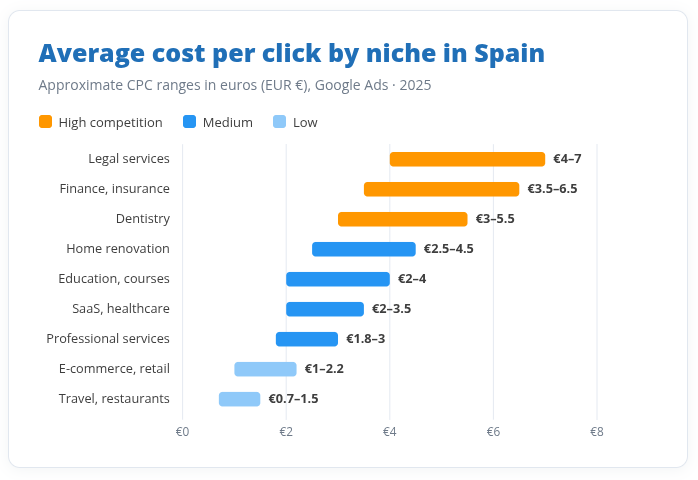
The first is the advertising budget—that is, the money paid directly to Google for clicks. This operates on an auction system: the higher the competition in a niche, the higher the cost per click. In less competitive niches, a click might cost less than a euro; in highly competitive ones (such as law, dentistry, and real estate), it can cost several euros or more. With a minimum media budget of €300–500 per month, you can test a narrow niche, but for most projects, a realistic starting point is €500–1,000 or more, depending on the region and objectives.
Second is the cost of setting up contextual advertising in Spain (payment for the specialists’ work). There are various models available here:
- One-time setup from scratch — a fixed fee for setup;
- Monthly maintenance — a subscription fee for management and optimization;
- A percentage of the advertising budget—the higher the spend, the higher the management fee.
What actually affects the cost of the work: the number of ad campaigns and formats (Search, Shopping, PMax, remarketing), the scope of keywords, the complexity of the account structure, and the number of regions. A single Search campaign targeting Valencia and a set of ten campaigns covering all of Spain represent different scopes of work—and therefore different price points.
Therefore, it’s better to ask not “how much does it cost in general,” but “what strategy will work in my case and how much will it cost.” A reputable PPC agency in Spain will first assess the task and only then provide a quote. If they quote a price before even reviewing the project, that’s a red flag.
And one more thing. A cheap setup that drains your budget ends up costing more in the long run. You shouldn’t focus on the cost per click alone, but rather on ROI—how much you’ve earned for every euro invested. A €3 click that brings in a €300 order is more profitable than a €0.5 click that doesn’t result in a single sale.
Why is it better to hire a contractor to set up Google Ads in Spain?
A fair question: Google’s interface seems to be open-source, and anyone can click the buttons. Why pay?
The thing is, there’s a world of difference between “launching an ad” and “making it profitable.” Google Ads involves hundreds of settings, and most of them are set by default to benefit Google itself, not the advertiser. Automatic recommendations often inflate spending. Broad match without negative keywords eats up the budget on irrelevant queries. PMax, launched without data, operates blindly.
What you get when you work with a team that knows the Spanish market:
- Less wasted budget. An experienced specialist sets up negative keywords, effective strategies, and geotargeting from the very start—rather than learning on your dime.
- Local expertise. Taking into account regional languages, legal restrictions, and seasonal factors that may not be obvious to a foreigner.
- Continuous campaign optimization. Advertising isn’t a “set it and forget it” process. The market changes, competitors adjust their bids, and without active management, results will decline.
- Transparent analytics. Clear reports: how much was spent, how many leads were generated, what the cost per conversion is, and what the ROI is.
Let’s say you’ve launched an online store and decided to handle PPC yourself. The first month brings 12 orders, and you get the feeling that “the ads aren’t working.” In reality, half the budget went to irrelevant impressions, conversions weren’t tracked, and Google Shopping wasn’t even set up. It’s a familiar scenario—and almost always, it’s about a lack of a system, not a bad product.
How do I choose a contextual advertising agency in Spain?
There are many contractors out there, and they all promise pretty much the same thing. How can you tell which ones will actually see the project through?
Look at the specifics, not just the fancy words. Here are a few pointers:
- Experience specifically with the Spanish market. Ask about case studies in Spain, working with regional languages, and knowledge of local restrictions. General experience with Google Ads isn’t the same as understanding google.es.
- Transparency. A good agency explains what you’re paying for, gives you access to the advertising dashboard, and shows you actual numbers—not just “everything’s fine, traffic is growing.”
- Focus on strategy, not just buttons. If your first meeting involves discussing business goals, the target audience, and the sales funnel, that’s a good sign. If they immediately start talking about “launching tomorrow,” that’s a red flag.
- Reasonable promises. No one can seriously guarantee exact sales figures in advance. What can be guaranteed is the quality of the setup and a systematic approach—not the outcome of the auction.
- Clear reporting. Regular reports featuring metrics that matter specifically to your business—such as leads, cost per lead, and ROI—rather than abstract impressions and clicks.
Here’s a simple test: ask your contractor, “What won’t you be doing on my project, and why?” Someone who really knows their stuff will easily explain which formats you don’t need and where you shouldn’t spend your budget. Someone who tries to sell you “everything at once” will usually get flustered.