Sweden is a small market with expensive clicks and high average order values. It has a population of about 10.5 million, but in terms of e-commerce volume, the country ranks among Europe’s leaders: Swedes are accustomed to buying everything online—from electronics to groceries. That’s why contextual advertising in Sweden pays off even with a high cost per click: the margin covers the expenses, and customers are both solvent and loyal.
The second argument is speed. SEO promotion in a new market takes 6–12 months, while Google Ads in Sweden brings in the first visitors as early as the day of launch. For testing a niche or a quick market entry, this is the most direct route.
How does contextual advertising in Sweden differ from that in Ukraine?
The mechanics of setting up Google Ads in Sweden are the same everywhere: auctions, bids, and pay-per-click. However, everything surrounding it in Sweden works differently—from the language of search queries and payment methods to advertising laws, which are stricter here than in most EU countries. Campaigns copied from the Ukrainian or even German markets usually fail precisely because of these details. Let’s break down what you need to consider, step by step.
Google dominates, but there’s a caveat with Bing
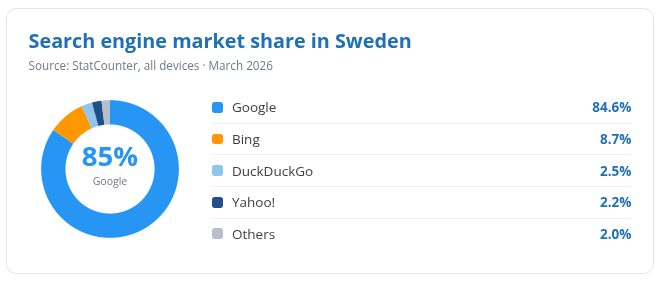
Google holds over 90% of Sweden’s search market—there’s no question about which platform to use as your primary one. That said, Bing Ads accounts for a modest 3–5%, but it’s too early to write it off: Bing’s audience consists mainly of corporate users on work computers running Windows. For B2B niches, it generates leads with a CPC 20–25% lower than Google’s, simply due to less competition in the auction. The standard combination for the Swedish market is Google Ads as the primary channel, plus Bing for the corporate segment.
About 96% of the country’s population uses the internet, with most accessing it via smartphones. Practical takeaway: it’s important to test the mobile version of your website before launching a campaign, not after. Slow loading times on a phone will kill conversions faster than a bad ad.
Language: Everyone knows English, but they shop in Swedish
About 90% of Swedes are fluent in English, which makes it tempting to cut corners on translation. Don’t give in to that temptation. Most commercial search queries are entered in Swedish, and ads in the native language yield conversion rates several times higher than those in English. The logic is simple: for Swedes, English is the language of work and travel, but purchasing decisions are made in their native language.
Machine translation is a whole other problem. Swedish is full of compound words and nuances: “billig” (cheap) sounds like “cheap stuff” in an ad, while the neutral “prisvärd” (good value for money) is exactly what you need. Google Translate doesn’t pick up on these distinctions. That’s why the semantic core and ad copy are either written by native speakers or proofread by them.
By the way, Swedish is partially understandable to Norwegians and Danes—but you can’t run a single campaign “across all of Scandinavia” without adaptation. For Norway, the texts are rewritten in Bokmål; for Denmark, in Danish. Otherwise, the ads look like they’re written in “broken language.”
Payments: A Country Where Cash Is Almost Dead
Sweden has the most cashless economy in Europe: less than 10% of purchases are paid for with cash. For advertisers, this means strict requirements for their websites:
- Swish—mobile payments via phone number; about 8 out of 10 Swedes use the app. For local shoppers, the absence of Swish signals that “the store isn’t local”;
- Klarna—pay in installments or after receiving the goods. The service was founded in Stockholm and has become the national standard for e-commerce: integrating Klarna significantly increases the average order value because it eliminates the fear of prepayment;
- Prices in Swedish kronor (SEK). Sweden is part of the EU but has not adopted the euro—pricing in euros instantly gives away that a customer is a foreigner and cuts into conversion rates.
Check this before launching your ads. Otherwise, you’ll end up with the classic scenario: campaigns drive targeted traffic, but there are no orders—people reach the checkout page and leave because they can’t find their usual payment methods.
Purchasing Power and E-Commerce Maturity
Sweden’s GDP per capita is about $55,000, and the average pre-tax salary is around 38,000–40,000 SEK per month. About 85% of the population shops online, and e-commerce’s share of retail sales is steadily growing. High purchasing power here goes hand in hand with rationality: Swedes are willing to pay for quality, but before making a purchase, they compare offers on price comparison sites like Prisjakt and PriceRunner and read reviews on Trustpilot.
What does this mean for advertising? An expensive click on a high-intent search query pays off if the website stands up to comparison with competitors. Conversely, there’s no need to undercut prices—price isn’t the main selling point for Swedish shoppers. Warranties, delivery times, and transparent return policies (the market standard is 30 days) often carry more weight than discounts.
Mindset: “lagom” instead of “Buy Now!”
In Swedish culture, there’s a word called “lagom”—“just the right amount, without excess.” It explains a lot about local advertising. Flashy banners, all-caps text, “Today only! −70%!”—all of this makes Swedes suspicious rather than eager to buy. What works is a calm, honest tone and concrete details: specifications, timelines, and terms.
Sustainability is a deciding factor, not just window dressing. A significant portion of Swedes are willing to pay extra for sustainable products, so mentioning recycling, local production, or carbon neutrality in an ad actually boosts the CTR. Just avoid “greenwashing”: unsubstantiated claims about sustainability are scrutinized here, including by regulators—more on that below.
Geography and Seasonality
One-third of consumer activity is concentrated in the Stockholm metropolitan area, followed by Gothenburg and Malmö. Targeting is set by county—the country’s 21 administrative regions. This gives you control over bids: in Stockholm, the auction is overheated and clicks are more expensive; in the northern counties, competition is lower, but demand is also more modest.
Seasonal peaks to factor into the media plan:
- November–December: Black Friday and julhandeln (Christmas shopping)—maximum bids and maximum sales;
- late December–January: mellandagsrea, the traditional post-Christmas sale;
- late June: Midsommar—the midsummer festival; business activity drops, but demand for garden supplies, grills, and vacation items rises;
- July: The country is on vacation en masse; B2B campaigns are usually paused or scaled back this month.
Ad moderation: why Google “cuts” campaigns
The first attempt to target the Swedish market often comes as a surprise: some ads are rejected, and the reason given is vague. Typical reasons include:
- phrasing that the algorithm considers misleading—superlatives (“best in Sweden”) without verification on the website;
- incomplete legal information: for e-commerce, both Swedes and Google expect the website to include the company’s full name, business registration number, return policy, and contact information;
- a landing page in a language other than the ad’s language;
- certification issues in regulated niches—finance, healthcare, and gambling require prior verification of the advertiser’s status.
Practical tip: Don’t resubmit a rejected ad ten times in a row—your account could get suspended. Figure out the reason, fix it, and file an appeal.
Legal Restrictions on Advertising
In addition to Google’s rules, local legislation applies—the Marknadsföringslagen (Marketing Act)—and compliance is monitored by the Konsumentverket (Consumer Agency) and the Reklamombudsmannen (Advertising Ombudsman). Key restrictions:
- Advertising targeted at children under 12 is prohibited in Sweden—this is one of the strictest regulations in Europe;
- Alcohol: Advertising of beverages with an alcohol content of more than 15% is almost entirely prohibited; for lower-alcohol beverages, strict presentation requirements apply;
- gambling: only operators licensed by Spelinspektionen may advertise, and the tone of the advertising must be “moderate”;
- Healthcare and finance: Mandatory disclaimers and restrictions on promises of specific results;
- Environmental claims: Statements such as “climate-neutral” without evidence are considered misleading—there have already been cases of legal action.
Violations result not only in ad rejections but also in fines. If your niche even slightly touches on regulated categories, it’s best to review the legal aspects before launching.
GDPR and Cookie Consent
Sweden is part of the EU, so the GDPR applies in full. For advertising, this isn’t just a formality: without a properly configured consent banner and Google Consent Mode v2, the system loses some conversion data. Campaigns are trained on incomplete data, remarketing audiences aren’t built, and reports underestimate actual results.
Setting up consent is a mandatory item on the pre-launch checklist, right alongside conversions and analytics. Get it right once, and it just works from there.
Which Google Ads formats work best in Sweden?
Google’s contextual advertising in Sweden isn’t limited to text ads in search. The effective toolkit looks like this:
- Search ads. The foundation for services and B2B. The user is already searching for a product—all that’s left is to show a relevant ad and an appropriate landing page. It’s the most expensive, but also the “hottest” format.
- Google Shopping. A must for e-commerce: product listings with photos and prices in SEK appear above the regular search results. For the Swedish market, it’s critical to set up the product feed correctly—currency, availability, and shipping terms.
- Performance Max (PMax). An automated format: Google itself allocates the budget across Search, the Contextual Media Network (CMN), YouTube, Gmail, and Discover. PMax scales sales well once conversion data has been accumulated. Launching it first, without any data, is a common mistake.
- Display Network. Banners on Google’s partner websites. In Sweden, the Display Network is used primarily for remarketing and to increase reach, rather than for direct sales.
- YouTube Ads and Demand Gen. Swedes are avid YouTube viewers, so video campaigns and Google Demand Gen are well-suited for building demand—especially for new brands that the market isn’t yet familiar with. Important note: Voiceovers and subtitles should be in Swedish, preferably recorded by native speakers.
- Retargeting. This brings back visitors who didn’t make a purchase on their first visit. Given the high average order value in Sweden, the decision-making cycle can be long—retargeting almost always pays off here.
How do we set up contextual advertising in Sweden?
The logic behind properly setting up contextual advertising in Sweden is not much different from that of any other market—but each stage requires local expertise.
- Niche and competitor analysis. We examine who is already advertising for your search terms in Swedish search results, what offers they’re using, and what they’re writing on their landing pages.
- Compiling a semantic core in Swedish. This isn’t a literal translation of Ukrainian or English keywords, but rather working with real search queries: using a keyword planner, analyzing top-ranking websites, and having a native speaker review the results. Let’s say you sell kitchen furniture—a direct translation would be “kökmöbler,” but Swedes more often search for “kök” and specific types of kitchen sets.
- Negative keyword optimization. We filter out irrelevant search queries right away; otherwise, your budget will be wasted on terms like “free,” “DIY,” and “used”—specifically in their Swedish variants, which are impossible to catch without knowledge of the language.
- Campaign and ad structure. Separate search campaigns, separate display campaigns, and narrow ad groups. Ad copy is written or reviewed by a native Swedish speaker.
- Conversion and analytics setup. Without proper tracking of leads and purchases, Google’s algorithms won’t be able to learn, and you won’t be able to evaluate the results.
- Launch, testing, and optimization. The first 2–4 weeks are for data collection: adjusting bids, refining search terms, and conducting A/B tests on ads. After that, we scale up what generates conversions and leads at a reasonable cost.
A separate point is the website. Localizing landing pages is just as important as the ads: a Swedish version of the site, prices in kronor, and local payment methods. A .se domain boosts trust, though it’s not a requirement. Proven in practice: identical campaigns on the English and Swedish versions of the website result in a significant difference in conversion rates.
The Cost of Contextual Advertising in Sweden
Let’s be honest right off the bat: there’s no fixed figure. Google Ads operates on a pay-per-click (PPC) auction model, and the total cost of contextual advertising in Sweden consists of two parts: the advertising budget (which goes to Google) and fees for specialists’ services.
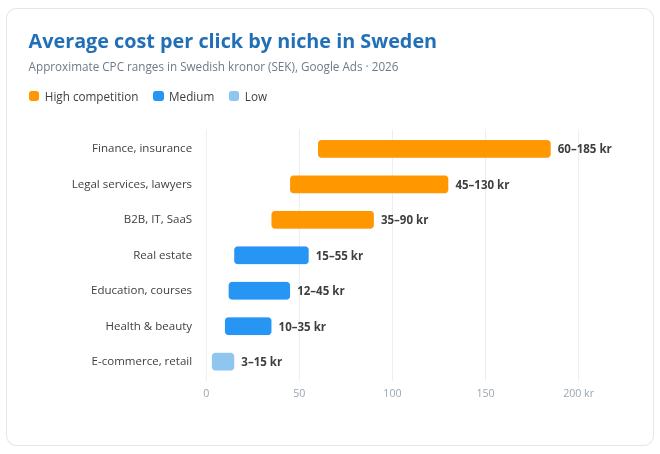
Here are some guidelines for the budget. Sweden is a Tier 1 market, so clicks here are more expensive than in Ukraine or Eastern Europe. The average CPC in search is approximately 1–3 euros (10–30 SEK); in competitive niches such as finance, legal services, or real estate, the rate can reach 5–10 euros per click. Shopping ads and Display Network campaigns are less expensive. The minimum test budget for the Swedish market is 1,000–1,500 euros per month; with smaller amounts, campaigns simply won’t generate enough data for optimization.
What matters here isn’t the cost per click itself, but the overall ROI. Example: a click costs 2 euros, and the website conversion rate is 3%. A lead costs approximately 67 euros. If you’re selling a service with a 2,000-euro price tag and close one out of every five leads, the advertising pays for itself many times over. The high purchasing power of Swedes is precisely what justifies the high cost per click.
Now, regarding services. The cost of setting up contextual advertising in Sweden is higher than for the Ukrainian market—due to the need to work with Swedish semantics and hire native speakers for copywriting. Guidelines: one-time setup—400–500 euros; monthly management—300–500 euros, depending on the number of campaigns and the scope of work. The agency provides an exact estimate after analyzing the niche.
The final cost is influenced by: competition for your keywords, ad quality score (a high Quality Score lowers your bid in the auction), and seasonality—for example, bids traditionally rise ahead of julhandeln (Christmas shopping).
Why is it more cost-effective to order contextual advertising in Sweden through an agency?
Technically, anyone can launch an ad campaign—the Google Ads interface is open to everyone. The issue is the cost of mistakes. In a market with a CPC of 2–3 euros, every irrelevant click is significant, and typical beginner mistakes—such as mixing search and display campaigns, using machine translation for keywords, and failing to set up conversions—can burn through your budget in a matter of weeks.
A contextual advertising agency in Sweden handles several tasks at once:
- keyword research and ad copy created by native Swedish speakers—without a “translated” tone;
- knowledge of local specifics: from Swish and Klarna to seasonality and communication tone;
- experience navigating moderation processes and working within restrictions;
- analytics and transparent reporting: You see the cost per lead, not just abstract click counts;
- scaling to Norway, Denmark, and Finland once your Swedish campaigns reach stable performance metrics.
If you’re planning to enter the Swedish market or have already tried launching a campaign but weren’t satisfied with the results, ordering contextual advertising in Sweden from a specialized team is more cost-effective than learning the ropes at your own expense. Submit a request: we’ll analyze your niche, calculate traffic projections and lead costs, and propose a strategy tailored to your goals.