
Slovakia is a compact yet affluent EU market: 5.4 million residents, a high share of online shopping, and moderate competition in ad auctions. For Ukrainian businesses expanding into Europe, this is one of the most accessible entry points. Contextual advertising in Slovakia drives customers as early as the first week after launch—without the long wait associated with SEO.
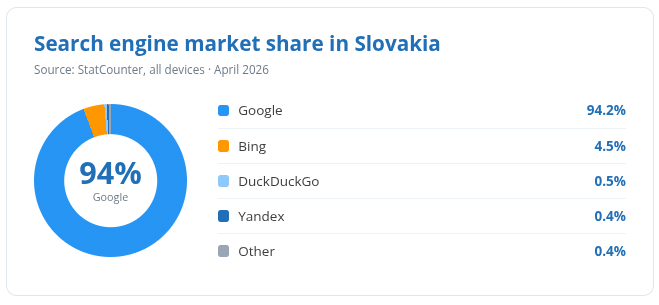
Google holds over 95% of the search market here. Slovaks do not have local search engines like Seznam in the Czech Republic. Therefore, Google Ads in Slovakia effectively covers the country’s entire search demand.
How does contextual advertising in Slovakia differ from the situation in Ukraine?
You won’t be able to simply transfer campaigns from a Ukrainian account “as is.” The Slovak market operates by its own rules, and here are the main differences:
- Language. Local residents search in Slovak. Ads in English get a low CTR and expensive clicks—users simply don’t click on “foreign” text. Direct machine translation also falls short: Slovak and Czech are similar but not interchangeable, and the audience instantly notices the substitution. For high-quality results, you need to localize your ads with the help of native speakers—or at least have the translation edited by a Slovak copywriter.
- GDPR. Slovakia is part of the EU, and strict data protection rules apply here. A website is required to request consent for data processing and properly manage cookies via Consent Mode v2. Without this, Google limits the conversion data it shares, and remarketing is only half as effective. Check your consent banner before launch—otherwise, part of your budget will be wasted.
- Competition and prices. The auction is less competitive in most niches than in Germany or Austria. The cost per click for commercial topics in Slovakia ranges from €0.3 to €4, whereas in German-speaking countries, impressions for the same keywords cost 2–3 times as much.
Incidentally, Slovaks’ purchasing power is higher than that of Ukrainians: the average e-commerce order value is significantly higher, which means that a lead cost of €5–15 often pays for itself with the very first sale.
Which Google Ads formats work best in Slovakia?
Google Ads (formerly AdWords) offers several types of ad formats. The choice depends on what you’re selling and where the customer is in the sales funnel.
Search Ads
Search ads are the foundation for services and B2B. An ad is displayed the moment a person enters a query such as “sťahovanie Bratislava” (moving to Bratislava) or “účtovník Košice” (accountant in Košice). This represents high demand and maximum readiness to buy.
Let’s say a law firm in Bratislava launches a search campaign targeting 40 keywords. After two weeks, it becomes clear that just 8 of those keywords account for 70% of the leads. We pause the rest or lower their bids—this prevents the budget from being wasted.
Product Campaigns and Performance Max
For an online store, the main tools are product ads and PMax. Here’s how it works:
- Create an account in Merchant Center and upload a product feed in Slovak.
- Go through the moderation process (Google checks prices, availability, and shipping and return policies).
- Launch Performance Max—the service will automatically distribute impressions across Search, Google Shopping, YouTube, and Gmail.
Cards with photos and prices in search results yield a higher CTR than text ads, and you only pay per click.
KMS and Remarketing
The Display Network covers Slovak news portals (Sme.sk, Aktuality.sk, Pravda.sk), blogs, and apps. Banners on the Display Network are inexpensive—ranging from €0.05 to €0.15 per click—and are well-suited for brand awareness.
Retargeting reaches those who visited the site but did not submit an order. Experience shows that, on average, a visitor to a Slovak online store returns to make a purchase after 2–3 interactions. Without retargeting, these people will go to competitors.
Setting Up Contextual Advertising in Slovakia: Steps Involved
Properly setting up contextual advertising in Slovakia takes 5–10 business days and consists of two main parts: campaign preparation (keywords, ads, analytics) and precise audience targeting. A mistake at any stage can impact your budget, so let’s break each one down in more detail.
Ad Campaign Preparation
- Niche and competitor analysis. We study Slovak search results: who’s advertising, what offers they’re using, and what they promise in their ads. We check actual bid prices via the Keyword Planner specifically for the “Slovakia” geolocation.
- Semantics. We build a semantic core in Slovak. Here’s an important nuance: locals use diacritics (č, š, ž), but some search queries are entered without them—both versions must be included in the core. Next comes clustering: we group keywords by meaning so we can write a separate ad for each group.
- Negative keywords. We’ll work on negative keywords: “zadarmo” (free), “bazár” (used), “recenzie” (reviews), and dozens of others to filter out irrelevant impressions. Skip this step, and 20–30% of your budget will be wasted on irrelevant clicks.
- Ads and Extensions. Write ad copy in Slovak, include prices in euros, a phone number with the +421 code, and details about delivery within Slovakia. The more specific the offer, the higher the click-through rate and the lower the cost per click in Google Auctions.
- Analytics. Set up order tracking: forms, calls, and purchases. Without this, it’s impossible to tell which ad campaigns are generating revenue and which are simply wasting money.
- Launch and Optimization. The first 2–4 weeks are the most critical. The algorithms are learning, and statistics are being collected. Managing ad campaigns during this period involves daily bid adjustments, refining search queries, and A/B testing.
Important! Don’t pause campaigns during the first few weeks because of “expensive” clicks. Sudden changes disrupt the algorithms’ learning process, and the system has to start the optimization process over. Let the statistics accumulate (this requires at least 30–50 conversions).
Setting Up Targeting
The target audience is segmented here using the same tools as everywhere else, but with local specifics.
In the initial stage, it’s important to set up geotargeting correctly. Bratislava accounts for one-third of the country’s online demand, and clicks are more expensive there. For a local business—such as a dental practice in Žilina—set a radius of 15–20 km around the city. For e-commerce with delivery throughout Slovakia, target the entire country, but adjust bids by region: the west has higher purchasing power than the east.
Set language targeting to Slovak + English + Czech. Why? The language setting in Google Ads determines the user interface language, not the search query language. Many Slovaks keep their browsers set to English—by limiting your targeting to Slovak alone, you’ll lose up to 30% of your reach.
A separate audience consists of Ukrainian expats (more than 100,000 of them). If your product is a good fit for them, launch a separate campaign in Ukrainian or Russian. Competition there is minimal, and clicks are significantly cheaper.
The Cost of Contextual Advertising in Slovakia
The total cost of contextual advertising in Slovakia consists of two parts: the marketing budget (which you pay to Google) and fees for specialists’ services.
Advertising Budget and CPC
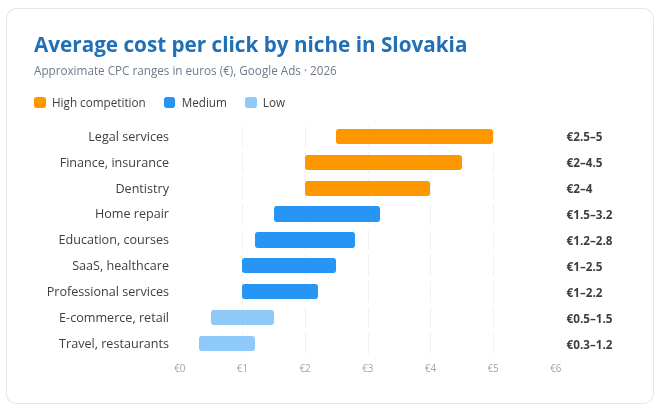
The cost per click in Slovakia depends on the topic. Approximate ranges based on auction data:
- law, insurance, finance — €3–12 per click;
- e-commerce and commercial services — €0.8–4;
- local services, informational topics — €0.3–2;
- banners in KMS — €0.05–0.15.
The minimum advertising budget for testing a niche is €300–500 per month. This is enough for 150–400 clicks and initial conclusions about return on investment. For an online store with a wide product range, budget €800–1,000: PMax requires data for training.
Let’s look at an example. A children’s goods store with an average CPC of €0.9 and a 2% conversion rate. A budget of €900 per month = 1,000 clicks = ~20 orders. The cost per order is €45. With an average order value of €80–120 and repeat purchases, the numbers add up.
Cost of Setting Up Google Ads
The initial cost of setting up contextual advertising for Slovakia through agencies starts at €300–400 per project for a single service area. Setup for an online store with a product feed, Merchant Center, and PMax will cost €500–900—there’s objectively more work involved.
Management fees are paid monthly: from €200–350 or a percentage of the budget (usually 10–15%) for large projects. Management includes bid optimization, ad testing, reporting, and scaling what works.
Honestly, trying to save money on setup is a bad idea. The difference between a “€100 freelancer campaign” and professional setup becomes apparent quickly: in the first case, the budget is wasted on irrelevant traffic; in the second, every euro is maximized.
Common Mistakes When Launching Ads in Slovakia
When reviewing new clients’ accounts, we see the same mistakes over and over:
- machine-translated ads that haven’t been proofread by a native speaker—click-through rates drop by 1.5–2 times;
- copying Ukrainian terminology via a translator instead of gathering Slovak search queries;
- not using Consent Mode—Google loses up to 30% of conversion data, and optimization stalls;
- prices on the website listed in hryvnias or dollars instead of euros (yes, this happens);
- a single generic landing page in English for “all of Europe”;
- Pausing campaigns after just a couple of days “because there are no sales”—before the algorithm has had a chance to learn.
Each of these mistakes individually reduces ROI by tens of percent. Together, they can bury even a promising project.
Why should you order contextual advertising in Slovakia through an agency?
Launching an ad campaign on your own isn’t technically difficult—the Google Ads interface is accessible to everyone. The question is the result. A contextual advertising agency in Slovakia provides what’s hard to achieve when launching a campaign on your own:
- Knowledge of the local market: actual bid rates by niche, local audience behavior, and seasonal demand patterns.
- Collaboration with native speakers for ad copy and landing pages.
- Proper configuration of GDPR tools—Consent Mode, cookie consent, and server-side analytics.
- Experience across dozens of projects: hypotheses that have already been tested using other people’s budgets, not yours.
- Transparent reporting: how much was spent, how many orders were generated, and the cost per conversion.
Before ordering contextual advertising in Slovakia, ask your contractor three questions: Do you have case studies specifically for EU markets? Who will write the Slovak copy? And how is conversion tracking set up to comply with GDPR? Clear answers to all three are a good sign.
Frequently Asked Questions
-
Search campaigns generate their first clicks on the day they launch, and leads typically come in within the first 7 days. Google display ads in Slovakia reach stable performance metrics within a month or a month and a half, once enough data has been collected and the algorithms have been trained.
-
Technically, yes; practically, we don’t recommend it. The conversion rate for an English-language site among the Slovak audience is 2–3 times lower. At the very least, translate the landing page where the traffic is directed.
-
Yes. Search campaigns targeting niche commercial keywords, combined with remarketing, are a proven strategy for B2B. There are fewer leads than in retail, but they’re more valuable: a single contract often pays for months of advertising.
-
No. Google Ads display campaigns in Slovakia can be launched from any account—Ukrainian, Polish, or any other. All you need to do is set the geotargeting to Slovakia. But keep the GDPR in mind: your website must comply with EU requirements regardless of where your business is registered.