The German market is a prime target. It boasts high purchasing power, a culture of online payments, and millions of people who search for products and services every day. But at the same time, there are strict rules and fierce competition in Google’s contextual advertising in Germany.
If you already have a basic understanding of how Google Ads works, this article will help you understand what to expect from the German market and what factors contribute to your results. No fluff and no explanations like “what are keywords?”
Key Considerations for Setting Up Contextual Advertising in Germany
Let’s start with the basics. Contextual advertising in Germany isn’t the same campaign you’d run in Ukraine or other post-Soviet markets, simply translated into German. Almost everything is different: user behavior, average order value, trust in advertising, language, and, of course, budget. Next, we’ll break down what influences the results and where budgets are most often wasted.
High CPC and a competitive auction
The market’s key financial characteristic. The cost per click here is significantly higher than in the post-Soviet region. In competitive niches—such as legal services, insurance, and B2B software—CPC can easily reach €4–8 per click or more. In less competitive sectors, such as local services, it’s realistic to stay in the range of €0.5–1.5.
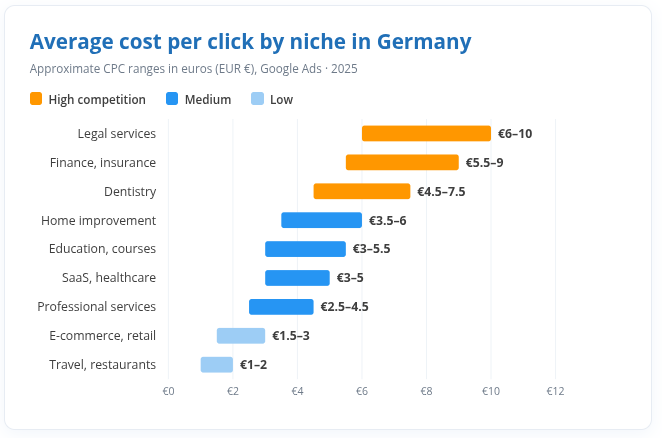
Why is it so expensive? It all comes down to the auction. The more advertisers compete for a keyword, the higher the bids go. And there are a lot of advertisers in Germany, many of whom have substantial budgets.
Let’s say you sell custom-made kitchens in Frankfurt. For the search term “Küche nach Maß,” you’re competing against dozens of local manufacturers as well as large chains. Everyone is willing to pay extra for the top spot—and that’s why the cost per click keeps climbing. At this point, it’s not enough to simply “set up ads”: you need to skillfully manage bids, relevance, and campaign structure, or your budget will be wasted.
Long transaction cycle
German shoppers are cautious. They compare products, read reviews, and verify company details; they rarely make a purchase on the first try. Impulse buys are less common than what we’re used to seeing in other markets.
On the other hand, once they’ve made up their minds, they pay on time and rarely return items without a valid reason. For advertisers, this means one thing: the path from click to lead is longer, but the resulting customer is of higher quality. It also explains why remarketing is so important—you need to “catch up” with the person and gradually build interest, rather than expecting a sale on the first visit.
Fierce competition
Germany is one of Europe’s largest advertising markets. This means two things. First, almost every niche already has established brands with a history and the trust of their audience. Second, these brands have been running ads for a long time and know what they’re doing.
You can’t just muscle your way in here. Newcomers have to compete not on budget, but on website quality, loading speed, reviews, and transparent pricing. Google takes all of this into account. A weak website with a big budget will lose out to a strong website with a modest one—that’s just how the market works.
German
Language is a whole other challenge. It seems like all you need to do is translate the ads, and you’re good to go. In reality, that’s not the case.
- Germans formulate search queries differently, often using long compound words (such as the seemingly endless “Kinderfahrradhelm” instead of three separate words).
- There’s a difference between the formal “Sie” and the informal “du”—and it depends on the context. Get the tone wrong, and you’ll lose credibility.
- Regional differences and borrowings from English also play a role: in some places, people search for “Handy” rather than “Smartphone.”
Machine translation can’t capture all of this. That’s why the semantics are reworked for German, and the texts are written by a native speaker or an expert with a solid command of German. Awkward phrasing has a double negative effect: it undermines trust and lowers the ad’s quality score.
Quality is more important than the budget
And here’s the conclusion that ties all of the above together: in Germany, it’s not the highest bidder who wins, but the advertiser with the highest ad quality score. Well-crafted keywords, relevant ad copy, and a high-quality website allow you to pay less per click than your competitors while still ranking higher than them. This is the part of the process that’s often underestimated.
In practice, it works like this: two advertisers appear for the same search query, but one pays €6 per click and ranks second, while the other pays €3.50 and ranks first. The difference isn’t in their budgets, but in how well their campaigns are optimized. In a market with high CPC, this is what makes the difference.
General Data Protection Regulation and German Federal Data Protection Act
But this is the biggest pitfall for those entering the market without any experience. In Germany, you can’t just set up Google Analytics and collect data however you like. The GDPR (known as the DSGVO in Germany) is in effect, and violations are subject to hefty fines.
What does this mean in practice:
- The website is required to display a proper cookie consent banner—not a “accept all” option, but one that offers users a real choice.
- Analytics and remarketing tags should only be triggered after a person has given their consent.
- You need to have Google’s Consent Mode set up; otherwise, some conversions simply won’t be tracked, and data will be collected incorrectly.
It may sound like a minor detail, but this is exactly where many people lose money. If the cookie banner is set up incorrectly, Google Ads doesn’t receive conversion data, the algorithms “go blind,” and automated strategies stop working. The campaign keeps running, the budget gets spent, and there’s nothing left to optimize the system with.
By the way, setting up consent properly isn’t just about compliance with the law. It’s about ensuring that your Google display ads in Germany can learn and improve on their own. Without clean data, any smart algorithm is useless.
Important: Running ads on a German website without a proper GDPR consent banner poses both a legal risk and a direct loss of data for optimization purposes. You should address this issue before investing a single euro in traffic.
Which types of Google Ads perform best in Germany?
Google Ads in Germany isn’t just about traditional search ads. A single account offers a whole suite of tools, and different formats are needed for different objectives.
- Search advertising. The foundation for most businesses. When someone enters a search query, they see your ad. It targets “hot” demand—when the customer already knows what they want. It works best for services and complex B2B products.
- DMA (Display Network). This includes banners and display ads on millions of Google partner sites, in Gmail, and in apps. It’s used for reach, brand awareness, and—most importantly—remarketing. Remember that cautious German buyer who doesn’t buy right away? That’s exactly who they target through the CMP.
- Google Shopping. Product ads featuring an image, price, and name right in the search results. Indispensable for online stores: users see the product before they even click, which means you attract more qualified traffic. For e-commerce in Germany, this is often the go-to tool.
- Performance Max (PMax). A hybrid campaign that automatically distributes impressions across all Google channels—Search, Display, Google Shopping, YouTube, and Maps. The PMax algorithm operates based on campaign goals and conversion data. It’s a powerful tool, but a finicky one: without clear analytics and a well-structured product feed, it can drain your budget on irrelevant impressions.
- Google Demand Gen. A relatively new format for generating demand on YouTube, Discover, and Gmail. It’s great for “warming up” an audience that isn’t yet actively searching for your product. It’s especially useful for visual niches—fashion, design, and home goods.
- Retargeting. It’s not a separate universe, but rather a layer on top of everything else. It brings back visitors who have already been to the site but didn’t submit a request. In the German market, with its long decision-making cycle, retargeting often delivers the best return on investment of all channels.
Which set of campaigns to choose depends on your niche. An online store almost always needs product campaigns and PMax. A service company needs search plus remarketing. B2B requires search, a well-targeted CMC, and a well-structured long sales funnel. There’s no one-size-fits-all solution, and that’s okay.
How do we set up Google Ads for Germany?
Now, let’s talk about the process. Setting up contextual advertising in Germany isn’t just a matter of “creating a dozen ads in an evening.” It’s a series of steps, each of which affects the final cost per click.
Here’s how we usually proceed:
- Brief and niche analysis. We examine the product, competitors in German search results, and average bid prices for the topic. Even at this stage, it becomes clear whether we can stay within the advertising budget.
- Compiling a semantic core. We select keywords in German—we specifically select them, rather than translating them. A direct translation is almost always off the mark: Germans phrase their search queries differently.
- Refining negative keywords. We filter out junk traffic—free listings, job postings, and irrelevant regions. A well-curated list of negative keywords can save up to 20–30% of your budget right from the start.
- Creating ads. The copy is written by a native speaker or a professional with a strong command of German, not by a machine translation service. This is very important: clumsy wording undermines trust and lowers the quality score.
- Setting up conversion tracking. We set up goals, events, and e-commerce tracking—all while taking cookie consent into account. Without this, there’s no way to measure leads and ROI.
- Launch and testing period. We’ll be collecting data for the first 2–4 weeks. The algorithms need to “build up” statistics before the strategies can operate at full capacity.
And then comes what sets active advertising apart from neglected advertising: managing ad campaigns. It’s an ongoing process: adjusting bids, pausing underperforming keywords, testing headlines, filtering traffic, and finding new audiences. Google Ads in Germany isn’t a “set it and forget it” kind of thing—the market and the auction change every week.
What factors determine the cost of contextual advertising in Germany?
The total cost of contextual advertising in Germany typically consists of three parts: a one-time setup fee, a monthly management fee, and the advertising budget itself, which goes directly to Google.
The cost of setting up contextual advertising in Germany starts at around €250–400 for a simple project and can reach €1,000–1,500 or more for an online store with a large product catalog, a Merchant Center feed, and complex analytics. The logic is simple: the more products, campaigns, and tracking points there are, the more expensive the initial work will be.
Bookkeeping is generally considered to be one of two methods:
- Fixed rate—for example, starting at €300 per month for a small account.
- A percentage of the advertising budget—usually 10–15%—which is convenient for large expenditures.
And then there’s the budget itself. The range here is huge. A local service might get by on €500–800 per month, while a competitive online store needs €2,000–3,000 or more just to “warm up” the algorithms. Below a certain threshold, Google simply doesn’t have enough time to collect data for optimization, and the return on investment doesn’t reach a normal level.
Important: A cheap setup often results in costly traffic. By saving €200 on a specialist, you can easily lose many times that amount on irrelevant clicks within the first few months. In the German market, with its high CPC, the cost of a mistake is higher than anywhere else.
A few words about payment. In Germany, local payment methods are typically used for transactions with Google Ads: SEPA transfers, PayPal (probably the most popular option), and Sofortüberweisung for instant payments. If you already have a German legal entity or bank account, there won’t be any issues with payment. If not, this can also be resolved, and the agency usually suggests a workable solution.
Why should you hire an agency to set up contextual advertising in Germany?
Can you run ads on your own? Technically, yes. Google doesn’t prohibit it. But there’s a huge gap between “running ads” and “getting a steady stream of leads at a reasonable price,” and in Germany, that gap is particularly wide.
An experienced contextual advertising agency in Germany addresses several common pitfalls that beginners often encounter:
- Knowledge of the local market and actual rates—you won’t end up overpaying at the outset due to a lack of information.
- Compliance with the GDPR and cookie consent—without legal risks or data loss.
- German texts written by native speakers, not machine translations, which tend to turn readers off.
- Continuous optimization and management—the campaign doesn’t “stagnate” after a month, and the quality of traffic improves over time.
- Transparent reporting: You can see how much each order costs and how the return on investment changes.
To be honest, the real value isn’t even in the technical know-how. It’s in the fact that a PPC specialist has already made all the common mistakes on other people’s budgets and won’t repeat them on yours. This saves you money, stress, and months of testing.
And one more thing. When you decide to order PPC advertising in Germany, don’t focus on empty promises like “leads starting at €1,” but on the specifics: will they ask you about your target audience, your profit margins, and your website’s conversion rate? If the conversation starts with these questions rather than the price—you’ve found people who really know how to work with PPC in the German market.
Important: Don’t ask the agency for case studies “in general”; instead, ask for case studies specific to Germany and your niche. The German market is unique, and marketing experience from other countries doesn’t necessarily translate directly to it.