When a business decides to order PPC advertising, it usually wants answers to three questions. What exactly am I buying for this money? How much will I have to pay in the first month—both to the agency and to Google? And how can I tell that the contractor is actually working, rather than just reporting back with vague phrases?
We will answer in order, without introductory lectures about what Google Ads is. ADWService has been working with Google Ads since 2014, holds Google Premier Partner 2026 status (top 3% of agencies worldwide), and manages 316 active e-commerce accounts across 10+ markets. If you want to start with facts about your account rather than our text, run a free automatic audit: it will reveal your account’s problems even without talking to us.
What will you get if you order PPC advertising setup from us?
We do not sell a “set of ad campaigns,” but an account architecture where each campaign plays its role in training the algorithms. The difference is fundamental: a set of campaigns can be launched in a day, and it will spend the budget exactly as the system decides. Architecture sets rules for the algorithms—which products to scale, which to hold back, and where to gather signals for learning.
Our main format is the Google Ads Architecture Sprint: a month of intensive work on the account structure, $1,200 for a catalog of up to approximately 7,000 SKUs. This includes:
- Performance Max with Bucket architecture—donor and core campaigns instead of one universal campaign;
- Google Shopping with a category structure tailored to the specific catalog;
- Search campaigns—branded, non-branded, and category keywords separated into different campaigns;
- Demand Gen—remarketing and expanded audiences as an amplifier for shopping campaigns;
- YouTube campaigns tailored to a specific stage of the sales funnel;
- Merchant Center Next—product feed audit and basic setup;
- GA4 and conversions—verifying that the correct tags and order values are transmitted to the system;
- weekly optimization—budget reallocation and restructuring based on accumulated signals;
- final report—what to scale next, what to turn off.
If you don’t need a full sprint yet, you can order PPC advertising setup as separate services: account audit, launching shopping ads and PMax, Merchant Center unblocking, video advertising, or a one-time consultation.
What is included in the service when ordering PPC advertising?
The work is divided into two blocks, and they shouldn’t be confused: setup is a one-time foundation, while management is the regular work that determines whether the foundation will bring in money six months down the line.
Ad campaign setup (what we do before launch)
- Website audit and readiness for traffic. Loading speed, presence of forms and a phone number, a clear call to action. There is no point in driving paid traffic to a page that doesn’t convert it.
- Keyword core and negative phrases. Keywords that users are actually searching for, plus a list of exclusions—”free,” “used,” “reviews,” if they do not lead to a purchase.
- Ad copy and extensions. A minimum of 2–3 variations per group for testing, callouts, prices, sitelinks, and locations.
- Product feed and Merchant Center—for online stores. Without a proper feed, you can’t launch Google Shopping or PMax, and half of all problems with shopping campaigns start right here.
- Bidding strategy tailored to a specific goal—clicks, leads, or conversion value. The choice depends on how much data has already been accumulated in the account.
- Analytics: GA4, conversions, tag verification. This is the most underrated point. The algorithm evaluates two things—whether a conversion occurred and how much it cost. If the tags are transmitted incorrectly, you are paying to train the system on distorted numbers.
PPC advertising management (what we do every month)
- keyword analysis and expanding the negative keyword list;
- budget reallocation in favor of ad combinations and product segments that generate cheaper sales;
- testing ads, creatives, and feed structure;
- monitoring Merchant Center for warnings, limitations, and the risk of suspension;
- monthly reporting with figures on spend, cost per lead, and ROAS—not just “everything is fine, keep working.”
Management is what people skimp on most often, and it is a costly corner to cut. A campaign without optimization doesn’t just stagnate; it degrades: competitors raise bids, ads experience ad fatigue, irrelevant search terms pile up, and the feed becomes outdated along with the inventory. After two or three months, the cost per lead increases noticeably—even though no one changed anything in the account.
Which Google Ads formats should you order for each goal?
Ordering “everything at once” is a quick way to spread your budget too thin. Below is what works for which goal.
| Campaign type | Who it’s for | What goal it solves | What is needed to launch |
|---|---|---|---|
| Search | Services, B2B, stores for category queries | Captures established demand: the person is already looking for a specific product | Semantics, negative phrases, landing pages |
| Google Shopping | Online stores | Shows the photo, price, and store name before the click—people who are satisfied with the price will click through | Product feed, Google Merchant Center, passing moderation |
| PMax | Stores with accumulated statistics | Scales sales instantly across Search, GDN, YouTube, Gmail, and Maps | Feed, correct conversions, accumulated data—it’s best not to launch on an empty account |
| Remarketing and Demand Gen | Anyone with website traffic | Brings back those who viewed a product but didn’t buy | Collected audiences, tags, creatives |
| GDN / Display advertising | Brands, products with a long buying cycle | Reach and brand awareness with cheap clicks; the audience is cold, so don’t expect quick sales | Banners, groundwork for targeting and placements |
| Video advertising on YouTube | Stores and brands that have something to show | Warming up demand and supporting shopping campaigns | Videos tailored to the specific stage of the sales funnel |
| Local campaigns | Businesses with a physical location | Drives people to a store, salon, or service center | Completed business profile, targeting radius |
These formats do not work in isolation, but in combinations, so it’s wiser to order Google Ads for a specific goal rather than as an “enable everything for us” package. For an online store, the working foundation is shopping ads plus PMax for profitable catalog segments, search campaigns for brand and categories, with remarketing and Demand Gen layered on top. For services, everything starts with a search campaign for “hot” queries, and remarketing is connected as a second step once the audience is built up.
How much does it cost to order PPC advertising for a website?
A price of “from 9,000 UAH” in an agency’s price list is usually the payment for the specialists’ work. The money for clicks goes separately to Google. Two amounts, two recipients.
Cost of ADWService’s services
| Service | Price |
|---|---|
| Automatic audit | Free |
| Google Ads audit | from $270 |
| Merchant Center unblocking | from $190 |
| Consultation with Yana Liashenko | $250 / hour |
| Google Shopping + PMax | from $850 |
| Video advertising on YouTube | from $800 |
| Google Ads Architecture Sprint | $1,200 / month |
| Demand Gen | from $200 |
| Advertising targeting the US, UK, EU | customized |
How much should be allocated for the ad budget?
It depends on the niche and competition: the cost per click in the flower delivery niche versus legal services differs significantly. Baselines for starting out:
- from $500 per month—the minimum for algorithms to gather signals. Smaller amounts do not allow the system to learn, and any conclusions about the channel’s effectiveness will be flawed;
- from $1,500–2,000 per month—for serious scaling.
Check before signing the contract: is the advertising budget included in the cost of services? In standard practice, you pay it directly to Google from a card or account, and pay the agency separately for their work. The “transfer everything to us, we’ll figure it out” scheme lacks transparency—you can’t see what actually went toward clicks and how much stayed with the contractor.
When should you avoid ordering Google Ads PPC advertising?
A failed campaign launch costs more than not launching at all—you lose not only money but also faith in the advertising channel itself. Ordering PPC advertising for a website that is not ready to receive paid traffic is the fastest way to become disappointed in the tool.
Do not order Google Ads right now if:
- Your budget is below the algorithm learning threshold. At less than $500 a month, the system won’t gather enough data, and you will get noise rather than results, making it impossible to make informed decisions.
- The website is not ready for visitors. Slow loading times, forms with ten fields, no phone number in the header, prices noticeably higher than the market. Ads will bring people in—but the website has to do the selling, and here we are powerless.
- There is no search demand in your niche. If no one is searching for your product, a search campaign will reveal this in the very first week. Such tasks are solved by Demand Gen, video advertising, and social media—which are different tools with different logic.
- There is no one to process the leads. An order that is followed up on two days later is a paid click gifted to a competitor.
In these cases, we offer: a free automatic audit to establish your current baseline, a consultation to analyze the situation, or a delayed launch after the website has been improved. Sometimes the most useful outcome of contacting us is the realization that your money shouldn’t be invested in advertising right now.
You have ordered Google Ads advertising: what’s next?
Working with us proceeds as follows:
- Request or free audit. You can start with the form on the website or run the automatic AI audit—it will highlight the main flaws for a more substantial conversation with a PPC specialist.
- Call. We always ask about profit margins, average order value, sales geography, and the sales cycle. If a contractor quotes a “turnkey” price without asking a single question about your business, a cookie-cutter setup awaits you.
- Architecture audit and media plan. We prepare an account analysis within 48 hours. The media plan includes the recommended budget, CPC forecast, and a baseline for the number of conversions. All this happens before signing the contract, not after.
- Contract and access. Google Ads, Analytics, and Merchant Center accounts are created under your email, and we gain access to them as a contractor. This is not a mere formality, but protection for your investments.
- Days 1–10: audit and launch. Checking the website, analytics, and Merchant Center. Developing the initial testing structure. Launching donor and core campaigns.
- Weeks 1–2: optimization. Testing formats, overhauling the structure based on the initial signals, and reallocating resources toward profitable directions.
- Days 14–30 and beyond: scaling. We reinforce working combinations, and test new audiences and buckets. In the end—a report answering two questions: what to scale and what to turn off.
What we will need from you: access to your website and analytics systems, an export or access to your product catalog, information on margins and priority categories, and a single point of contact on your side who can quickly approve decisions.
When should you expect the first leads from PPC advertising?

We answer honestly, because the promise of “clients within the first few hours after launch” is the most common falsehood in our niche.
- Launch day—the first clicks and website visits. Just traffic, no leads yet.
- 3–7 days—the first inquiries from search campaigns targeting hot keywords. Shopping campaigns start slower: time is needed for feed moderation.
- 2–4 weeks—the learning period for bidding strategies and filtering search queries. The cost per lead fluctuates during this time, and that is normal: the system is testing hypotheses, while we narrow its corridor.
- 1–2 months—reaching stable metrics. Performance Max requires accumulated conversions, so conclusions on it are drawn later than for search.
It is impossible to guarantee an exact number of orders in an auction. We provide a forecast in the media plan and take responsibility for meeting it within the agreed corridor—this is fundamentally different from stating “we guarantee 50 leads.”
What to do if traffic is coming in, but there are no orders after two weeks. Most likely, the problem is not with the campaigns. Check step by step:
- whether conversions are reaching analytics (a frequent situation—ads are running, but tracking is broken);
- whether your prices align with the market;
- how many steps it takes to place an order and whether the product is in stock;
- how quickly inquiries are processed.
What Google Ads reporting do we provide?
The phrase “we provide transparent reporting” can be found on every agency’s website. You can only verify it through concrete numbers. Here are the metrics that must be included in a monthly report.
| Metric | What it shows | What to look for |
|---|---|---|
| Spend | How much went to Google during the period | Must match the billing in your account |
| Cost per click (CPC) | Average cost of a website visit | An increase while CTR remains stable usually means heightened competition in the auction |
| Conversions | Number of target actions | Check what is counted as a conversion: a lead and a contact page view are two different things |
| Cost per acquisition (CPA) | How much a single inquiry costs | The key metric for services and B2B |
| ROAS | How much revenue is generated per dollar invested | The key metric for an online store |
| Impression share | What portion of available impressions you capture | A low share coupled with good ROAS is a direct signal that there is room to scale |
| Spend on irrelevant queries | How much money went to the wrong place | Shows whether negative keywords are actually being worked on |
Important! What a report should NOT contain: just clicks, impressions, and CTR alone. These figures look great as they grow but say nothing about money. Another sign of a superficial approach is a report lacking any conclusions or proposals for the following month.
A one-minute check available to any account owner. Go to your ad account and open the change history. It shows who logged into the account, when, and what they changed. If the history is empty for a paid month of management—you are paying for thin air, and no report can cover that up.
Who should you order Google Ads setup from?
There are three formats available on the market, and none of them is the right one by default.
| Freelancer | Agency | In-house specialist | |
|---|---|---|---|
| Cost | The lowest | Higher than a freelancer, lower than a full-time employee | Salary, taxes, training, tool subscriptions |
| Launch speed | Fast | Fast | Slow: searching and onboarding take months |
| Depth of expertise | Limited to one person’s experience | Multiple specialists, accumulated data across dozens of accounts | Limited to one person’s experience |
| Main risk | Might disappear, get sick, or leave for another project | Might manage things on an “assembly line” basis if the project is too small for the agency | Burnout and falling behind platform updates |
| When optimal | Single channel, small budget, straightforward niche | Shopping campaigns, multiple markets, growing budget | Large constant volume and in-house expertise |
A good freelancer is better than a bad agency—that’s true. But as investments grow and tasks become more complex (feeds, Merchant Center, multiple markets, CRM integration), a single person hits a ceiling of time, not qualification.
Seven red flags when choosing a contractor
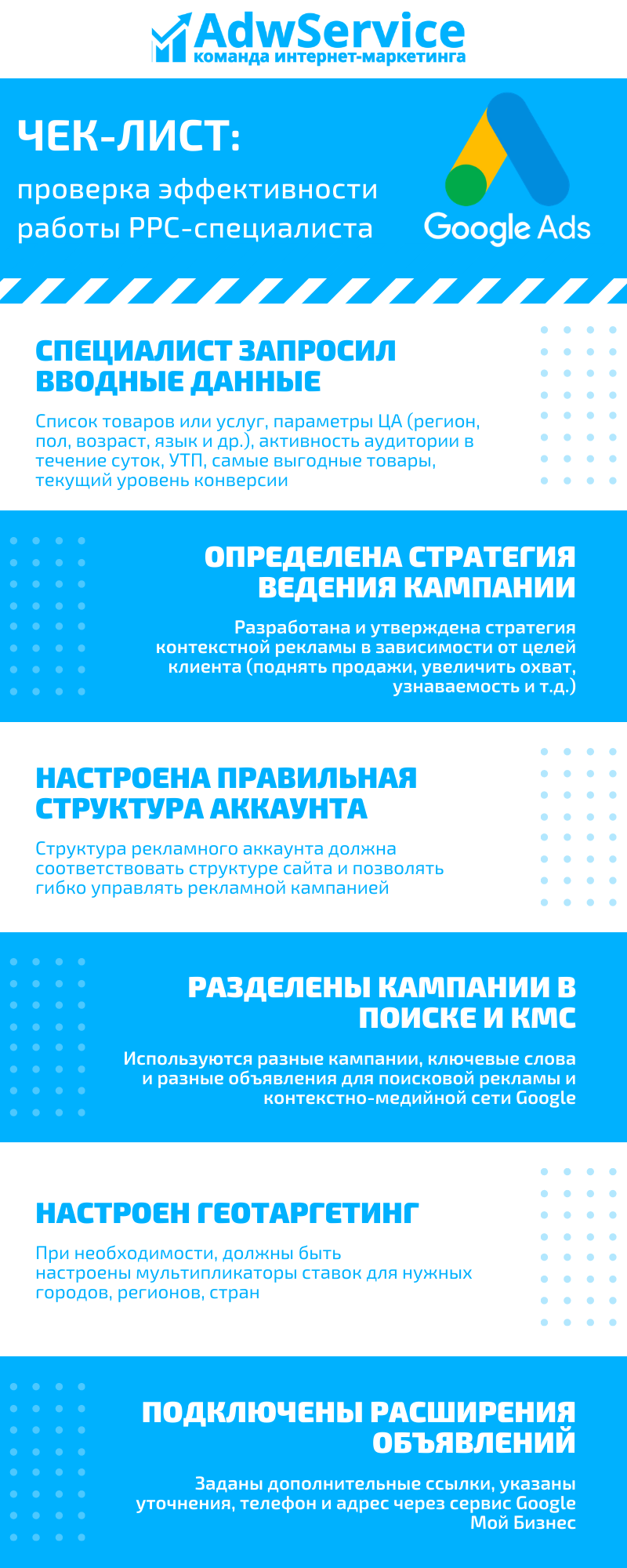
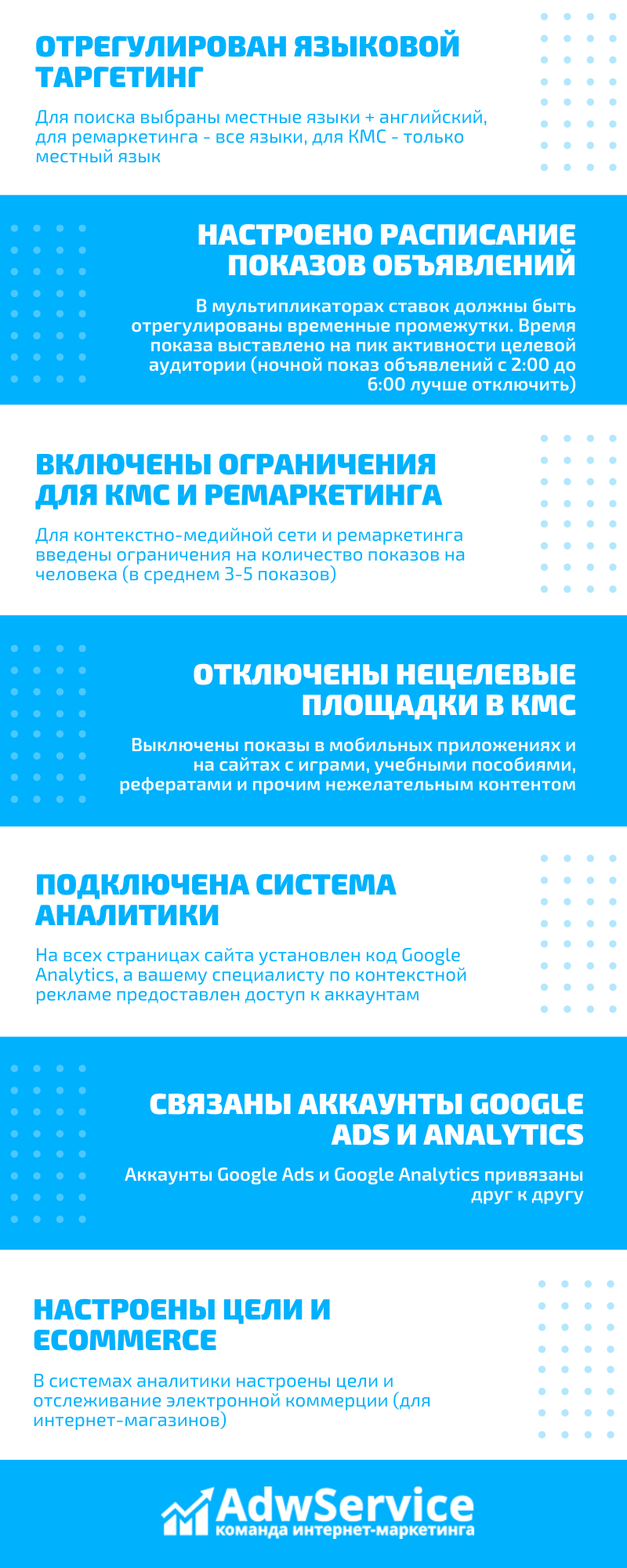
- Guaranteeing a specific number of leads or “first place in search results.” Google Ads is an auction, and ad position depends on the website’s quality, among other things. Promising exact results here is impossible.
- Refusal to grant access to the ad account. This is non-negotiable.
- Proposing to run the advertising budget through the agency’s account without detailing the spend. You stop seeing how much actually went to clicks.
- A “turnkey” price without asking a single question about your business. Without knowing your margins, average order value, and sales cycle, you can’t even choose a bidding strategy.
- Case studies featuring only CTR and click screenshots. Ask for business metrics: cost per lead, ROAS, revenue.
- Claiming massive turnover without a partner status. A Google Partner status verifies both the specialists’ qualifications and the actual turnover in managed accounts. This can be checked in the official partner directory—where you can verify us as well.
- An empty change history in the account during paid management. The most objective sign of all.
You should check us against this list as well—all verifications are gathered in the next section.
Why do people order PPC advertising from ADWService?
We are not a full-service agency. We have been handling Google Ads for e-commerce since 2014, and all our expertise is centered around shopping campaigns: feeds, margins, seasonality, and demand structure by SKU.
Here is why we are trusted:
- Narrow specialization instead of “a bit of everything.” Performance Max and Google Shopping aren’t just “another campaign type” on our price list; they are our main product. Where most contractors encounter problems—the product feed, Merchant Center restrictions, and suspensions—is exactly where our work begins. Over 300 online stores have resumed showing ads after we unblocked them.
- Proprietary methodology, not just a retelling of official documentation. ADW Bucket Architecture™ is developed by Yana Liashenko, founder of ADWService. It is based on the understanding that Performance Max is not a “black box,” but a model with four layers of learning: conversion tracking, Google’s global pre-training, local account setup, and dividing the task into product segments. In practice, this means the algorithm learns to scale profitable items rather than spending funds evenly.
- Data-driven decisions, not hunches. We publish our own market research based on datasets of over 2.24 million rows—covering the cannibalization of search campaigns by Performance Max, product duplication between PMax campaigns, and why the metric of “50+ conversions per month” is misleading. These insights are applied in client accounts before they ever make it to our blog.
- Transparency as a core principle. We explain what we are doing, why, and what effect we expect—on a YouTube channel with over 34,000 subscribers and more than 1,400 videos about Google Ads, and a Telegram channel with over 3,500 readers. Around 70% of our clients come to us through referrals.
How this is backed up:
- Google Premier Partner 2026—top 3% of agencies in the world, status officially confirmed;
- 20th place among 494 digital companies in Ukraine in the Ringostat 2025 ranking (judged by 42 experts);
- A 5.0 rating on Clutch based on 14 verified reviews—quality, deadlines, and cost all received top marks;
- 316 active e-commerce accounts under management across 10+ markets: Ukraine, the US, the UK, the EU, Australia, and Canada;
- Over $84 million in conversion value generated for clients in a year, with an average portfolio ROAS of 7.5x.
The figures for accounts and turnover are taken from our MCC for 2025; screenshots are available upon request.
-
Technically yes, we do offer such services. But an ad campaign without optimization doesn’t stay idle: competitors raise bids, ads experience ad fatigue, irrelevant search terms pile up, and the feed diverges from actual inventory. After two or three months, the cost per inquiry rises significantly, despite no one touching the account.
-
The audit, analytics setup, and launch of the first campaigns are completed within the first 10 days of the sprint. Search campaigns launch faster than shopping ones: the latter need time for feed preparation and passing moderation.
-
No. We manage projects throughout Ukraine, as well as for clients selling in the US, the UK, the EU, Canada, and Australia—we have a dedicated division for international markets with specific expertise for each region.
-
Start with a free automatic audit—it will quickly uncover the main problems. Based on its results, it will become clear whether to fix the existing account or rebuild the architecture. A situation where “ads sort of work” is the most common among our clients at the start.
-
These are tools with different mechanics, not competitors. Ads provide traffic immediately but only work as long as impressions are running. SEO takes a long time to gain momentum, but it eventually brings in clients without costing you per click. For most projects, a combination works best: PPC for quick sales, alongside SEO for the long haul.