
Contextual advertising in the Czech Republic works in the usual way: a user enters a search query into Google, sees ads above the organic search results, clicks through to the website, and you pay per click.
But the Czech market has its own unique characteristics, which is why a campaign designed “as if for a neighboring country” almost always blows the budget. Those who enter the Czech market with ready-made templates often stumble over these characteristics. Let’s start with them.
Key Considerations for Setting Up Contextual Advertising in the Czech Republic
This is where things get interesting. When launching Google Ads campaigns in the Czech Republic, you need to take local factors into account—factors that are easy to overlook if you rely on your usual approach.
Search engines
Google has long been the market leader in the Czech Republic and accounts for the majority of search traffic. But not all of it. The local search engine Seznam.cz, with its Sklik advertising system, still holds a significant share of the audience—especially among older users and in smaller towns.
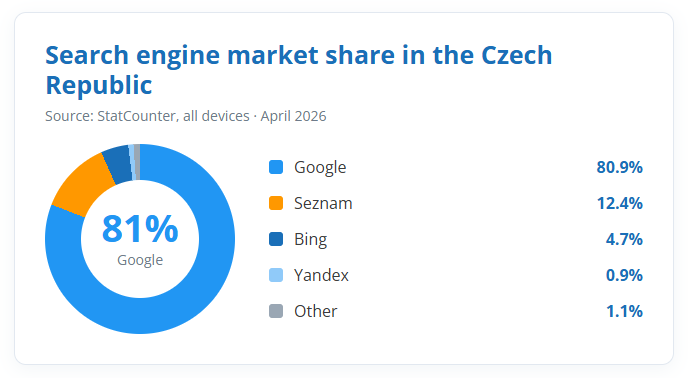
When it comes to achieving full coverage of the Czech market, it makes sense to run parallel campaigns on Sklik as well. But with a limited budget, it’s best to start with Google—and that’s the right approach.
Language
Ads must be in Czech—and in natural, well-written Czech, not machine translation. Czechs can instantly spot poorly written text and will simply skip over it.
We’ve seen campaigns where ads were translated by machine translation “to save money”—the conversion rate was practically zero. A native speaker or an editor to proofread the texts isn’t a luxury—it’s a necessity.
Currency and Mindset
Google Ads accounts are typically managed in CZK (Czech koruna), and less commonly in euros. And the audience thinks in korunas. If prices on a website are listed in euros or, even worse, in another obscure currency, trust plummets. People want to see the familiar korunas.
A real-world example. An online home goods store launched in the Czech Republic with a pre-built website where everything was in Slovak and priced in euros. Traffic was coming in, but there were almost no orders. They translated the site into Czech, set prices in korunas, and rewrote the ad copy—with the same campaign budget, conversions increased significantly. It’s not about the advertising itself, but the little details that local users notice in a split second.
GDPR and cookie consent
The Czech Republic is a member of the EU, which means that the GDPR—the European General Data Protection Regulation—applies there. For the advertising industry, this isn’t just abstract red tape, but very specific requirements.
The most important thing for you to know is that your website must display a proper cookie consent banner—that pop-up window asking for consent to collect data. Without the user’s consent, you are not allowed to set advertising or analytics cookies. And without them, remarketing and conversion tracking simply won’t work properly.
It may sound like a contradiction, but it can be resolved by properly configuring Consent Mode in Google Ads and Analytics. This is a technical task, and it’s best to entrust it to those who understand how to align legal requirements with advertising tools.
Important: Running ads on a website without cookie consent enabled not only puts you at risk of a GDPR fine, but also results in incomplete, “inaccurate” data. Google doesn’t receive conversion data, and you don’t get an accurate picture of your return on investment.
Which Google Ads campaigns perform best in the Czech Republic?
Many people think of Google’s contextual advertising in the Czech Republic as simply text ads in search results. In reality, there are more tools available, and different formats are suited to different objectives—from targeting trending searches to automated campaigns that automatically allocate budgets across platforms.
- Search campaigns—for high demand. This is the best option when people are already looking for a specific product or service.
- Display Network campaigns—banners and teasers on partner websites. These work well when demand is still low and needs to be generated.
- Retargeting involves showing ads to people who have already visited your website but didn’t make a purchase. A customer looked at a kitchen, left to think it over—and you remind them of your business on other websites. It’s one of the most cost-effective formats.
- Google Shopping — this campaign is a must for online stores: product listings with photos and prices appear directly in the search results.
- YouTube video campaigns—for visual products and branding.
- Performance Max is the most automated ad format. A single campaign covers all Google platforms at once. You upload your ads, ad copy, images, and conversion goals, and the algorithm then decides on its own who to show the ads to, where to show them, and at what cost. It’s ideal for online stores and performs better the more high-quality sales data the campaign has.
- Demand Gen is a format designed to generate demand on visual feeds (YouTube, Shorts, Discover, Gmail). It serves as the bridge between reach and immediate demand: you showcase an appealing product to people who aren’t actively searching for it yet, but are highly likely to be interested. It works well for brands with strong visual content.
Tip: Start with search campaigns. They generate the fastest and most predictable leads. Wait to enable Performance Max and Demand Gen until you’ve built up an audience and have enough data for the algorithms to learn from.
The cost of contextual advertising in the Czech Republic
The total cost of contextual advertising in the Czech Republic consists of two parts: the advertising budget, which goes directly to Google, and the fee paid to a specialist or agency. These are two separate amounts, and it is important not to confuse them.
An advertising budget is the money spent on clicks. The average cost per click (CPC) in the Czech Republic starts at around 5–15 CZK (roughly 0.2–0.6 euros). In less competitive niches, it tends to be closer to the lower end of the range. However, in competitive sectors such as legal services, real estate, finance, or insurance, the rate can be significantly higher—it’s not uncommon to see 30 or even 50 crowns per click.
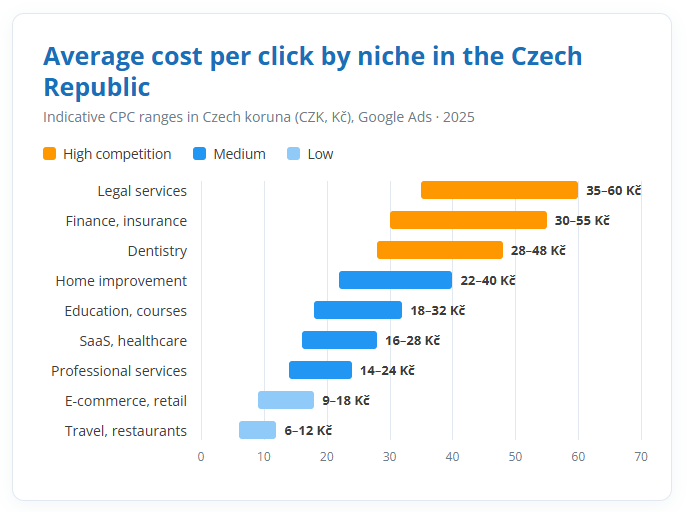
The minimum working budget for a campaign that makes sense to start with is 3,000 CZK per month. With a smaller budget, you simply won’t accumulate enough data, and without data, there’s nothing to optimize. Although, to be honest, for most niches, a realistic starting point is 8,000–15,000 CZK or more.
Now for the second part. The cost of setting up contextual advertising in the Czech Republic is typically billed in one of two ways:
- One-time fee for a turnkey setup — You pay for the campaign to be set up, launched, and handed over to you. This is a fixed amount.
- Monthly management — the specialist doesn’t just launch the ad campaign; they actively manage it on an ongoing basis: monitoring bids, removing negative keywords, testing ads, and optimizing for conversions. Payment is either a flat fee or a percentage of the advertising budget.
Important: A cheap setup often ends up being the most expensive option. A campaign that’s thrown together in a hurry and left unmanaged will easily eat up your budget on irrelevant clicks. Cutting corners on hiring a specialist ends up costing you more in Google fees.
On average, a one-time setup for contextual advertising in the Czech Republic with a competent contractor is a significant but cost-effective investment, while ongoing management is billed on a monthly basis. The exact figure is always provided after the initial briefing, as there are simply too many variables.
How do we set up Google Ads campaigns in the Czech Republic?
To help you understand what you’re paying for, here’s how the process usually works.
- Brief and analysis. We figure out what kind of business it is, who the clients are, what the profit margin is, and what the goals are. Without this, all further work is like shooting in the dark.
- Competitor analysis and keyword research. We identify keywords, immediately compile a list of negative keywords, and examine what competitors are doing in Czech search results.
- Campaign structure. We break down search terms into groups, decide which ones go into Search, which ones go into the Display Network, and which ones to leave to the automated system.
- Creating ads. We write ad copy in Czech, craft headlines and extensions, and, if needed, create banners and videos.
- Setting up analytics and goals. Without conversion tracking, advertising is pointless—you need to focus on leads and calls, not just clicks.
- Launch and testing phase. The first few weeks are dedicated to data collection. The campaign is learning.
- Optimization. We turn off what isn’t working and amplify what generates leads.
A quick note. The most common mistake is skipping step five. You launch an ad campaign, the clicks are coming in, but you have no idea where the leads are coming from or how much they cost. Analytics should be your top priority—not something you “figure out later.”
Once the campaign is launched, the management process begins—and this isn’t a one-time event, but an ongoing process. The market changes, competitors adjust their bids, and new search queries emerge. Without ongoing management, a campaign will lose effectiveness within a month or two.
Why is it better to hire a contractor to set up your ads in the Czech Republic?
It’s entirely possible to run ads on your own—you don’t need a degree to use the Google Ads interface. The question is, how much will your mistakes cost you?
It’s a classic story. The business owner set up the campaign himself, used broad keywords without negative keywords, and didn’t set up conversions. He spent 12,000 CZK over the course of a month, got a ton of clicks, and… three leads, two of which were spam. The money was gone, and while he gained some experience, it came at a high cost.
What usually goes wrong when you try to start it yourself:
- No complaints—the budget is being wasted on unrelated requests;
- Analytics aren’t set up—it’s impossible to tell what’s working;
- Ads in machine-translated Czech — low CTR and high cost per click;
- Performance Max is launched without conversion data—the algorithm has nothing to learn from, so it just burns through the budget;
- There is no ongoing management—the campaign was abandoned immediately after launch.
Google Ads in the Czech Republic is all about data and constantly working with it. Someone who is also running a business simply doesn’t have the time to keep up with it all. That’s why many people eventually decide to hire specialists to manage their Google Ads campaigns in the Czech Republic—not because they couldn’t figure it out on their own, but because time is money.
How do I choose a contextual advertising agency in the Czech Republic?
Let’s say you’ve decided to outsource. It’s not that hard to spot a good Google Ads agency in the Czech Republic—there are a few key indicators to look for.
- They ask about the business and profit margins instead of quoting a price right away. Without an understanding of economics, advertising is done blindly.
- They talk about ROI and return on investment, not just clicks and impressions. Clicks are a process, but what you need are results: leads and sales.
- They set up analytics and provide transparent reporting. You should be able to see exactly where every penny went.
- They write job postings in proper Czech or work with a native speaker.
- They comply with the GDPR and properly configure cookie consent.
A useful question to ask during negotiations: “How do you measure the success of a campaign?” If the answer mentions reach and click-through rates, be wary. If it mentions cost per lead, conversion rates, and return on investment, you’re on the right track.
And one more thing about expectations. Advertising isn’t a magic button. The first few weeks are spent gathering data and training the campaign; real optimization begins after that. A contractor who honestly warns you about this inspires more trust than one who promises you the moon by tomorrow.
By the way, calculating ROI is simple: it’s the amount you’ve invested in advertising versus the revenue generated from the customers you’ve attracted. If you get a return of several times the amount invested for every dollar spent, the campaign is working. If not, you need to figure out where the problem lies: in the ads, the landing page, the price, or the product itself. And this is a joint effort between you and your contractor, not a task you can completely offload onto someone else.