
Turkey has a population of 85 million, a growing e-commerce market, and a region where nearly all search traffic flows through a single platform. For businesses in Ukraine and the CIS, this is a straightforward entry point: run an ad, and you’ll receive inquiries from people who are currently searching for a specific product.
Pay-per-click advertising in Turkey delivers results faster than SEO. You can see positive results within the first few weeks if the campaign is designed with local specifics in mind. And there are plenty of specifics to consider—from the language to Google’s tax surcharges. Let’s break it down step by step: where to advertise, how much it costs, which niches perform best, and why you can’t launch a campaign in the Turkish market using a “one-size-fits-all” approach with ads translated via Google Translate.
Why is Google Ads the primary channel for the Turkish market?
Google accounts for about 90–95% of search traffic in Turkey. Yandex, Bing, and the rest share the meager scraps. This means one simple thing: if someone in Istanbul or Ankara is looking for something, they almost certainly do it on Google. Google’s dominant share of the search market eliminates the need to spread yourself thin across a dozen platforms—it’s enough to participate in just one auction.
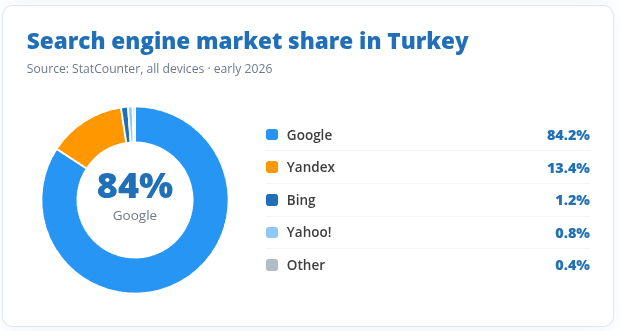
The Turkish audience is active and mobile. Up to 70% of ad clicks come from smartphones, and people are accustomed to searching, comparing, and placing orders directly from their phones. Add to this the major demand centers—Istanbul, Antalya, and Izmir—and you get a market where Google Ads in Turkey pays off quickly with proper configuration.
Here’s the bottom line: Google isn’t just “one of” the channels here—it’s the main one. That’s why high-quality PPC advertising accounts for the majority of paid traffic without the need for additional systems.
Key Considerations for Setting Up Contextual Advertising in Turkey
You can’t just launch a campaign “as if you were at home.” Google’s contextual advertising in Turkey is hampered by several local factors—from data laws to website payment methods. Any one of these factors alone could wipe out your entire advertising budget. Let’s go over each one.
The KVKK Data Protection Law
In fact, this is Turkey’s equivalent of the GDPR, requiring explicit consent from users for the processing of their data and the placement of cookies on their devices. Without a proper cookie banner and privacy policy, remarketing and audience targeting become a legal risk. The rules are strictest in the medical and financial sectors, where data is sensitive and regulators are more vigilant.
In practice, here’s the procedure: first, place a consent banner and a well-written privacy policy on your Turkish site, and only then enable audience targeting. If you get the order wrong, you risk both a fine and having your campaign blocked.
Check this before you start. Cookie consent isn’t just a formality. Without it, you can’t build audiences for remarketing in Turkey.
Google’s taxes and surcharges that eat into the budget
Google adds a Regulatory Operating Cost to the bill for ad impressions in Turkey—this fee has typically ranged from 5% to 7% over the years. On top of that, your country’s VAT/KDV applies. Additionally, for ads paid for from Turkey, a 15% withholding tax applies when paying a foreign supplier.
It may seem like a small amount until you actually do the math. On a $3,000 advertising budget, a 6% surcharge adds up to an extra $180—an amount that’s easy to overlook when planning. Be sure to factor it in right from the start. And check the current Regulatory Operating Cost rate in Google’s help center before launching your campaign—it has changed several times in recent years.
Turkish audience
Up to 70% of ad clicks come from smartphones. Turkish users search, compare, and place orders on their phones—often in the evening, while commuting, or on the go. What this means in practice: your landing page must load instantly and respond to touch—no zooming, no horizontal scrolling, and large buttons. A “desktop-style” or slow website kills conversion before a person even finishes reading the ad.
Also keep communication habits in mind. Turks are constantly on messaging apps, and a WhatsApp button on a landing page often generates more inquiries than a traditional contact form.
Translation of advertisements into Turkish
This is where money is most often wasted. Automatically translating ads is a surefire way to get a low CTR and lose credibility. The Turkish language is sensitive to nuances: a literal translation sounds “foreign” to locals, and they’ll just scroll past it.
How to approach localization in practice:
- Have your ads translated by a native speaker, not by a machine. A native speaker will choose wording that sells.
- Set your language targeting to Turkish, but also check the Russian- and English-speaking segments (expatriates, relocators, and tourists in Antalya).
- Adapt the formats to the locale: currency ₺, date yyyy/mm/dd, Turkish phone number +90, metric system.
Localization is about conveying meaning, not simply substituting words. A native speaker and a machine translator would phrase the same sentence differently, and a Turkish audience picks up on this instantly.
Payment methods and online payment
Turkish shoppers won’t complete their orders if they don’t see a familiar payment method. Integrate local payment systems: İyzico and PayTR support card payments and taksit installment plans (which are hugely popular here), plus bank transfers (Havale/EFT), which are still widely used. An e-commerce landing page without İyzico or PayTR loses a significant share of orders at the final step—right when the advertising budget has already been spent.
A real-world example. One online store initially used only an international payment gateway on its website. Traffic from ads was coming in, shopping carts were filling up—but there were almost no payments. After adding PayTR and an installment plan, paid orders increased by 30% with the same advertising budget.
The cost of contextual advertising in Turkey
There are two separate issues here: how much is spent on clicks and how much a specialist’s services cost. Don’t confuse them—these are different budget lines.
Cost per click by niche in Google Ads
Turkey is cheaper than most European countries. That said, competition is on the rise there. Estimated cost per click:
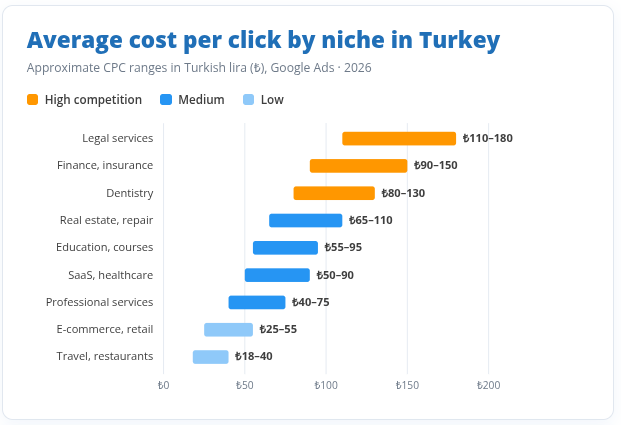
- Travel services, healthcare, and education — $0.50–2 per click.
- E-commerce and local businesses — $0.20–1.50.
- B2B and real estate — $1–4, sometimes higher in Istanbul.
The numbers vary: CPC depends on the auction, the season, ad quality, and the CTR. Narrow geotargeting to a specific city almost always lowers the cost per click—there are fewer competitors in the search results.
Cost of setup services
The cost of contextual advertising in Turkey, as quoted by the agency, includes turnkey setup and ongoing monthly management. The estimated price starts at 12,000 UAH (subject to change depending on the number of campaigns and the scope of keywords).
Let’s say a Turkish online cosmetics store has allocated $1,500 for a one-month test. With a CPC of ~$0.60, that’s about 2,500 clicks. From there, it all comes down to the landing page conversion rate: at a 2% conversion rate, that’s 50 leads; at 4%, it’s already 100. That’s why the cost of setting up contextual advertising in Turkey pays off specifically through work on the landing page and analytics, rather than through “cheap clicks.”
Which Google Ads formats perform best in Turkey?
Different tasks call for different types of campaigns. Don’t just launch everything at once; it’s important to choose the right tool for your specific niche.
- Search advertising. The foundation for most projects. When a user enters a search query, they see your ad at the top of the list. It works best for services, healthcare, B2B, and real estate. Keywords and negative keywords are critical here: without negative keywords, your budget will be wasted on irrelevant queries.
- Performance Max. An automated campaign across all Google channels at once—Search, Display, YouTube, Maps, and Gmail. It’s particularly effective for e-commerce when the website supports product feed uploads. It requires a large set of clean conversion data; otherwise, the algorithm will learn from junk data.
- Google Shopping. Product listings with photos and prices right in the search results. For online stores, this is practically a must-have format. Turkish shoppers compare prices at a glance, and a product image with a price tag eliminates half of their objections before they even click.
- Google Demand Gen. Display ads on YouTube, Discover, and Gmail. Great for generating demand in fashion, beauty, and travel—industries where purchasing decisions are driven by emotion.
- Retargeting. This brings back visitors who viewed the site but didn’t submit a form. Under the KVKK, it must be set up carefully—by requesting consent for cookies. However, in terms of cost per lead, it’s often the most cost-effective format.
How do we set up contextual advertising for Turkey?
Launching a successful marketing campaign is a process, not just a matter of hitting the “start” button. That’s why setting up contextual advertising in Turkey should include:
- Competitor and niche analysis. We look at who is already running ads, for which search terms, and what they’re offering. We identify entry points and a realistic CPC.
- Semantics. We collect keywords in Turkish, filter them, and group them. At the same time, we create a list of negative keywords to block irrelevant traffic.
- Localization. We translate and adapt ads and landing pages for a Turkish audience.
- Analytics. We set up Google Analytics (GA4) and configure conversion tracking—inquiries, calls, and purchases. Without this, there’s nothing to optimize.
- Launching a campaign the right way. We start with a limited budget, just enough to test hypotheses about potential audiences and ads.
- Optimization. We eliminate underperforming keywords, reallocate the budget toward what generates leads, and fine-tune bids and ad copy.
The Best PPC Niches in Turkey
Based on our experience and PPC auction data, several categories lead the way in the Turkish market:
- Travel. Hotels, tours, rentals, transfers. Seasonal demand is huge, especially in Antalya and along the coast. The combination of “search + demand generation” works great.
- Medicine. Dentistry, cosmetic surgery, IVF—Turkey has long been a medical hub for foreigners. The high cost is justified by CPC rates of up to $2–4. At the same time, special attention must be paid to KVKK requirements here.
- E-commerce. Google Shopping and Performance Max account for the bulk of sales. An online store with a product feed and a well-designed landing page can turn a profit fairly quickly.
- B2B and services. Legal, accounting, and IT services; equipment. Search engine advertising with precise targeting and a focus on generating leads.
Real estate is in a league of its own: high-cost clicks, long sales cycles, but the payout is such that a single lead can cover a month’s worth of advertising.
Why should you hire an agency to set up contextual advertising in Turkey?
You can certainly manage an advertising campaign on your own. But the Turkish market leaves little room for error: language, the KVKK, tax surcharges, auctions—every misstep costs money. A contextual advertising agency in Turkey can help you save on two things—time and budget—which would otherwise be spent learning from your mistakes.
The benefits of working as a team:
- launch in 1–2 business days instead of weeks of trial and error;
- a native speaker for translating advertisements and proofreading landing pages;
- Transparent reports—you can see exactly where every hryvnia goes and which channel generates leads;
- ongoing management of Google Ads, rather than a one-time setup where the account is abandoned immediately after the first campaign launches.
Effective Google Ads contextual advertising for Turkey isn’t a “set it and forget it” process—it requires weekly data analysis. Google’s algorithms are constantly changing, and your competitors in the auction aren’t sitting idle either.
Frequently Asked Questions
-
Yes, but only with professional localization. Machine translation undermines trust and lowers CTR. Ads and landing pages should be translated by a native speaker—this directly impacts conversion rates.
-
You can realistically start a test campaign with a monthly budget of $300–500 for clicks. This will be enough to test your hypotheses in niches with low CPCs. For competitive sectors—such as healthcare and real estate—set aside a larger budget.
-
For online stores: İyzico or PayTR, plus bank transfer (Havale/EFT). Turkish customers expect familiar payment methods and installment plans.
-
It is recommended. A .com.tr domain or a subdomain with a properly configured hreflang tag builds trust and aids in geotargeting. You can start with the main domain, but having a local domain is an advantage.
-
The first clicks come on launch day. The first leads usually come within the first week. Then the optimization begins: refining keywords, tweaking ads, and reallocating the budget to what’s delivering results.
-
Targeting specific cities—Istanbul, Antalya, Izmir—eliminates ads in areas where your customers aren’t located. This results in fewer unnecessary clicks, a lower cost per click, and a higher percentage of qualified leads.