Affiliate marketing is a promotion model whose popularity grows year after year, yet misconceptions still surround it. Some think it’s just advertising in a different wrapper. Some confuse it with network marketing (spoiler: these are completely different things). And some, upon hearing about “traffic arbitrage,” imagine shady schemes and close the tab.
Let’s break it all down — what affiliate marketing actually is, how it works from the inside, what payment models exist, and most importantly, how to apply all of this in practice.
What is affiliate marketing in simple terms?
Suppose you recommended a great barbershop to a friend. He booked an appointment, came in, got a haircut, and was satisfied — and the owner sent you a thank-you payment to your card for the new client. A nice story, right? Affiliate marketing works exactly on this logic — though the scale differs. Instead of a barbershop, it’s an online business, and instead of a verbal recommendation, it’s links, banners, and content on the internet.
To be more precise: affiliate marketing is a promotion model where a company pays a partner (also called an affiliate or webmaster) for attracted customers. The partner places advertising materials on their platforms — on a website, blog, social media, email newsletter — and receives a commission for a target action (purchase, registration, application, app installation).
This model is very attractive because everyone benefits. The business pays strictly for results, not for “air” impressions. The partner earns from their accumulated audience and skills. And the buyer finds what they’re looking for — often with a nice bonus in the form of a promo code.
For example, you run a blog about home workouts and insert an affiliate link to a sports equipment store. A reader clicks, orders dumbbells with a 10% discount. You receive a commission, and the store gets a customer. Everyone wins.
But behind this apparent simplicity lie many nuances. Payment models, niche selection, fraud protection, analytics — all of this is worth understanding before you begin. Which is exactly what we’ll do now.
How does affiliate marketing work?
Four parties participate in the process:
- Advertiser. This is a company looking for customers. The advertiser creates an offer: describing the product, terms, and reward amount. For example, an online electronics store offers partners 5% of the order amount for attracting a buyer.
- Affiliate (webmaster, partner). They provide traffic to the advertiser. Affiliates can be bloggers with an Instagram audience, niche website owners, or arbitrage specialists who buy advertising and direct users to the advertiser’s page.
- Affiliate network (CPA network). A platform-intermediary between the first two. It accumulates offers, provides webmasters with tools, and handles tracking — recording who clicked, where they came from, and whether they made a purchase.
- Buyer. The one who performs the target action. By the way, they often have no idea they clicked through an affiliate link.
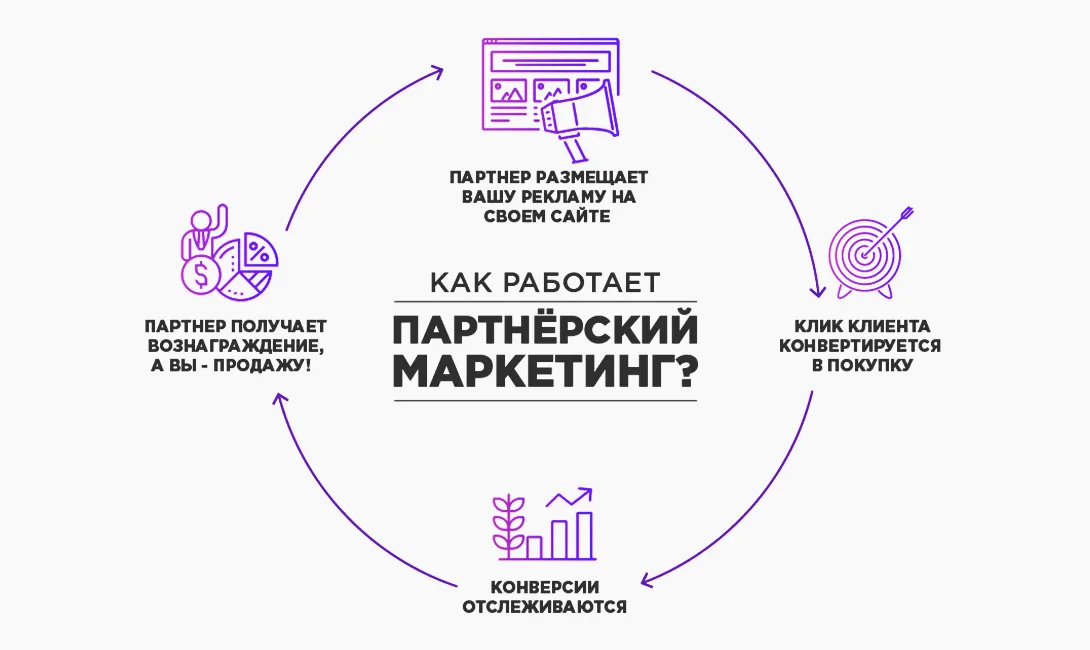
And now, how affiliate marketing works. The advertiser places an offer in the affiliate network → the affiliate connects to this offer and starts driving traffic → the buyer performs the required action → the tracking system counts the conversion → the affiliate receives their money.
Important: the entire chain depends on transparency. With incorrect tracking setup or cheating by the advertiser, the partnership won’t last long. This is precisely why it’s so important to carefully choose networks and offers for cooperation.
What types of affiliate marketing exist?
It may seem that affiliate marketing is one unified direction. But in fact, this is not the case. In practice, there are two noticeably different directions — by mechanics, goals, and who exactly becomes a partner.
Referral marketing

The essence is simple: existing business customers recommend the product to acquaintances and receive a bonus. The bonus format depends on the program. Discount, cashback, points on account, free month of subscription. Often the person who was invited also receives a bonus. This creates a chain: a satisfied customer brings a friend, who also buys — and can become the next “recruiter” themselves.
For example, you use an online platform for learning English. You like the service, you send a link to a colleague, he registers — you both get a week of free access. A typical referral scheme.
The main advantage is traffic quality. A recommendation from an acquaintance generates substantially more trust than a banner in the corner of the screen. Customer acquisition cost is also usually lower. However, the program’s scale is limited by the advertiser’s customer base size. If there are few users so far — don’t expect an explosive effect.
Affiliate marketing (affiliate)
In this scheme, partners are not customers but external players: bloggers, influencers, review website owners, coupon services, media networks. They are not required to use the product — their task is exclusively promotion. They invest their own resources: creating content, buying traffic, testing advertising bundles.
Payment is strictly for results. Sale, lead, registration. No conversion — no payment. Therefore, affiliate marketing by its nature assumes that the partner takes on marketing risks.
The potential here is serious: you can really quickly enter new markets and reach an audience that the business simply wouldn’t find on its own. But there are plenty of complexities. You need to control traffic quality, build relationships with partners, track fraud, and constantly calculate return on investment. “Launch and forget” won’t work.
Important: referral and affiliate marketing are often confused, but the key difference is in who promotes. In the first case, it’s your customers; in the second, it’s professional partners for whom promoting other people’s products is their main activity.
Advantages and disadvantages of affiliate marketing for business

Suppose you opened an online cosmetics store. You launched contextual ads, hired an SMM specialist, started investing in SEO. All of this is slowly yielding results, but the budget is melting, and the return is modest so far. And then you learn about affiliate marketing, where you can pay exclusively for a specific result.
This is essentially the main advantage of affiliate marketing for business. You don’t waste money on impressions and clicks that may turn out to be ineffective. Commission is accrued on the condition that the customer performed a target action — placed an order, submitted an application, paid for a subscription.
But this is not the only plus. Additionally, the business gets:
- Access to an audience that escapes ordinary advertising. Webmasters work in the most unexpected niches — from cooking blogs to Telegram channels about personal finance.
- Scaling without proportional budget growth. Connected ten partners — got traffic from ten different sources. Connected a hundred — traffic will come from a hundred, while payment remains result-based.
- Clear expense analytics. Tracking systems show the number of conversions brought by each partner, as well as the channel they came from. No guessing in the spirit of “well, probably the advertising just worked.”
And now for the flip side. Not all partners play fair. They may drive fraudulent traffic — fake registrations, inflated applications. Traffic quality control and conversion tracking are not just technical formalities. This is an issue that determines the viability of the entire affiliate program.
Tip: if you’re launching an affiliate program for the first time — start with a verified CPA network. It will take on partner moderation, technical infrastructure, and anti-fraud. Yes, you’ll have to pay a commission for this, but at the start it will be cheaper than figuring everything out yourself.
Pros and cons of affiliate marketing for affiliates
Before diving into this field, it’s worth soberly evaluating both sides of the coin. Affiliate marketing is not a magic “money” button, but it’s not something impossibly difficult either. Let’s figure out what to expect.
Advantages
- No need to invent and create a product. Developing something from scratch — that’s time, money, and a lot of risks. Here you promote what already exists and has proven its viability. Connected — and you’re working.
- Low entry barrier. No equipment, no membership fees. Registration in most programs takes a couple of minutes: name, email, payout details. That’s it. Suppose you have a travel blog — tomorrow you can connect to a booking service affiliate program and start earning.
- Minimal risks. Initial investments tend to zero, so there’s not much to lose. Compare with launching an online store, where you need to buy goods, find a warehouse, hire people. In CPA networks, everything is incomparably simpler.
- Ability to achieve passive income. Yes, you’ll have to work at the start — and quite a bit. But when the system is assembled (content published, links placed, traffic flowing), money can come with practically no involvement. Sometimes — quite decent amounts.
- You promote what you like. There are thousands of affiliate programs. Into fitness? Promote sports nutrition. Know gadgets? There are electronics affiliate programs. When the topic is genuinely interesting, work feels more like a hobby.
Disadvantages
- You may not be accepted into the program. If traffic on your site is still modest — many programs will simply refuse. They have specific requirements, and a resource with 50 visits a day is unlikely to pass selection.
- Quick money won’t happen. Without a built-up audience, earnings will remain symbolic. Honestly, this is where most beginners stumble — expecting results in a week, but they don’t come. First you’ll have to invest in traffic growth.
- Terms can change at any moment. You depend on the brand. Today the commission is 10% of sales, tomorrow the company decides to cut it to 5%. You can hardly influence this.
- Advertising restrictions. Partners are usually prohibited from using branded keywords in paid ads. So you’ll have to be inventive when setting up advertising.
- Mandatory disclosure of affiliate relationships. Placed an affiliate link — please indicate that you cooperate with the brand. Hiding this is a bad idea from all sides: you can get fined, lose rewards, and undermine audience trust.
- Growing competition. More people want to try affiliate marketing every year. But this is not a sentence. You just need to enter with a clear plan, not with hope that “somehow it’ll work out on its own.”
Payment models in affiliate marketing
One of the first questions beginners ask: “What exactly will I be paid for?” There are several models, and the choice depends on tasks and role in the process.
- CPA (Cost Per Action) — payment for target action. The most common model. The action can be a purchase, subscription, form fill. The advertiser pays only when the user does something specific. No result — no expenses.
- CPL (Cost Per Lead) — payment for lead. Essentially a special case of CPA, but the target action here is specifically a lead: application, registration, completed form. Often found in finance, insurance, education. For example, a bank pays 150 UAH for each completed credit card application — doesn’t matter if it was approved later or not.
- RevShare (Revenue Share) — percentage of revenue. The partner receives not a fixed amount but a share of revenue generated by the attracted customer. And sometimes — for the entire duration while they pay. The model is popular in SaaS, subscription services, online casinos. In the long term, RevShare can bring significantly more than a one-time payment. But the risk is higher too: the customer may unsubscribe in a month, and your income ends there.
- CPC (Cost Per Click) — payment per click. Occurs less frequently but hasn’t disappeared completely. The partner gets money for each click on the link — regardless of whether the user bought something or not. This is less profitable for the advertiser, so rates are usually modest.
Which model to choose? Depends on which side you’re on. CPA or CPL help minimize risks for the advertiser — pay strictly for results. For a partner with quality loyal audience, RevShare can give noticeably higher income over the distance. And if you’re just exploring a niche and want to test — CPC will let you get first payouts fastest, even if small.
What tools do partners use?

How exactly does an affiliate drive traffic? The basic tool is the affiliate link. This is a unique URL with a partner identifier. A user clicks it, makes a purchase — and the system knows exactly who brought this customer.
Such a link looks approximately like this: site.com/?ref=partner123. Sometimes it’s run through a shortener or masked as a regular URL — but inside there’s still a referral tag embedded.
Besides links, promo codes are actively used. Especially convenient when a partner works with an offline audience or through video content. A blogger in a video says: “Enter promo code BLOG20 — get 20% discount,” and the advertiser on their side counts how many times this code was activated. Simple and transparent.
Another option is a referral link within a referral program. The mechanics are similar, but there’s a difference: referral programs are usually designed for ordinary users, not professional webmasters. Suppose, a food delivery service offers: “Invite a friend — both get 100 UAH on your account.” This is also affiliate marketing, just in a more everyday format.
But professional affiliates — those engaged in traffic arbitrage — have a much wider set of tools. Landing pages, pre-landers, advertising campaigns in Facebook and Google, push notifications, teaser networks. All this requires both investment and skills. But the return can be of a completely different order.
How does a webmaster start their path in affiliate marketing?

If you’ve decided to try yourself as an affiliate, use our plan.
- Define your niche. Don’t try to promote everything at once — that’s a path to nowhere. Choose a topic you understand or at least find interesting. Finance, health, gadgets, travel, education — the choice is huge. Promoting what you yourself are indifferent to is a so-so idea. You’ll quickly lose motivation.
- Choose a platform. Blog, YouTube channel, Telegram, Instagram, email newsletter — any format where you have an audience interested in your content will work. By the way, you don’t have to limit yourself to one platform — but at the start it’s better to focus.
- Register in a CPA network. On the Ukrainian market there are several large networks with local and international offers. Study the terms, rates, minimum withdrawal amount. And be sure to pay attention to conversion confirmation periods — this directly affects how quickly you’ll see the money.
- Get an affiliate link and start promotion. Create useful content — reviews, comparisons, guides — and organically weave links into it. You don’t need to shout “buy through my link” in every post. People need value, not “in-your-face” advertising. If the content is genuinely useful — clicks will come.
- Analyze and adjust. Track statistics: clicks, conversions, ROI. Affiliate networks usually provide detailed analytics. Something not working? Change your approach. Test other offers, formats, platforms. This is a normal part of the process.
Important: don’t invest serious money in paid traffic until you’ve mastered the basics. Arbitrage is not “press a button and earn.” Many beginners drain their entire budget in the first month simply because they don’t know how to calculate unit economics.
How to choose an affiliate network?
Niche defined, platform ready — now you need to find a CPA network. And here you can get stuck for a long time: dozens of networks, each with their own offers, interface, terms. How not to get confused and not step on rakes?
Here are several criteria worth paying attention to:
- Reputation and reviews. Yes, it sounds obvious, but this is where you need to start. Check forums, Telegram chats of arbitrageurs, thematic communities. If there are mass complaints about a network — delayed payouts, rejecting conversions without explanation — that’s a serious signal. Of course, there are no perfect networks, negative feedback can be found everywhere. But when complaints are uniform and repeat month after month — better walk past.
- Quantity and quality of offers. A network with a thousand offers, 900 of which don’t convert, is no better than a network with a hundred working proposals. Look if there are offers in your niche, what the rates are, what geos are available. Working for the Ukrainian market? Make sure the network accepts UA traffic and supports payouts in hryvnia.
- Payout conditions. Minimum withdrawal amount, payout frequency, payment systems — all this directly affects your comfort. Suppose you earn 500 UAH a week at the start, but the minimum withdrawal threshold is 5,000 UAH. Turns out, you’ll only see your money after two and a half months. For a beginner, this can be a demotivating factor.
- Tracking quality. The network should provide detailed statistics: clicks, conversions, EPC (earnings per click), CR (conversion rate). The more data — the more accurately you can optimize work. Without proper tracking, you’re essentially working blind.
- Support. A manager who responds in hours, not days — that’s a huge plus. Especially at the start, when there are more questions than answers. In some networks, each partner is assigned a personal manager — and this really makes life easier.
Don’t get attached to one network. Experienced affiliates usually work with two or three in parallel. The same offer in different networks may differ in rates and terms. Compare — and choose what’s more profitable.
And one more point rarely mentioned. Some advertisers launch their own affiliate programs — directly, without a CPA network as intermediary. By rates this is sometimes more profitable (no network commission), but risks are higher: fewer guarantees, more modest tools, sometimes unstable payouts. If you’re just starting — it’s safer to start through a verified network, and move to direct programs later when you have experience and market sense.
Best affiliate networks for Ukraine
Theory is useful, but let’s get specific. Which CPA networks really work on the Ukrainian market and are worth attention? Below is a selection of verified platforms. It doesn’t claim to be absolute truth — the market is alive, new players constantly appear. But as a reference for starting — it will do.
SalesDoubler
One of the most recognizable Ukrainian CPA networks. On the market since 2012, during this time it has built a reputation as a reliable platform. Main focus — fintech vertical, but the catalog has more than 250 active offers across 8 directions in 20 countries.
Among verticals — PDL (microloans), e-commerce, crypto, insurance, banking products, online services. Has its own tools: site-vitrine constructor, SMS broadcaster, integration with Google Analytics and Facebook. For beginners, starter packages are provided, which is convenient if you’re just getting started. Among minuses — the network is noticeably “tuned” for finance, so if you’re interested in product offers, the choice will be more modest.
PDL-Profit
Another Ukrainian network firmly established in the finance niche. Office in Kyiv, main focus — MFIs and credit offers. According to arbitrageur voting results, PDL-Profit consistently ranks in the top three for reliability on the Ukrainian market.
Key advantage — no hold: everything confirmed by the advertiser is paid without delays. Payouts are weekly. If you plan to work with finance offers for Ukraine — look at this network first.
Admitad

Large international network, one of the leading in CIS and Eastern Europe. Works with a huge pool of advertisers — from online stores to banks and subscription services.
Main plus — breadth of assortment. Offers exist in practically any vertical and for different geos. Among minuses — for very small traffic volumes, terms are sometimes not the most attractive. Reviews occasionally include complaints about moderation and conversion confirmation, but honestly, this is an illness of almost all large networks.
Leadgid

Estonian company with a representative office in Ukraine. Specialization — finance vertical. Scale is smaller than the previous ones, but in its niche the network works quality. If you’re looking for offers from banks and MFIs with good conditions — worth paying attention.
Everad
International CPA network with an office in Kyiv, focused on nutra vertical — health and beauty products. If this niche interests you, Everad is considered one of the leaders. Own product manufacturing, own call center, wide geo coverage.
Before registering in any of these networks — check profile resources like Partnerkin, read fresh reviews and cases. The CPA network market is mobile: last year’s leader today may yield to newcomers. And vice versa.
And if you’re an advertiser choosing where to place your offer — the logic is similar. Look at the number of active webmasters, anti-fraud system, support quality, and network specialization. Placing a finance offer in a network where 90% of traffic goes to product offers — not the best strategy.
What mistakes do beginner affiliates and advertisers often make?

Let’s talk about typical blunders that in practice lead to money loss. And both sides make mistakes.
From the partner’s side
- Promoting everything at once. Today you’re advertising microloans, tomorrow — sneakers, the day after — programming courses. Result? The audience stops trusting you. And trust is essentially the affiliate’s main capital. Lose it — and no rates will save you.
- Violating offer rules. Each offer has its own conditions: allowed traffic sources, prohibited promotion methods, creative requirements. Ignore — lose payouts. And that’s a mild scenario: you can get banned from the entire network.
- Working without analytics. Driving traffic and not looking at numbers is about the same as shooting with closed eyes. Theoretically you can hit. But chances are slim.
From the advertiser’s side
- Launching a program without proper tracking. If you can’t accurately determine where a customer came from — you’ll either overpay for fake conversions or underpay real partners. Both options lead to problems.
- Too harsh conditions for partners. Low rates, long holds, rejecting conversions without coherent explanations — and strong webmasters will simply go to competitors. Those who care least about traffic quality will remain.
- Ignoring fraud. Without an anti-fraud system, you risk paying for bots, fake registrations, and inflated actions. And then wonder why with good statistics there are no real sales.