
Google holds more than 95% of the search market in Portugal. Virtually all paid search demand—from searching for a plumber in Lisbon to ordering furniture in Porto—goes through a single advertising platform. That’s why Google’s contextual advertising in Portugal remains the fastest way to generate leads: your ad is shown to a user right when they’re already searching for your product or service.
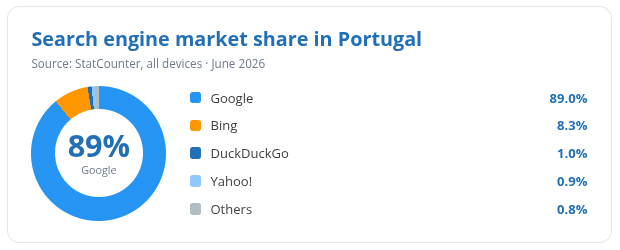
Speed is the key advantage. SEO takes 4–8 months to deliver results, while Google Ads in Portugal generates the first leads within a few days of launch. For a new business, it’s also an inexpensive way to test demand: invest 300–500 euros in a test campaign—and in two weeks, you’ll see the actual cost per lead in your niche, rather than forecasts from spreadsheets.
By the way, the PPC channel is easy to scale. If the campaign is profitable, increase your ad budget, and the system will bring in more customers. If it’s not profitable, pause your ads in a minute—with no penalties or obligations.
What should you consider when setting up contextual advertising in Portugal?
Settings that worked perfectly in Ukraine, Poland, or even Spain yield different results in Portugal. It’s a small country, but one with its own unique character: demand is concentrated in two metropolitan areas, the audience speaks three or four languages, and the auction in commercial niches is heated up by European budgets. Before launching a campaign, it’s important to understand five key factors: geography, language, audience composition, competition, and seasonality. Below, we’ll explore each of these with data and practical insights.
Geography of Demand: A Country of Two Metropolitan Areas
Portugal has a population of about 10.5 million, distributed extremely unevenly. The population is concentrated along the Atlantic coast, with two major centers: Greater Lisbon (about 2.9 million residents) and the Porto metropolitan area (about 1.7 million). Together, these account for more than 40% of the country’s total population and significantly more than 40% of its purchasing power: salaries in the capital are on average 20–25% higher than in rural areas.
The third point on the map is the Algarve. The region thrives on tourism and real estate, and its population increases severalfold in the summer. The inland regions (Alentejo, Trás-os-Montes) are sparsely populated rural areas where demand for most services is minimal.
What does this mean in practice? Targeting “all of Portugal” is almost always a mistake. Your ads end up in regions without your audience, and your statistics become skewed. Set your geographic targeting precisely: the districts of Lisbon, Porto, Setúbal, Braga, and—if necessary—radii around specific cities. For local businesses (clinics, auto repair shops, salons), the effective radius is 10–20 km; people simply won’t travel farther than that.
Language: Portuguese, but not just any Portuguese
Portuguese is essential for reaching a local audience—no one disputes that. The nuance lies elsewhere: European Portuguese differs significantly from Brazilian Portuguese. Different vocabulary (“autocarro” instead of “ônibus,” “telemóvel” instead of “celular”), different grammatical conventions, and a different tone of voice. A local will instantly recognize an ad written by a Brazilian or machine-translated “in the Brazilian style”—and trust in the advertiser plummets even before the user clicks.
Important! Ad copy and the landing page must be in European Portuguese. Ideally, they should be written or proofread by a native speaker from Portugal. This directly affects the CTR, quality score, and, as a result, the cost per click.
Localization is more than just translation. Prices in euros, local phone formats (+351), mentioning regions and cities in headlines, and communication methods familiar to Portuguese people (WhatsApp is more popular here than phone calls)—all of this boosts landing page conversion without a single euro of additional budget.
Tourists and expats: three audiences instead of one
Portugal is one of Europe’s top tourist destinations: the country welcomes tens of millions of visitors annually, and about a quarter of them are Spanish. Add to that the British, Germans, French, and a growing expat community—according to various estimates, more than 800,000 foreigners live in the country, including a significant Russian- and Ukrainian-speaking diaspora.
For advertisers, this means three distinct segments:
- local residents—Portuguese, the full range of niches;
- tourists and seasonal visitors—English and Spanish, covering niches such as rentals, tours, restaurants, and transfers;
- expatriates and relocators—English, Russian, and Ukrainian, with demand for lawyers, real estate agents, insurance, medical services, and document processing.
Each segment is a separate campaign with its own semantic core, ads, and landing page. In terms of labor costs, a bilingual project is equivalent to two separate ones, and PPC specialists honestly factor this into their pricing. However, the return is higher: competition is lower in “expat” niches, and clicks are cheaper than in the Portuguese-speaking segment.
Competition and Cost Per Click
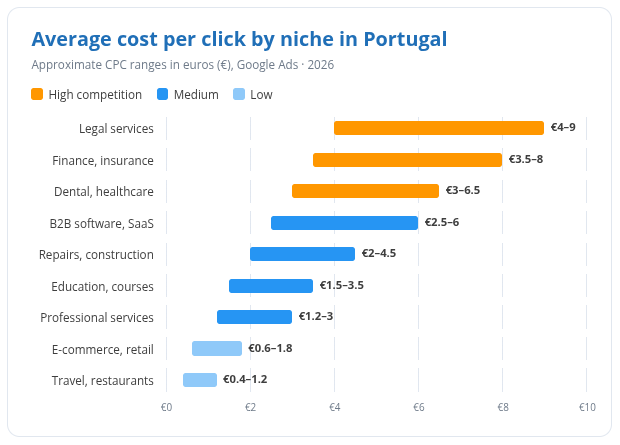
Portugal is an EU country with a high proportion of small businesses and a well-developed digital sector: about 85% of the population uses the internet, and nearly all searches are conducted via Google. The auction in commercial niches is overheated. In legal services, immigration, dentistry, and real estate, dozens of advertisers compete for a single search query, and CPC can reach 3–6 euros.
At the same time, Google Ads operates on a second-price auction model: you don’t pay your maximum bid, but rather a bid that’s slightly higher than your closest competitor’s. The practical takeaway is that in an overheated market, it’s not money that wins, but quality. A relevant “keywords–ad–landing page” combination boosts your Quality Score, and Google awards you clicks at a lower cost than competitors with larger budgets and sloppy campaign setup. The difference in cost per click between a well-optimized campaign and a “raw” one in the same niche can be as much as double.
Seasonality and Buyer Behavior
Demand in Portugal follows the tourist season. The peak runs from May through September: in the Algarve and Lisbon, everything from car rentals to food delivery sees an uptick. August is vacation time for the Portuguese themselves, and B2B niches traditionally see a slowdown during this period. December brings a surge in e-commerce, while January and February are the “quietest” months—but clicks are cheaper during this period.
A couple more details to complete the audience profile. The Portuguese take their time making decisions—the sales cycle in high-end niches is longer than what advertisers from Eastern Europe are used to, so remarketing here isn’t an option, but a necessity. More than 70% of traffic comes from mobile devices: if a landing page loads slowly on a smartphone, your budget goes to waste. And yes, local shoppers love paying via MB Way—offering a familiar payment method in an online store significantly boosts conversion rates.
Which Google Ads tools work best in Portugal?
- Search ads. The foundation for most niches. They capture high-intent traffic: queries like “advogado imigração Lisboa” or “reparação de eletrodomésticos Porto” bring in people ready to submit a request today. Success here depends on precise semantics, well-defined negative keywords, and smart bidding strategies.
- Google Shopping. This is a must-have for online stores. Product listings with photos and prices appear above regular search results and drive conversions at a significantly lower cost than search ads. To get started, you’ll need a properly formatted feed in Google Merchant Center—with prices in euros and descriptions in Portuguese.
- Performance Max (PMax). Covers all Google platforms at once: Search, Display Network, YouTube, Gmail, and Maps. The algorithm automatically distributes impressions; your task is to upload high-quality creatives and provide the system with conversion data. In e-commerce, PMax often delivers the best ROAS among all campaign types, but it requires accumulated performance data.
- Display Network. Suitable for reaching a broad audience and generating interest. Display Network banners are inexpensive and perform well in niches with long sales cycles—such as real estate, home improvement, and education.
- Remarketing. Brings back visitors who were on the site but didn’t submit a request. When search ads are expensive, this is a lifesaver: re-engaging a warm audience costs significantly less. For example, if a visitor viewed a service page, added a product to their cart, and left—reach out to them with a banner offering a discount or a reminder.
How do we set up Google Ads for Portugal?
Professional setup of contextual advertising in Portugal typically involves several stages:
- Brief and niche analysis. We study the product, profit margins, and competitors in Portuguese search results. Even at this stage, it becomes clear which tools will deliver results and which ones aren’t worth spending money on.
- Semantic research. We gather keywords using Google Keyword Planner, taking local phrasing into account; we categorize them by language and search intent, and compile a list of negative keywords.
- Preparing landing pages. We check the landing pages for speed, responsiveness, application forms, and localization. A weak landing page can undermine even a perfectly optimized campaign.
- Setting up analytics. We connect Google Analytics 4, set up goals, and configure conversion tracking to the ad account—without this, automated strategies operate blindly.
- Campaign creation. We write ad copy (ideally proofread by a native speaker), set up targeting, geographic targeting, and ad schedules, and set initial bids.
- Launch and optimization. The first 2–4 weeks are the learning period: we filter search queries, reallocate the budget, and test ad copy and bidding strategies.
After that, the ongoing management of advertising campaigns begins. A one-time setup rarely works for long—the auction changes, competitors update their ads, and seasonality shifts demand. Monthly optimization typically reduces the cost per lead by 20–40% compared to the first month.
How much does contextual advertising cost in Portugal?
Costs consist of two parts: Google’s pay-per-click fees and the work of specialists. Let’s break down both.
The cost of contextual advertising in Portugal, in terms of clicks, depends on the niche. Approximate CPC in search results:
- e-commerce, everyday goods — 0.2–0.6 euros;
- services for individuals (repairs, cleaning, beauty) — 0.5–1.5 euros;
- real estate, cars — 1–3 euros;
- legal and immigration services, healthcare — 2–6 euros and higher.
Only a test will reveal the exact figure: the auction is dynamic, and the actual cost per click fluctuates even throughout the day. The minimum working advertising budget for Portugal is 500–600 euros per month per search campaign. With smaller amounts, the system lacks sufficient data for training, and the statistics become unreliable.
The cost of setting up contextual advertising in Portugal through agencies typically starts at 300–500 euros per project—this figure increases with the number of languages, campaigns, and product categories. Management is billed separately: either a fixed fee of 200–400 euros per month or a percentage of the advertising budget (typically 10–15%).
Tip: Focus on ROI, not just expenses. A lead worth 15 euros with an average order value of 800 euros is an excellent result. The same lead with an average order value of 40 euros is a loss. Before launching, calculate your unit economics: how much are you willing to pay per lead to keep your advertising in the black?
Why is it better to order contextual advertising in Portugal through an agency?
To be honest, the Google Ads interface looks user-friendly, and that’s a trap. At every turn, the system pushes you toward “recommended” settings that increase spending: broad match without negative keywords, automatic application of recommendations, and overly broad geographic targeting. On average, a beginner loses 30–50% of their budget to irrelevant clicks in the first few months.
A contextual advertising agency in Portugal eliminates these risks. Here’s what you get in practice:
- keyword targeting and ads tailored to local phrasing, rather than direct translations from another language;
- accurate analytics—decisions are based on conversion data, not on gut feelings;
- regular optimization of search terms and bid management that keeps CPC below the auction average;
- Transparent reporting: impressions, clicks, CTR, bid price, ROAS—all presented clearly every month;
- experience with dozens of similar projects—common mistakes in your niche are already identified and avoided.
An added bonus is speed. Our specialist can launch Google Ads in Portugal in 3–5 business days, whereas figuring it out on your own would take weeks.
To order contextual advertising in Portugal, submit a request on our website—we’ll discuss your project, calculate a forecast for your budget and cost per lead, and propose a launch strategy. The consultation is free and comes with no obligation.