
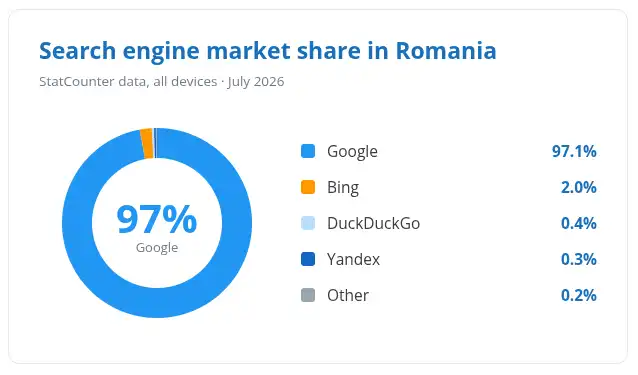
Romania is the second-largest market in Eastern Europe after Poland: it has about 19 million residents, with over 17 million regularly using the internet. Google holds around 95% of the search market here, local search engines are practically non-existent, and eMAG (the country’s largest marketplace) accustomed people to buying online about a decade ago. At the same time, the cost per click in most niches is noticeably lower than in Germany, the Czech Republic, or Poland. It makes sense that PPC advertising in Romania has become one of the first channels Ukrainian companies turn to when they decide to sell in the EU.
Below is what you need to know about launching, what affects the price, which formats work, and how ADWService, as a PPC advertising agency in Romania, approaches campaign setup.
Features of PPC advertising in Romania
At first glance, there is nothing special—it’s the same Google Ads. But copying a Ukrainian campaign one-for-one won’t work; this has been proven time and again. Below are the factors that actually impact your results.
Language and keywords
Romanian is a Romance language, not Slavic, and you will have to build your keyword list from scratch. Auto-translating keywords works poorly: the word “buy” is more often written as “cumpără” or “cumpar” (without diacritics), and “price” as “preț” or “pret”—both variations appear constantly in search queries. Keyword Planner considers them different words, so both forms need to be in your keyword list.
There are also lexical traps. “Magazin” means a store, not a magazine. “Comandă” is an order. “Livrare gratuită” means free shipping, which is the most common trigger in commercial keywords. Plus, there is regional vocabulary: residents of Cluj-Napoca and Iași might call the same product by different names, and in Transylvania, a portion of the search queries are in Hungarian.
Practical tip: Gather your core keywords using Keyword Planner with geotargeting set to Romania, and then hand the list over to a native speaker for review. An hour of an editor’s work saves weeks of unsuccessful impressions. The same applies to ads and landing pages—Romanians can spot machine translations from the very first sentence, and trust drops instantly.
Currency and prices
Romania is not yet in the Eurozone; transactions are conducted in lei (RON). Prices on your website must be in lei, your ad account is easier to manage in RON or EUR, and we usually recalculate the budget for Ukrainian clients into UAH so it’s clear how much it costs. The exchange rate as of mid-2026 is: 1 RON ≈ 8.7–9 UAH, 1 EUR ≈ 5 RON.
An important nuance for an online store: the price in your product feed and on your website must match down to the ban (a leu is divided into 100 bani). If the price on the site is dynamically converted from euros, sooner or later it will desync from the feed—and your products will be disapproved. It’s better to fix prices in lei and update them manually or on a schedule, synchronously with the feed.
Another point: Romanians are accustomed to seeing prices with VAT included (the standard rate is 21%). A price “without TVA” on the storefront looks like a scam to a retail buyer.
GDPR and cookie consent
Romania is an EU country; GDPR is in full effect, and oversight is handled by ANSPDCP (the local regulator). For advertising, this means three things.
First—a consent banner with a real choice. The “Accept” and “Reject” buttons must be equal; the scenario with “one big green button and a tiny link to settings” has already led to fines.
Second—Consent Mode v2 in GTM. Without it, the advertising platform doesn’t receive conversion data from those who opted out of cookies, remarketing audiences aren’t built, and automated strategies train on truncated statistics. In our experience, after properly setting up Consent Mode, the number of tracked conversions increases by 15–30%.
Third—a privacy policy in Romanian and a clear opt-out form for newsletters. Merchant Center checks for these sections during verification.
Please note: GDPR fines in Romania are real, not theoretical. The regulator regularly publishes decisions with penalty amounts ranging from 3,000 to 100,000 euros, including for small online stores. You should check your banner and set up Consent Mode before launching, not after receiving your first letter from ANSPDCP.
Buyer behavior
Romanians love to compare. Compari.ro is the second most popular price comparison site in the country, and some users, after clicking your ad, will go there to check if they can find it cheaper. This leads to two conclusions: your price must be competitive, and remarketing must be set up from day one to bring back those who left to compare.
Reviews are actively read—on Trustpilot.ro, Google Maps, and in Facebook comments. A store without reviews is viewed with suspicion, especially a foreign one. Displaying ratings in Shopping ads (via Google Customer Reviews or Trustpilot) noticeably boosts CTR.
Cash on delivery is still the most popular payment method in e-commerce, accounting for about 60–70% of purchases. An online store without a “plata la livrare” (payment on delivery) option loses buyers at the checkout stage. Customers expect delivery in 1–3 days and love pick-up points and parcel lockers (easybox by Sameday). A 14-day return policy is the norm under EU law and must be clearly stated.
Mobile traffic accounts for 70–75% of clicks. A landing page that takes longer than 3 seconds to load on a phone will just burn through your budget.
Competition and marketplaces
eMAG is the largest e-commerce player in Romania, and it advertises for almost all product keywords. Alongside it are Altex, Flanco, Dedeman (hardware and home improvement), and Fashion Days. Competing with them head-on for branded or very broad search queries (“laptop”, “telefon”) is pointless: the cost per click is high, and the buyer will still go to the familiar brand.
What works: narrow categories, niche products, and mid- to long-tail keywords where marketplaces don’t bother creating specific ads. Add your own advantages to the mix—fast shipping from stock, expert consultation, warranties, and bundling. And make sure to add marketplace names to your negative keywords so you don’t pay for people specifically looking for eMAG.
There’s also a flip side: if your product is a good fit, you can sell through eMAG Marketplace parallel to your own website. In this case, the ad campaign works on brand awareness, while a portion of sales flows through the marketplace.
Geography: which cities to target?
Romania is not just Bucharest, although the capital accounts for 25–30% of all online orders nationwide. If your budget is limited, it makes sense to start with large cities and then expand:
- Bucharest — 1.8 million residents, highest competition and CPC (20–40% higher than the national average), but also the most affluent audience;
- Cluj-Napoca — the IT capital, a lot of young people, great for promoting premium products and services;
- Timișoara — an industrial hub in the west, close to Hungary and Serbia, excellent for B2B;
- Iași — the largest city in the east, lower competition, cheap clicks;
- Constanța — a port and resort city, seasonal spikes in the summer;
- Brașov, Craiova, Galați, Oradea — cities with 200–300 thousand residents where competitors often don’t show up at all.
If you ship nationwide, it makes more sense to target the whole country with regional bid adjustments rather than fragmenting the campaign into ten different cities. For local services, do the opposite: set a precise radius around your office. Also, make sure your location options are set to “Presence” and not “Presence or interest”—otherwise, part of your budget will go to Romanians living in Italy and Spain (and there are over a million of them there).
Which Google Ads formats work best in Romania?
It all depends on the type of business. But the general picture is as follows.
- Search campaigns — the foundation for services and B2B. Lawyers, clinics, logistics, repairs, IT outsourcing. The demand is already formed, a person types in a keyword—and you show up. The main thing here is high-quality keywords in Romanian and a landing page in the same language.
- Google Shopping — a mandatory format for online stores. Product listings occupy a prominent space in Romanian search results, and without them, you are essentially handing buyers over to eMAG and Altex.
- Performance Max — shows good results if you have at least 300–500 conversions over the last 30 days or have data from other campaigns. On a blank account, PMax often just drains money on the GDN and YouTube. We usually enable it in the second or third month, after Search and Shopping ads have accumulated enough data.
- Remarketing — brings back users who browsed your site and left to compare prices (and in Romania, I repeat, almost everyone compares). Dynamic remarketing using a product feed is one of the cheapest sources of sales for e-commerce.
- Google Display Network (GDN) and Google Demand Gen — for brand awareness and reaching cold audiences. Demand Gen (ads on Discover, Gmail, and YouTube Shorts) is inexpensive in Romania—CPM is around 8–15 lei—and works well for highly visual products like clothing, furniture, and cosmetics.
What do you need to launch ads for an online store in Romania?
E-commerce requires a separate discussion. If you plan to enter the Romanian market with an online store, you must prepare for advertising in advance; otherwise, your first couple of weeks will be spent fixing errors rather than making sales.
What must be ready before launch:
- A website in Romanian — not a machine translation, but proper localization: product pages, shipping and return policies, terms and conditions, and an “About Us” section. It’s best to hire a native speaker or at least an editor with strong language skills for the translation.
- Prices in lei, including VAT (the standard rate here is 21%).
- Shipping options — Fan Courier, Sameday, Cargus. Buyers expect delivery in 1–3 days and want pick-up points (easybox by Sameday is extremely popular).
- Payment methods — credit card and cash on delivery (COD).
- Merchant Center with a verified domain and a correct feed: titles and descriptions in Romanian, GTINs, pricing, availability, and links to your return policy.
- Reviews — integrate Trustpilot.ro or Google Customer Reviews. Displaying ratings in Shopping ads significantly boosts your CTR.
A quick note on the feed. The most common reason products get disapproved in Merchant Center for Romanian stores is a price mismatch between the website and the feed (e.g., due to dynamic currency conversion) and missing mandatory sections.
By the way, Compari.ro can be run in parallel—it uses its own CPC model, and for some categories (electronics, household chemicals, baby products), it drives traffic just as well as Google Shopping.
How much does PPC advertising in Romania cost?
This is the number one question. The cost of PPC advertising in Romania consists of two parts: the ad budget that goes to Google, and the agency or specialist’s service fee.
Ad budget
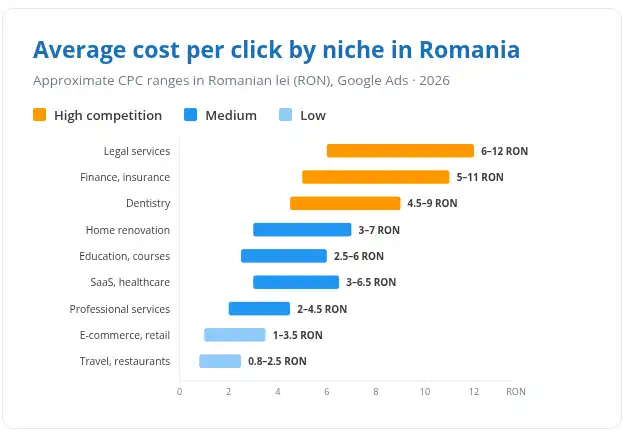
The average cost per click in local search is 0.8–2.5 lei. However, the range varies greatly by niche:
- legal and financial services, insurance — 4–12 lei per click;
- healthcare, dentistry, cosmetology — 3–8 lei;
- real estate, automotive — 2–5 lei;
- e-commerce (clothing, home goods, electronics) — 0.5–2 lei;
- B2B and manufacturing — 2–6 lei.
Shopping campaigns are cheaper than Search: 0.3–1.2 lei per click in most categories. Remarketing is even cheaper.
The minimum viable budget to start with is: 2,500–3,000 lei per month (approx. 22–27 thousand UAH) for a local service in a single city, and 5,000–8,000 lei for an online store if you want to test multiple formats at once. With smaller amounts, the campaigns simply won’t have time to gather enough data—meaning neither you nor we will know if the setup actually works.
To be honest, we often hear the question, “Can we just try it out for 500 lei?” You can. But it won’t be a test; it will be a lottery.
Cost of setting up PPC advertising in Romania
Our agency’s prices for PPC advertising setup for Romania depend on the scale of the project:
- Search campaign for services in one city (up to 100 keywords) — from 20,000 UAH;
- Comprehensive turnkey launch for an online store: Search + Shopping + Remarketing + Merchant Center + Feed — from 45,000 UAH;
- Account management — a percentage of the budget (usually 10–15%), depending on the scope of work.
What is included in account management: weekly bid and budget monitoring, search term cleaning, adding negative keywords, ad testing, feed and moderation management, and a bi-weekly report with conversion and CPA metrics. It’s not a “set it and forget it” approach, but actual active management.
How does the Google Ads setup process for Romania work?
Let me explain how PPC advertising setup in Romania looks using a typical client as an example—say, a sports nutrition store that is already operating in Ukraine and wants to sell in Bucharest and Cluj-Napoca.
- Business and competitor analysis. We look at who is already advertising for the desired keywords in Romanian search results, their pricing, and their shipping terms. We evaluate whether the client has a competitive edge (price, assortment, speed)—if not, we communicate this honestly upfront.
- Keyword research in Romanian. We gather keywords via Keyword Planner targeted to Romania, add variations without diacritics, regional phrasing, and transactional keywords (“cumpără”, “pret”, “magazin online”, “livrare”). We build a negative keyword list—in Romanian, there are many queries containing “gratis”, “pareri” (reviews), or “second hand” that we don’t need.
- Website and analytics preparation. We verify the translation, pricing, GA4, GTM, Consent Mode v2, and conversion goals. For e-commerce, we configure purchase data tracking to pass transaction values in lei.
- Merchant Center and feed (for e-commerce). Domain verification, feed upload, troubleshooting errors, and integrating reviews.
- Ad copywriting. Texts are written or edited by a native Romanian speaker. We set up Responsive Search Ads with 10–15 headlines, plus extensions: callouts, sitelinks, prices, and promotions.
- The first two weeks post-launch. As an initial strategy, we use Manual CPC or “Maximize Clicks” with a bid limit until we hit 30–50 conversions. Then we switch to “Target CPA”.
- Scaling. We add Remarketing, PMax, and expand the geographical targeting to include Timișoara, Iași, Constanța, and Brașov.
The entire cycle from the brief to launch typically takes 7–14 business days. It takes longer if the website hasn’t been translated yet or if Merchant Center requires adjustments.
Why is it better to order PPC advertising in Romania from an agency?
It might seem that launching Google Ads in Romania isn’t difficult—the interface is the same as in Ukraine. Technically, yes. But moving from “launching” to “getting leads at a reasonable cost” usually involves two to three months of experimenting and wasted budget.
What partnering with an agency provides:
- ready-made expertise in the Romanian market — you won’t have to figure out on your own why a feed was disapproved or how to properly write your terms and conditions;
- a team, not just one person: a PPC specialist, an analyst, and a native Romanian copywriter;
- an account manager you can speak with in Ukrainian — no need to struggle to communicate with a Romanian freelancer;
- contractual responsibility for results and transparent reporting.
We work with businesses of all sizes—from a local clinic in Bucharest to an online store with 15,000 SKUs. You can order PPC advertising in Romania with ongoing management or just the setup—if you have your own in-house specialist, we are ready to hand over the account with full instructions.
-
No. You can manage Google Ads using a Ukrainian legal entity or sole proprietorship (FOP), paying by card or invoice. However, shipping, payments, and taxes are a different matter: for B2C sales within the EU exceeding 10,000 euros a year, you will need to register for OSS (One Stop Shop) for VAT. This should be discussed with your accountant before launching.
-
Technically yes, but the audience is tiny. The primary language is Romanian. In certain regions of Transylvania, it makes sense to add Hungarian.
-
The first clicks happen on launch day. The first sales for an online store usually happen within the first week. A stable and predictable cost per acquisition is achieved in 4–8 weeks, once data is accumulated and automated strategies are fully trained.
-
Yes. Google Ads PPC advertising in Romania is one of our agency’s core services. Our clients include both local businesses and Ukrainian companies expanding into the local market.
-
Access to your website and analytics (or a task to set them up), an understanding of your goals and budget, and 30–40 minutes for a brief. We handle the rest.