Contextual Advertising Agency Services in Kyiv and Ukraine
A person types “buy water heater Kyiv” into Google search—and a second later, several stores appear before them. One of them will get the order today. This is how PPC advertising works: the offer is seen by those who need it right now. The agency’s job is to ensure your website is on that list, and that paying for clicks doesn’t eat up your margins.
ADWService is a PPC agency that has been managing projects across Kyiv and all of Ukraine for over ten years. Below, we’ll break down what is included in PPC advertising services, what works best for your specific niche, how much it will cost, how to order PPC advertising for your website, and how to vet a contractor before signing a contract.
How does Google Ads work?
The Google Ads advertising system (known as AdWords until 2018) displays ads in search results, on partner sites, on YouTube, and in Gmail. You pay for clicks, not impressions: the PPC model stands for pay-per-click. No money is deducted until a person actually visits the website.
There is no fixed cost per click (CPC)—it is determined by an auction that takes into account both your bid and your Quality Score. And there is a pleasant nuance: relevance carries just as much weight as money here. A strong ad can end up in the top position at a lower cost than a competitor who bid more but wrote a weak text and directs users to a slow page.
In terms of ROI speed, PPC in Ukraine is still beyond competition. Search engine optimization takes months to gain momentum, whereas Google PPC advertising in Ukraine brings in the first visitors on the day of launch. CTR, conversions, and the cost per lead—everything is visible in the reports down to the last penny, making the channel easy to measure and scale.
What services are included in the agency’s work?
The work is divided into two main blocks: setup and management. Let’s break down each one.
Ad campaign setup
This is the foundation: mistakes made at the start will drain your money for months. If you decide to order PPC advertising setup, the basic package includes:
- gathering the keyword list: keywords that customers use to find your product, plus a list of negative keywords to filter out irrelevant impressions (for example, “free,” “DIY,” or “used”—if you sell new items);
- writing ad copy—at least 2–3 variations per ad group for A/B testing;
- adding ad extensions: callouts, prices, locations, and links to website sections;
- setting up targeting by geography, ad schedule, and devices;
- choosing a bidding strategy tailored to your goal—traffic, leads, or sales;
- setting up analytics: without conversion tracking, advertising is flying blind.
For online stores, this also includes preparing the product feed and connecting Google Merchant Center—without this, you can’t launch Google Shopping or Performance Max.
Important: the account is created under your name, not the agency’s. If a contractor refuses to give you access to the account, that’s a red flag. When changing agencies, you risk losing all accumulated data, which is worth more than the setup itself.
Management and optimization
Launching a campaign is only half the battle. Then the regular work begins: the auction changes, competitors adjust their bids, and seasonality affects demand. Management includes analyzing search queries and adding negative keywords, testing creatives, and reallocating the budget to “keyword + ad + landing page” combinations that generate cheaper leads. Plus, monthly reporting—with actual numbers on clicks, conversions, and cost per lead, rather than generic phrases like “everything is fine, keep going.”
Management is where people most often try to cut corners. And they shouldn’t. A campaign without optimization starts to get more expensive after 2–3 months: CTR drops, irrelevant queries accumulate, and competitors’ bids rise.
Types of campaigns in Google Ads
Different tasks require different tools. Here is a brief overview of each.
- Search campaigns. The classic: appearing in search results for specific queries. The best option for established demand: a person searches for “washing machine repair Kyiv”—and sees you. This provides the warmest traffic and generally the highest conversion rate into a lead.
- Google Display Network (GDN). Banners across millions of Google partner websites. A click is significantly cheaper than on search, but the audience is colder. GDN is great for brand awareness and reach, rather than quick sales.
- Remarketing. Retargets those who have already visited the website but didn’t leave a request. A visitor looked at a pair of sneakers for 3,200 UAH, left—and a day later sees a banner featuring that exact model. In our experience, remarketing brings back 10–20% of “lost” visitors and costs less, which is why we include it in almost every project.
- Google Shopping. Product ads featuring a photo, price, and store name right in the search results. They run via a product feed and Merchant Center. For an online store, this is a must-have: the user sees the price before even clicking, so only those who are okay with the price actually click through.
- Performance Max (PMax). An automated format: a single campaign covers Search, GDN, YouTube, Gmail, and Maps. The system finds buyers on its own based on audience signals and conversion history. PMax helps e-commerce grow well, but it’s useless without accumulated data—it’s usually not worth starting with on a brand-new account.
- YouTube Ads. Video ads before videos and in the feed. A channel for reach and warming up demand: selling “head-on” is harder, but the brand gets remembered.
- Local campaigns. Drive foot traffic to a physical location—a store, salon, or auto repair shop. Ads appear on Google Maps and Search near your address. For businesses tied to a specific neighborhood in Kyiv, this is one of the most underrated formats.
Who can benefit from PPC advertising services?
Virtually anyone with online demand—but the strategy is different for everyone.
- Online stores: e-commerce and PMax plus category search, while remarketing brings back those who abandoned their carts.
- Service industry (cleaning, renovations, auto repair, dentistry): search based on “hot” queries and displaying ads only in specific neighborhoods.
- B2B: narrow keyword lists, long sales cycles. Here, lead quality is more important than quantity, so the focus is on exact match queries and remarketing to users who visited pages with commercial terms.
- Small businesses: starting with one search campaign focused on a priority service. It’s better to thoroughly target one service than to spread 10,000 UAH thinly across everything at once.
Let’s say you have a nail salon in Pozniaky with a budget of 8,000 UAH a month. Running ads across all of Kyiv is pointless—a client won’t travel across the city. However, showing ads within a 3–5 km radius for queries like “manicure Pozniaky” or “nail extensions Osokorky” will provide a steady stream of appointments at a modest cost.
Ad campaign launch stages: how the work is structured
- Brief and niche analysis. We study the product, competitors in the search results, their ads, and prices.
- Media plan. Forecasting the budget, cost per click, and estimated number of leads—before starting, not after.
- Campaign and analytics setup. This usually takes 3–7 business days depending on the scope.
- Launch and testing period. For the first 2–4 weeks, we gather data: which queries convert and which ads get clicked.
- Optimization and scaling. We turn off what isn’t working, scale what is profitable, and integrate new tools.
How much does PPC advertising cost in Kyiv and Ukraine?
The costs for ordering PPC advertising are divided into two parts: the ad budget, which Google charges for clicks, and the payment for the agency’s services. You shouldn’t confuse these two amounts.
The size of the budget depends on the niche and the competition: a click in the “flower delivery” niche versus the “legal services” niche differs in price by several times. For a test in most niches in Ukraine, you need between 9,000 and 15,000 UAH per month. With smaller amounts, the system doesn’t have time to gather data and learn, and conclusions about the channel will be flawed.
Note: clarify whether the ad budget is included in the cost of the agency’s services before signing the contract. Standard practice is that you pay the ad money directly to Google from your own card or account, and you only pay the agency for their work. The “transfer everything to us, we’ll handle it” scheme is opaque: you won’t see how much was actually spent on clicks.
Payment for services can be a fixed rate, a percentage of the budget, or a combination. For small businesses, a fixed rate is more convenient—expenses are predictable. For ad spends starting at 100,000 UAH, a percentage usually applies.
How to choose a PPC advertising agency in Kyiv?
The choice is massive: there are hundreds of agencies and freelancers, and they all promise “leads from day one.” To spot a professional, one call and a few clarifying questions are enough. Here is a handy checklist.
- Certificates and status. Request the company’s profile in the Google Partners directory—Google Partner status proves both their qualifications and actual ad account turnover. Certified specialists should be on staff, not “outsourced somewhere.”
- Case studies in your or a related niche. Look at business metrics, not just pretty CTR screenshots: cost per lead, sales, and return on investment.
- Questions for you. A good contractor will ask about your margins, average order value, geography, and sales cycle on the first call. If they immediately give you a “turnkey” price without asking a single question about your business—expect a cookie-cutter setup.
- Access. Your Google Ads account and analytics belong to you. Period.
- Transparent reporting. Clarify the format: what metrics, how often, and who will be in touch.
How can you check on a Google Ads PPC agency once the work has already started? Log into your account and open the change history. There you can see when the specialist last logged into the account and what they changed. If the history is empty after a month of “management”—you are paying for thin air.
How to order PPC advertising from ADWService?
On most agency websites, this section comes down to a “Submit a request” button. Let’s explain in more detail: what happens after you order services, what is required from your side, and in what formats you can generally order PPC advertising.
What formats do we work in?
You can order PPC advertising services from us in one of three formats:
- Turnkey setup. A one-time job: keywords, ads, extensions, analytics, and launch. Suitable if your in-house marketer or PPC specialist will manage everything afterward.
- Setup + management. The primary format for most projects: we launch and optimize on a monthly basis.
- Auditing and refining existing campaigns. If ads are already running, but leads are expensive or scarce. We check the account structure, search queries, conversion tracking, and bidding strategies—and we either provide a list of edits or implement them ourselves.
What should you prepare before ordering?
To ensure the media plan is accurate and the launch isn’t delayed, it helps to have:
- a working website or landing page with up-to-date prices and contacts;
- business numbers: average order value, margin, geography, seasonality, and sales cycle;
- access to the website (for installing analytics and tags) and to existing Google Ads, Google Analytics, and Merchant Center accounts, if you have them;
- for online stores—a product feed or the ability to generate one on the website;
- a baseline for the monthly ad budget.
If you are missing something from the list—don’t worry. We will set up analytics, prepare the feed, and create accounts under your name.
Our workflow after you order advertising services
- Request. A form on the website, phone call, or messenger. Keep it brief: what you sell, where, and what the goal is.
- Briefing call. We ask questions about your business and look at your website and competitors in the search results. This takes 30–40 minutes.
- Media plan and commercial proposal. Budget forecast, CPC, estimated number of leads, cost of services, and timelines—provided within 1–2 business days after the brief.
- Contract and access. We finalize the scope of work and reporting format. The account is registered under your name, and the agency gets manager access.
- Setup and launch. Then we follow the stages outlined above: 3–7 business days for preparation, followed by the launch and testing period.
It usually takes 1.5–2 weeks from the initial request to the first impressions. Ordering PPC advertising doesn’t tie you into a long-term contract: we work month-to-month, and if you decide to change agencies, the account with all its data stays with you.
Which is better for business: PPC advertising or SEO?
This is a flawed question, even though people ask it all the time. They are not competitors, but tools with different mechanics.
PPC provides traffic immediately, but only as long as your ads are running. Stop paying, and the leads stop. SEO takes 4–8 months to gain traction, but afterward, visitors come in for free. It’s a quick sprint versus a marathon.
The optimal strategy for most projects is to launch PPC advertising in Ukraine for quick orders while simultaneously investing in SEO. In about six months, organic traffic will pick up some of the demand, and the freed-up ad money can be redirected to new areas.
Do you even need PPC advertising if your website is already at the top of the search results? More often than not—yes. Ads occupy the top spots above organic listings, and competitors running ads will siphon off some of your clients even if you rank first in SEO. Plus, ads cover what organic search can’t: remarketing, product ads, instant launch of promotions, and showing up for queries where your site doesn’t rank yet.
When will the first leads from PPC advertising come in?
The first clicks happen on launch day. Leads are trickier, and here’s why.
Search campaigns based on hot queries typically bring in inquiries within the first 3–7 days. The next 2–4 weeks go into training bidding strategies and cleaning up keywords—during this period, the cost per lead gradually decreases. Reaching stable metrics takes 1–2 months.
If there are no orders after two weeks with normal traffic, the problem is most likely not the ads. Check your landing page: prices higher than the market rate, no phone number in the header, a form with ten fields—all this kills conversions even with perfectly set-up campaigns. Ads bring people in; the website does the selling.
Do you only work with Kyiv?
No. Google PPC advertising in Kyiv is our most popular area, but we have no geographical boundaries: we manage projects across all of Ukraine and for clients selling abroad.
What is the minimum budget needed to start?
It depends on the niche. For local services, a test is realistic starting at 9,000 UAH per month; for an online store with competitive categories, budget from 20,000 UAH. We calculate the exact figure in the media plan.
Can I set up ads once and never touch them again?
Technically, yes. Practically, a campaign without management degrades. Competitors raise their bids, new irrelevant queries appear, and ads experience “ad fatigue.” In a couple of months, the cost per lead increases by 30–50%.
Do you guarantee a certain number of leads?
It is impossible to guarantee an exact number of orders in an auction-based system, and a contractor who promises this is being disingenuous. We provide a forecast in the media plan and take responsibility for meeting it within an agreed-upon range.
Google Ads AI Architect · e-Commerce
Performance Max and Google Shopping work as well as their architecture is designed. We know how to do that.
ADWService — a Google Ads performance partner for e-commerce businesses that need controlled growth rather than haphazard management of contextual advertising. We build a system: from account structure and product feeds to profitable scaling through Shopping, PMax, and Search.


We’ll show you where your Google AI is losing money—in 48 hours
Or Telegram @Adwservice_bot
— or —
MCC Account 2025
316 accounts
active e-commerce sites managed by
Conversion Value
$84M+
customer revenue/year
Markets
10+
(UA · US · UK · EU · AU · CA)
* Google Ads MCC, 2025. Screenshot upon request.
5.0
14 reviews · Clutch.co
Avg. Rate
$100-149/hour
Rating for cost
5/5
34,700 subscribers · 1,400 videos
Average ROAS for the portfolio
7.5×
for every dollar spent on advertising
Performance Max isn’t a black box. It’s an AI model with four layers of training. We know how to “talk” to it through data.

ADW Bucket Architecture™
Most agencies launch Performance Max “as is.” We build our campaign architecture around how Google Ads AI actually learns—through conversion labeling, account fine-tuning, and task decomposition by product segment.
This isn’t just theory from Google’s documentation. It’s practical know-how based on 316 active e-commerce accounts in 10+ countries.
The result: your PMax learns to scale profitable products, rather than simply burning through your budget.
L1
Conversion Tagging
AI evaluates only two things: whether a conversion occurs or not, and what its value is. We configure the system to assign the correct labels.
L2
Google’s global pre-training
The Great Brain at Billions of Auctions—we can’t change it, but we can activate it properly through signals.
L3
Local account fine-tuning
Learning period + continuous online learning. Every action we take is a “prompt” for your store’s AI.
L4
Bucket campaign structure
Task decomposition: donors, cows, nursery, scaling by geography and margin—all as separate fine-tuning models.
Why ADWService
Contextual advertising exists, but its scale isn’t growing — ROAS remains stable only at low volumes.
Performance Max has been launched, but it’s performing inconsistently or “eating up” the budget without delivering results.
Google Shopping isn’t generating the expected sales volume, or CPA is increasing as the budget grows.
In Merchant Center, there are constant issues, restrictions, or account suspensions.
The budget is being spent, but there is no clear decision-making process or understanding of what comes next.
It’s not enough to simply “order contextual advertising”; you need a clear growth architecture for e-commerce.
Who is this for?
Narrow focus — deep expertise.
We understand the specifics of contextual advertising for retail stores: product feeds, profit margins, seasonality, and demand patterns by SKU.
We’re building an account structure where each campaign plays a specific role. Not just a “collection of campaigns,” but a system.
We look not only at clicks and impressions—but also at ROAS, CPA, revenue, and demand structure.
Custom scripts, the bucket system, and understanding how to train Google Ads AI—it’s not just about manual management.
Performance Max, Google Shopping, and feed optimization—where most people run into problems is where our advantage begins.
We explain what we do, why we do it, and what results we expect. 70% of our clients come to us through referrals.
Cases
Actual figures from advertising accounts. Confirmed by screenshots.
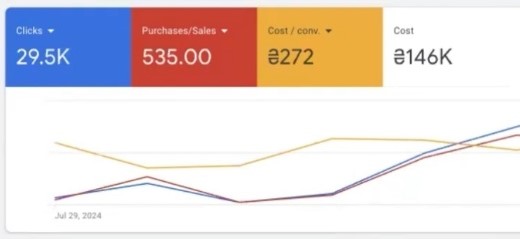
Home Goods
Achieve a stable cost per conversion on Google Shopping
333
Sales / 30 days
~50 ₴
cost per conversion
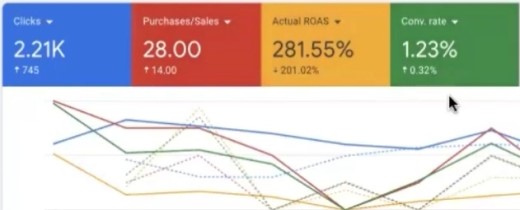
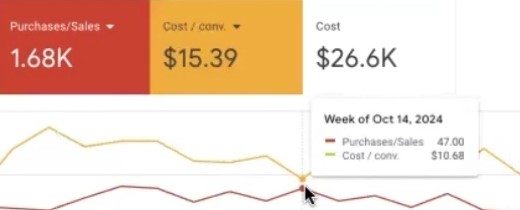
Auto Parts
Launching Google Shopping for an auto parts store in the U.S.
565%
ROAS for the first month
×2
Traffic Throughput (Scaling Test)
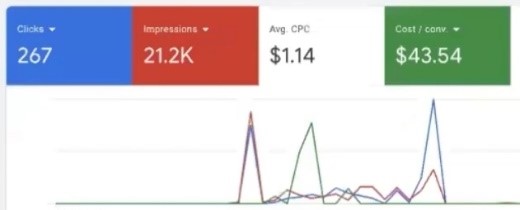
Dietary Supplements
We sell dietary supplements in the U.S. through product advertising, bypassing Amazon
×4
sales growth
$20 → $13
cost per conversion
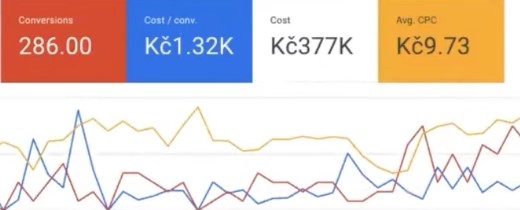
Pool Supplies
Promoting a pool supplies store with Performance Max
÷2
Lower cost per conversion
$15
cost per conversion
Children’s Products
We are promoting handmade children’s products in the Italian market
2↑
increase in average conversions
104
purchases made within the first 24 hours after clicking
Tools
Hardware Store: Increasing Average Order Value Without Losing Conversions
1,5x↑
average check
=
Conversion rates remained stable when switching to high-priced items >4,000 ₴
Main Product
After just one month of intensive work on the architecture, your Google Ads AI begins to understand your business.
1-Month Sprint
We don’t just “set up campaigns”—we build a system where each campaign plays a specific role in training Google Ads AI.
- Performance Max with Bucket Architecture (donor campaigns + main campaigns)
- Google Shopping: category-based structure tailored to your catalog
- Search campaigns: brand / non-brand / category queries
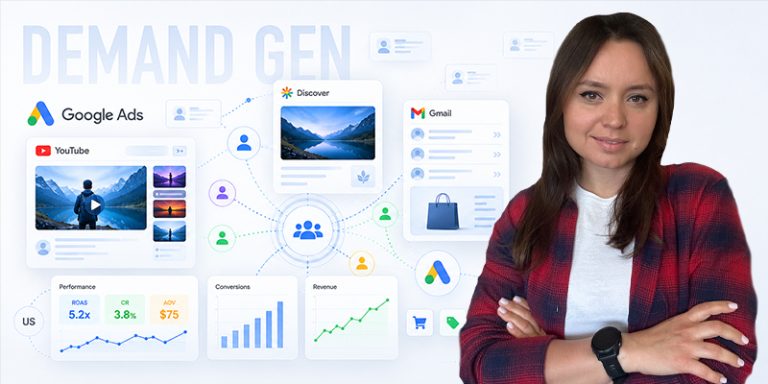
- Demand Gen: Remarketing + Expanded Audiences
- YouTube campaigns: funnel support
- Merchant Center Next: Feed Audit + Basic Settings
- GA4 + Conversions: Verifying Correct Label Transmission
- Weekly optimization: budget reallocation, restructuring
- Final report: what to scale up next, what to pause
Days 1–10
Audit + Launch
Website audit, analytics, Merchant Center. Development of the initial test structure. Launch of donor and main campaigns.
Weeks 1–2
Structure Optimization
Extensive testing of formats and structures. Adaptation to market signals. Reallocation of budgets to profitable segments.
Day 14-30+
Scaling
Consolidating working relationships. Scaling budgets. New audience and basket tests. Final report.
Also available
Extensive Catalog
(10,000+ SKUs)
Volume surcharge
Additional Google Demand Gen Campaigns
Starting at $200
Intensive Video Advertising (100+ Videos)
One-on-one
Consultation
Yana Lyashenko
$350/hour.
All Services
Individual services for specific tasks—if you don’t need a sprint just yet.
Google Ads Audit
A 21-point audit of your advertising account. We’ll identify where AI is spending money in the wrong places.
Starting at $350
Google Shopping + PMax
Setting up sales campaigns with a category-based structure. 1 category or the entire catalog.
Starting at $950
Yana’s Consultation
One-on-one Zoom session. We’ll walk you through your account, campaigns, and structure—with a video recording.
$350 per hour
Unlock Merchant
300+ successful unbans. A complete checklist for meeting Google’s Merchant Center requirements.
Starting at $350
Automatic Audit
Automated account structure analysis—free, in just a few minutes.
Free
YouTube Video Ads
Setting up video campaigns for the sales funnel: lead generation, remarketing, and Shopping support.
Starting at $800
Advertising in the U.S. / UK / EU
Launching and managing Google Ads campaigns in international markets. The specifics of each region.
On a case-by-case basis
Demand Gen
Remarketing and expanded audiences. A booster for Shopping and PMax, not just a “banner backdrop.”
as part of the sprint

Who’s behind this
Google Ads AI Architect · Founder of ADWService
I’ve been working with Google Ads for e-commerce since 2014. I specialize in Performance Max and Google Shopping: I structure campaigns so that Google Ads AI learns to sell your specific products, rather than just “eating up the budget.”
I’ve developed my own system for understanding how AI works within Google Ads—through four levels: labeling, global pre-training, local fine-tuning, and task decomposition by segment. This isn’t official Google documentation—it’s practical know-how gained from working with real accounts.
Top 30 Ringostat Digital Agencies in Ukraine
in 10+ countries under the team's management
E-Commerce Project Consultant




Scientific Approach
Based on real data comprising more than 2.24 million search term entries.

Reviews about us
PPC Management · Software Company
“What I liked most was their approach to communication and the depth of their expertise right from the start. Yana prepared a 30-minute video audit of our account, in which she broke down in detail what the previous agency did right and what they didn’t. Bot traffic is a whole other story. For our niche, when advertising in the EU, the U.S., and Canada, it’s a real headache. Together with the AdwService team, we managed to solve this problem, and the quality of traffic has noticeably improved.”
Marina Malieva
Software Company · Clutch.co · Verified
Ecommerce Marketing · $10K–$50K
“We came to AdwService with a specific goal—to scale our sales through Google Ads while maintaining a profitable ROAS. We wanted to increase our ad spend and revenue without sacrificing effectiveness. The result pleasantly surprised us—revenue grew by 140% compared to the previous period. Yes, the cost per lead increased, but we maintained our target ROAS, and overall profit grew. In fact, that’s exactly what we wanted.”
Dmytro Zaikin
e-Commerce · Clutch.co · Verified
Pay Per Click · $10K–$50K
“The team handled the entire process—from setup to the ongoing management of our online store’s advertising. They worked with Performance Max, Google Shopping, and Demand Gen campaigns. What impressed us the most was their systematic approach and attention to detail. The team doesn’t just run ads; they explain complex concepts in simple terms and focus on real business results, not just impressive numbers in reports.”
Tanya Rabina
e-Commerce · Clutch.co · Verified
Conversion Optimization · Ecommerce Marketing
“The specialists implemented Yana Lyashenko’s Bucket architecture. The campaign included various types of campaigns—Performance Max, Shopping, Search, and Demand Gen. The main result was that sales increased by approximately 40–50% over the course of our collaboration. While the cost per conversion and profitability fluctuated at times (which is inevitable in a seasonal niche), overall performance improved, especially during peak periods.”
Andriy Kutovyi
E-commerce · Clutch.co · Verified
5.0
14 reviews · Clutch.co

“AdwService offers competitive pricing and good value for cost… comprehensive Google Ads management, resulting in improved sales and conversions.”
— Clutch AI Summary, based on verified reviews
Frequently Asked Questions
What is the minimum advertising budget?
We recommend starting with $500/month—that’s enough to gather the initial signals needed to train Google Ads AI. For serious scaling of Shopping campaigns, you’ll need an advertising budget of $1,500–2,000/month.
Is it suitable for a small store?
Yes, if you have a catalog of ~50 SKUs and an advertising budget of $500/month or more. If your budget is lower, we recommend starting with a consultation ($250/hour) to determine whether a full-scale campaign makes sense.
Do you work exclusively with Ukraine?
No—the 316 active accounts include the U.S., the U.K., Canada, Australia, Poland, and other markets. There are separate services for stores expanding into Western markets.
How long does a sprint take?
One month of intensive work. The first data begins to be collected during the first week. A stable structure and initial conclusions are established by the end of the fourth week. Some clients extend the project for 2–3 months.
We already have an agency. Should we switch?
Run a free automated audit—in 5 minutes, you’ll see where the problems lie. If your current contractor isn’t building a bucket architecture or analyzing AI signals, there’s likely room for improvement.
What if the ad is already up and it’s “sort of working”?
“It sort of works”—that’s the most common scenario. Most of our projects started exactly that way. The first step is a free audit, after which you’ll see exactly where and how much you’re losing.
Confirmation
Clutch TOP PPC Company
Ecom
Ukraine 2026
Merchant Center Unlock Course
Over 300 online stores have resumed operations

YouTube channel
Community with 36,200 followers. ADWService | Google Ads & E-Commerce Advertising

Clutch · 5.0/5.0
Verified reviews. Quality, Schedule, Cost — all 5.0.
TOP eCommerce Marketing Agency
Ukraine 2026
TOP Display Advertising Company
Ukraine 2026
Leave the site—we’ll show you where your campaigns are losing
money and what can be fixed.
Or Telegram @Adwservice_bot · We respond within 2 hours