
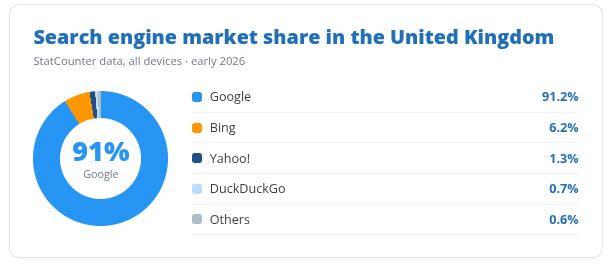
The British market is one of the most expensive—and at the same time, one of the most affluent—in Europe. The average transaction value is 3–5 times higher than in Ukraine, and shoppers are accustomed to ordering everything online, from food delivery to legal services. Google’s share of the country’s search engine market exceeds 90%, which is why contextual advertising in the UK remains the primary channel for quickly attracting customers—both for local companies and for businesses just entering this market.
SEO here takes 6–12 months to show results. Search advertising—on the very day of launch. If you have an online store, a service company, or a B2B service and need orders as early as this month, Google Ads in the UK gets the job done faster than any other tool.
How does the UK market differ from what you’re used to?
You won’t be able to simply copy and paste your campaigns “as is” from your Ukrainian account. Or rather, you can—but you’ll burn through your budget. Here’s what you’ll need to consider:
- Competition and bid prices. In London, dozens of companies are competing simultaneously in the auction for the search term “emergency plumber.” The cost per click in the legal niche ranges from £15 to £50, and in insurance, from £20 to £40. By comparison, appliance repair or cleaning services cost £1–4 per click. Before launching, calculate the economics of the niche; otherwise, your money will be wasted on blind testing.
- Language. British English isn’t just a formality. Brits write “trainers” instead of “sneakers,” “flat” instead of “apartment,” and “hire” instead of “rent” (when referring to people). Ads containing Americanisms lower the CTR and Quality Score. Localizing text to use local vocabulary is a mandatory step, not a nice bonus.
- Geography of demand. London accounts for up to a third of the country’s total traffic, but clicks there are 30–60% more expensive. Manchester, Birmingham, Leeds, and Glasgow are cities with decent demand and lower bid rates. Effective geotargeting with regional bid adjustments saves 15–25% of the budget.
- Legal framework. The UK GDPR and the PECR require consent for cookies before ad tags can fire. Without a proper consent banner, Google Ads loses some conversion data, and the business risks a fine from the ICO. Set up Consent Mode v2—without it, the algorithms train on incomplete data.
One detail that’s often overlooked: search works through Google.co.uk, and the results there differ from what you see in Ukraine. Check your competitors’ ads through the Ads Transparency Center or a VPN with a UK IP address, rather than through a regular search.
Which Google Ads formats work in the UK?
The choice of format depends on your niche and goals—leads, e-commerce sales, or brand awareness. In practice, Google Ads display campaigns in the UK are most often built around a combination of 2–3 ad types.
- Search ads—the foundation for services and B2B. A person searches for “accountant for limited company London,” sees an ad, and submits an inquiry. This offers the highest demand and the most transparent analytics.
- Google Shopping and product campaigns—the primary format for online stores. A card featuring a photo, the price in pounds sterling, and the store name appears directly in the search results. Brits actively compare prices, so a competitive offer is key here.
- Performance Max is an automated format that covers Search, the Display Network, YouTube, Gmail, and Maps simultaneously. It works well once you have accumulated conversion data, but requires careful monitoring at the start.
- The Display Network—banners on Google’s partner websites. It’s suitable for warming up an audience and for brand awareness campaigns, but not for direct sales.
- Retargeting—bringing back visitors who have left your site. In the UK, due to high CPC, this is a must-have: losing paid traffic without trying to bring it back is a waste.
- Google Demand Gen — visual campaigns on YouTube Shorts, Discover, and Gmail. Suitable for e-commerce and brands that need to generate demand, rather than just capture existing demand.
Let’s say you have a children’s clothing store that ships throughout England. The working combination looks like this: a product campaign covering the entire catalog, a search ad campaign targeting the brand and categories, and remarketing for abandoned carts. Performance Max is activated after a month or a month and a half, once enough data has been collected.
The Cost of Contextual Advertising in the UK
The question “how much does it cost” always breaks down into two parts: the advertising budget (the money Google charges per click) and the cost of hiring specialists. Let’s break down both.
Advertising Budget
There’s no fixed price—Google operates on an auction basis, and the cost of contextual advertising in the UK depends on the niche, region, and campaign quality. Approximate CPCs based on auction data:
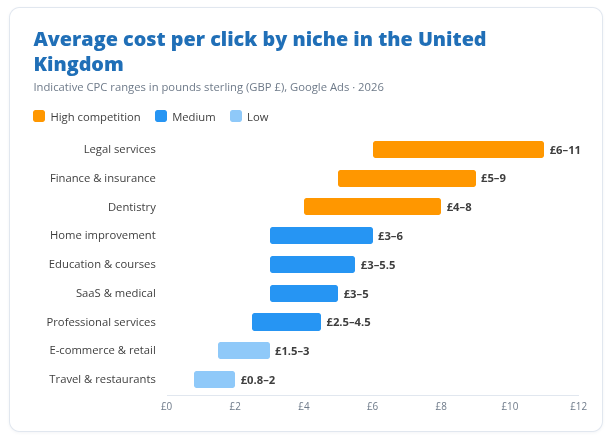
The minimum test budget for services is £600–1,000 per month; for an online store, it’s £1,000–1,500. With smaller budgets in competitive cities like London, the system simply won’t gather enough data for optimization.
Let’s look at an example. A cosmetic clinic in Manchester: CPC is about £3, and the landing page conversion rate is 5%. Each order costs £60. With a budget of £1,200/month, you’ll get roughly 20 leads. If the average procedure cost is £250 and half of the leads book an appointment, revenue is £2,500 with costs of £1,200 plus agency fees. The ROI is positive right from the start, and metrics typically improve over time through optimization.
Don’t rely on the cost-per-click figures shown by the Keyword Planner in the Ukrainian advertising dashboard without geotargeting set to the UK. Actual bids in the UK auction can vary significantly.
Cost of Setting Up Search Ads in England
Current prices for setting up contextual advertising in the UK through agencies usually consist of a one-time fee for launching the campaign and a monthly maintenance fee:
- setup from scratch (keyword research, account structure, ads, analytics) — from $400–800 depending on the number of ad groups and the complexity of the niche;
- management and optimization — $300–600/month or a percentage of the advertising budget (10–15%) for high-volume campaigns;
- audit of an existing account — $150–300; this amount is often later credited toward the cost of services.
Important! Prices charged by Ukrainian contractors are significantly lower than those in the UK: a London-based PPC agency would charge £500–1,500/month just for the management fee for the same tasks. At the same time, the caliber of specialists working with Western markets is comparable—the difference lies in the cost of living, not in quality.
How do we set up Google Ads for the UK market?
Launching an ad campaign for the UK takes 5 to 10 business days. Here’s the step-by-step process.
- Brief and niche analysis. We study the product, profit margins, and delivery or service regions. We analyze competitors in UK search results: their offers, prices, and landing pages.
- Keyword research. We select keywords based on UK vocabulary and search habits. We also carefully identify negative keywords—in the UK, there are many queries containing “free,” “DIY,” and “second hand,” which waste money.
- Account structure. We organize campaigns by category, region, and demand level. We set up geotargeting: precise radii for local businesses or the entire country with adjustments for e-commerce.
- Ads and extensions. We write ad copy in British English, include prices in pounds, specify delivery details (the British love “next-day delivery”), and add links to website sections.
- Analytics and cookie consent. We set up Google Analytics 4, configure conversion tracking, and implement Consent Mode v2 to comply with the UK GDPR.
- Launch and training. For the first 2–4 weeks, the algorithms gather information. A specialist cleans up search queries daily, adjusts bids, and disables underperforming ad groups.
Then comes the routine—but most important—part: optimization. A/B testing of ads, working on the Quality Score, and reallocating the budget to campaigns with the best ROI. A one-time setup without ongoing management almost never yields good results: the auction is dynamic, competitors adjust their bids, and seasonality shifts demand.
Common Mistakes Advertisers Make When Entering the UK Market
This list is compiled from real account audits of advertisers who tried to run ads on their own or hired freelancers with no experience working in the UK.
- Copying Ukrainian campaigns and simply translating them. They ran ads through a translation tool, changed the target location—and are surprised why the CTR is 1.5%. The search queries, offers, and objections of the British audience are different. Campaigns need to be built from scratch to match local demand.
- Ignoring mobile traffic. Over 60% of traffic in the UK comes from smartphones. If the landing page takes 6 seconds to load and the application form is difficult to use on a phone, the conversion rate drops by half—and no amount of ad optimization will fix that.
- Geotargeting that’s too broad. A service operates within a 20-mile radius of Birmingham, but the ads run across all of England. Or the opposite: a store delivers nationwide, but targeting is set only for London because “that’s where the money is.”
- Lack of conversion tracking. Without data on leads and sales, smart bidding strategies are operating blindly. Money is being spent, but there’s nothing to optimize.
- Cutting corners on the landing page. An expensive UK click requires a page that actually sells: a clear offer, prices, Trustpilot reviews, and a phone number with the +44 code. Driving traffic at £5 per click to the site’s homepage is the fastest way to become disillusioned with PPC.
Before launching, check the legal details: is the company’s address listed on the website, is there a privacy policy compliant with the UK GDPR, and does the cookie consent banner work correctly? Google is increasingly rejecting ads due to data protection issues.
Why should you hire an agency to run contextual ads in the UK?
Launching a campaign on your own is a viable option if you have the time to figure it out and a budget to cover mistakes. The math usually doesn’t add up: with bids of £2–10 per click, a month of a poorly optimized campaign costs more than six months of work by specialists.
A contextual advertising agency in the UK, with the right experience and market knowledge, offers three things that are hard to come by otherwise. First is experience: specialists already know which offers and formats work in specific UK niches, so they don’t waste your budget testing basic hypotheses. Second—speed: what a novice might spend three months testing, an experienced team can set up in two weeks. Third—consistency: regular optimization, reports with clear metrics (leads, their cost, ROI), rather than just “traffic is coming in.”
What to look for when choosing a contractor:
- case studies specifically from Western markets—the UK, the US, and Europe—not just local projects;
- Google Partner certification and access to Google support;
- transparent reporting: You can view the ad account, and the budget goes directly to Google, not through the agency;
- an understanding of the UK GDPR and experience setting up Consent Mode—this is a clear indicator that the team has actually worked with the UK.
It makes sense to order contextual advertising in the UK before your website and offer are “perfected.” A good contractor will advise you as early as the audit stage on what to improve on the landing page, what budget to set, and which niches within your industry will provide the fastest return on investment. Having an experienced team set up contextual advertising in the UK isn’t an expense—it’s a way to reach profitability 2–3 months earlier.
Pay-per-click advertising in England leaves little room for error due to high cost-per-click rates, but it also rewards generously: a solvent audience, high average order values, and a market where, with the right approach, promoting your business in the UK pays for itself within the first few months. Send us your niche and website—we’ll calculate a budget forecast and cost per click estimate for your project free of charge.