Performance Max is perhaps the most automated and, at the same time, the most closed format for advertising campaigns in Google Ads. The system itself determines the audience, selects placement sites, and chooses creatives. On the one hand, this saves time. On the other hand, you are effectively handing over control to the algorithm and do not always understand where your budget is going.
For example, you launched a campaign three months ago. You’re getting impressions, clicks, and even conversions. But for some reason, the cost of customer acquisition is rising, and the quality of leads is falling. What’s wrong? Without expert analysis, it’s almost impossible to answer this question. This is where a Google Performance Max audit comes in handy—it allows you to look inside the “black box.”
Why is it difficult to analyze a Performance Max campaign on your own?
Performance Max campaigns automatically cover all of Google’s advertising inventory: search results, YouTube, Gmail, the Display Network, Google Maps, and the Discover feed. All you need to do is specify your business goals and upload your ad creatives—the algorithm will then decide where, when, and to whom to show your ads.
It sounds like a marketer’s dream. In practice, however, there is a serious problem: Google only provides generalized statistics and does not disclose details. You can see the total number of conversions, but you don’t know whether they came from search, YouTube, or the display network. This lack of transparency creates a false impression that everything is working perfectly, when in reality the situation may be completely different.
Here are the most common problems advertisers encounter when working with PMax:
- Paying for traffic under your own brand. Part of your PMax budget may be spent on people who are already searching for you by company name — they would have come anyway. But reports won’t show how much money was spent on such “ready-made” customers and how much on attracting a new audience.
- It is unclear whether audience signals are used. You have uploaded lists of similar audiences and specified the interests of potential buyers. But does the algorithm use this data or ignore it completely? There is no answer in the standard reports.
- It is unclear how the algorithm evaluates creatives. Google assigns ratings such as “low performance” or “best result” to objects. But why does this particular headline perform worse? Which image brings more conversions? There are no details — only general labels.
- Questions about attribution. Are the actions that are important for the business counted as conversions? Or is the algorithm optimized for something else—for example, micro-conversions that do not lead to sales?
An important nuance: PMax tends to “intercept” conversions from your other campaigns. Imagine: a person saw your ad in a search campaign, remembered the brand, and then clicked on a PMax banner and placed an order. The conversion will be counted, even though the search campaign did the actual work. Without a detailed audit of your Performance Max campaign, you risk disabling effective tools and leaving those that only take credit for someone else’s work.
When exactly should you order a Google Performance Max audit?
- The indicators began to stall or roll back. Just a month ago, the cost of conversion remained at a comfortable level, but now it is growing week after week. At the same time, the number of applications is falling, although the budget is being spent at the same rate. This is a typical scenario when the algorithm has “hit the ceiling”: it has found a specific audience, squeezed the maximum out of it, and is now spinning its wheels. Or, worse, it has started showing ads to people who are simply not interested in your product.
- The campaign has just been launched, and you want to check the settings. The first few weeks of PMax are the most expensive in terms of potential errors. An incorrectly selected conversion goal, a weak set of creatives, empty audience signals — all of this leads to the algorithm learning from incorrect data. For example, if you sell premium furniture and specify viewing the contact page as a conversion, the system will optimize for random visitors rather than real buyers.
- You changed agencies or took over advertising yourself. The new team gets access to the account and sees a campaign set up by someone else. What works here? What should have been disabled long ago? Which decisions were deliberate, and which were random? Without a Google Performance Max audit, you’ll have to fly blind or spend weeks studying the structure yourself.
- Your business is growing, and you are planning to increase your budget. Before doubling or tripling your advertising investment, it is important to make sure that the foundation can handle the load. It happens: a campaign works great at $100,000 per month, but at $300,000 it starts to fall apart — the algorithm goes beyond the target audience, the quality of leads drops, and CPA skyrockets. Ordering a Performance Max audit before scaling means identifying weaknesses in advance and preparing the structure for growth.
What does a Google Performance Max advertising audit include?
The specialist systematically studies each element: from basic settings to the smallest details in creative content. As a rule, we analyze:
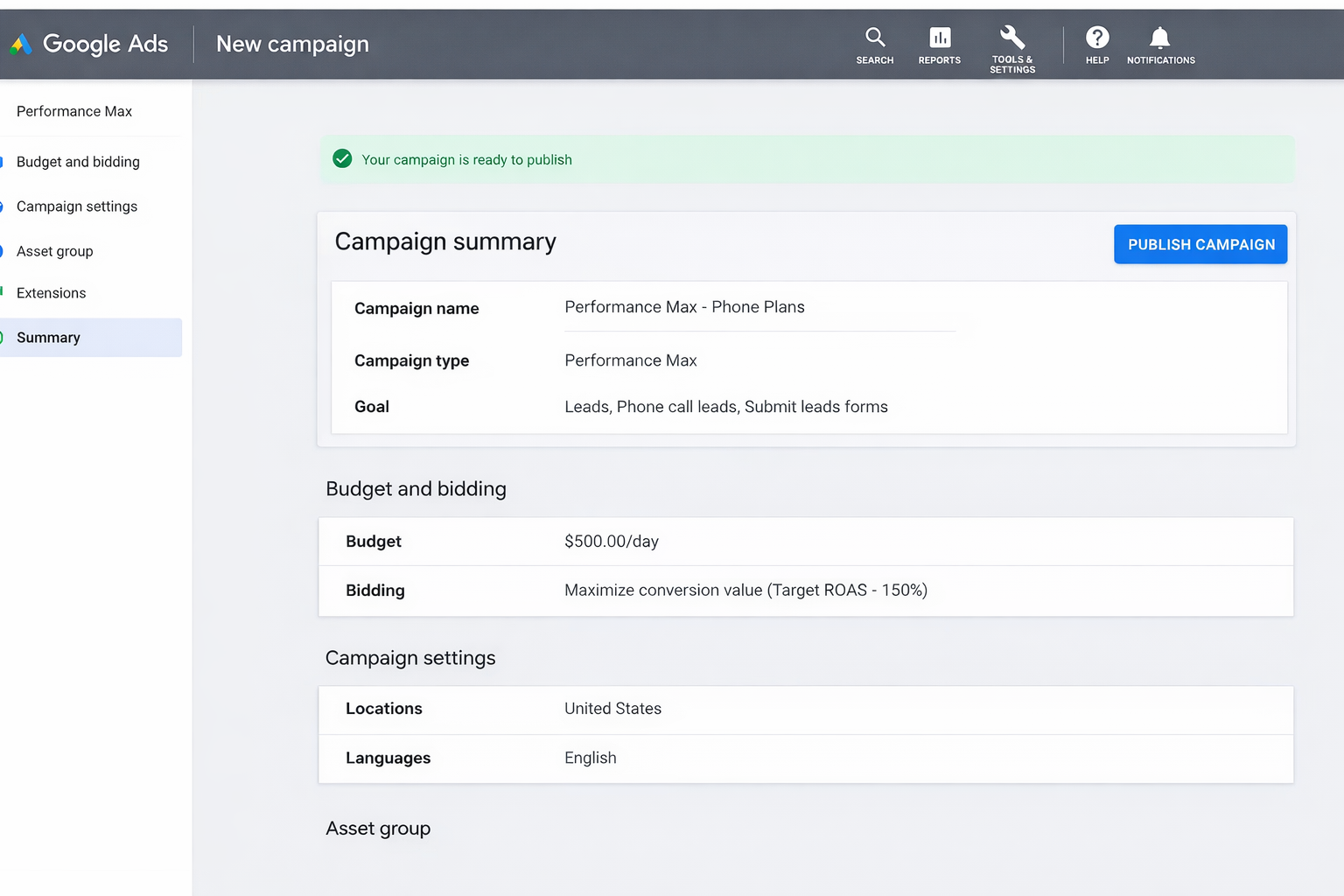
- Campaign structure and settings. A PPC specialist checks the correctness of the selection of goals, the settings of object groups, and the presence of division by product categories or audience segments. A common mistake is to lump everything into one group. For example, an online clothing store adds men’s jackets, women’s dresses, and children’s jumpsuits to a single group. The algorithm simply does not understand what to show to whom, and you then cannot figure out which product is actually generating sales.
- Conversion goals and their value. This is perhaps the most critical point. A Performance Max audit must include a review of which user actions are counted as conversions, how they are technically configured, and what value is assigned to them. Imagine: you sell industrial equipment with an average check of 500,000 hryvnia. At the same time, both completed orders and clicks on the “Show phone” button are recorded as conversions. If both actions are assigned the same value, the algorithm will chase cheap clicks on the phone instead of real deals.
- Product feed quality. During the audit of Performance Max advertising campaigns, the following are checked: completeness of mandatory attributes (titles, descriptions, high-quality images, current prices), errors and warnings in Merchant Center, use of custom labels for product range segmentation.
- Creatives and objects. A specialist evaluates a set of uploaded materials: images in various formats, videos, headline and text options. Google assigns internal ratings to objects (“low effectiveness,” “good,” “best result”), but these ratings do not always reflect the real picture. It is important to check several points: are there enough variations for full-fledged A/B testing, do the photos and texts meet the expectations of the target audience, are there any obviously unsuccessful elements that spoil the overall statistics?
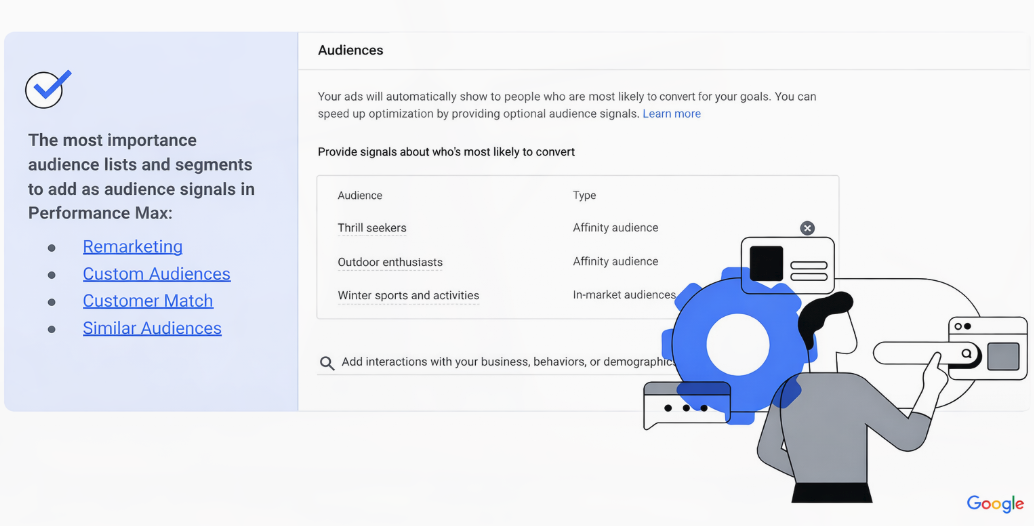
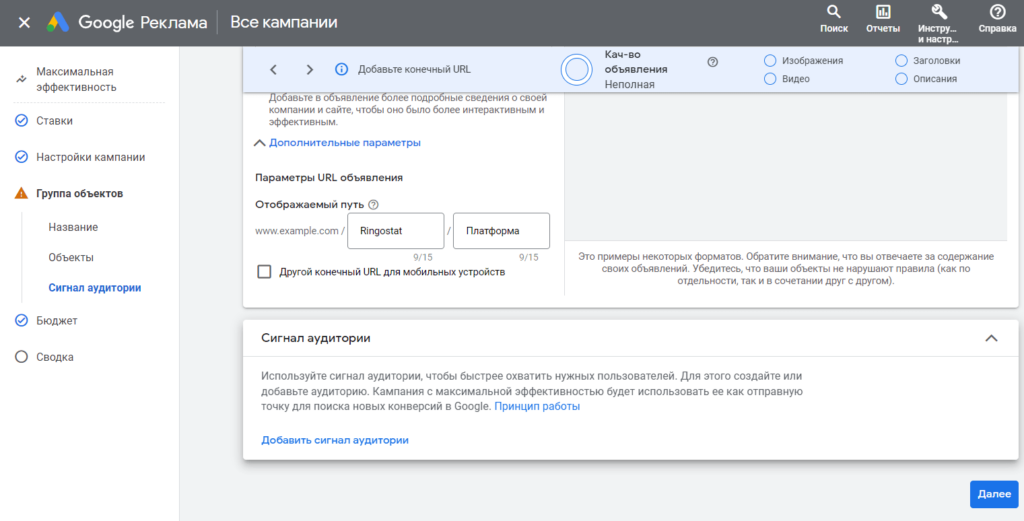
- Audience signals. These are unique prompts for the algorithm: “Pay attention to these individuals first.” During the verification process, we determine whether signals have been added at all (surprisingly often they are simply forgotten), how well they match the buyer’s profile, and whether remarketing lists and existing customer data are connected.
- Exclusions and negative keywords. It is important to understand whether brand queries are excluded (so you don’t pay for those who are already searching for you by name). Are irrelevant regions excluded? Are sites with low-quality traffic blocked? When there are no exceptions at all, your budget is wasted on ads in mobile games for children or on sites with questionable content — and you won’t even know about it.
What are the stages of a Google PMax campaign audit?
At our agency, Google PMax auditing is a clearly structured process consisting of five consecutive steps. Each stage fulfills its own purpose and prepares the ground for the next one.
- Collecting access and source data. It all starts with gaining access to advertising accounts. We will need Google Ads and Analytics — preferably with statistics accumulated over at least 30–90 days. If you sell goods online, Merchant Center is also added. Why is history important? Without it, we will only see the current snapshot, but we will not understand the dynamics: whether the indicators grew, fell, or remained unchanged.
- Technical analysis. At this stage, we check the “infrastructure”: are conversions set up correctly, are all accounts linked, and are tracking tags working correctly? This is the foundation of the entire audit. Let’s say the purchase tag is set up incorrectly and only records every third transaction. Then all the metrics in the reports — CPA, ROAS, number of sales — will be distorted. Any conclusions based on such data will lead to incorrect decisions.
- Analysis of structure and content. Here we break down the campaign into its constituent parts: object groups, uploaded creatives, product feed, audience signals, and configured exclusions. For each element, we record any problems we find and potential areas for growth. For example, we see that one group of objects contains a mix of products priced at 2,000 and 200,000 hryvnia — we record this as a structural error. We notice that competitors are actively using video creatives, but you don’t have any — we mark this as an opportunity.
- Effectiveness analysis. Let’s move on to the numbers. We study key metrics in dynamics: how the cost of conversion changed over weeks, what ROAS the campaign shows, how much traffic comes from different channels (as far as Google PMax reports allow us to extract), and what is the quality of incoming leads. Be sure to compare the results with other campaigns in the account and with industry benchmarks. If the average CPA in your niche is 800 hryvnia, and yours is 2,500, that’s a reason to dig deeper.
- Preparation of the report and recommendations. The final stage is the creation of a document with the results. These are not abstract arguments along the lines of “improve creativity,” but a concrete plan: what to fix, in what order, and what results to expect. Each problem is given a priority—critical, important, or desirable to fix.
It is important to understand that an audit is a diagnosis, not a cure. You get a complete picture of the state of your campaign and step-by-step instructions for improvement. Then it’s up to you: implement the recommendations yourself, pass them on to your current contractor, or entrust the implementation to our team.
What results can you expect from a Performance Max advertising campaign audit?
When the Google Performance Max audit is complete, you receive not just a report with statistics, but a comprehensive roadmap: where you are now, what is going wrong, and where to go next. It usually includes:
- Budget leaks detected. You will finally understand where your money is actually going. What percentage is spent on showing ads to people who will never become your customers? How much is “eaten up” by branded queries, even though these users would have found you in organic search results anyway? Which platforms generate clicks but don’t bring in any conversions?
- Ranked list of errors. Problems in a campaign are rarely equal. One error can cost you 30% of your budget, while another may only cost 2%. We sort all findings by their impact on the result: critical ones go to the top of the list, cosmetic ones go to the bottom. This way, you know exactly what to tackle first.
- Detailed recommendations for optimization. No vague phrases like “work on your creatives.” Instead, specific instructions: replace this headline because it duplicates another one, add a 16:9 video for YouTube, exclude mobile app impressions, upload a list of buyers from the last year as an audience signal.
- Growth potential forecast. Based on our analysis, we assess what improvements can realistically be achieved after implementing the recommendations. For example: a 15–25% reduction in customer acquisition costs, a 20% increase in ROAS while maintaining the current budget, and an increase in the conversion rate from new users.
- An independent view of the campaign. If advertising is handled by an in-house marketer or an external agency, the audit becomes a control tool. You receive an objective assessment from specialists who are not affiliated with the current contractor and have no interest in embellishing the results.
A real-life example. An online electronics store with a monthly budget of 50,000 UAH approached us. After auditing Google Performance Max ads, we discovered something unexpected: almost 40% of all expenses were spent on brand-related searches. In other words, the company was paying for clicks from people who already knew the name of the store and would have found it through a regular search for free. We recommended excluding branded keywords from PMax and redirecting the freed-up budget to attract a cold audience. The result: with the same UAH 50,000 budget, the number of orders increased by 30%, and these were from customers who had not previously known about the store.
Google PMax audit cost
The price of a Google Performance Max campaign audit depends on the scale of the project: the number of campaigns, the size of the product catalog, and the depth of analysis required. We offer three cooperation options so that you can choose the one that best suits your needs:
- Basic Plan ($350). Suitable if you need to quickly understand what is happening with your campaign and get guidance for improvements. The package includes checking the campaign structure and logic of dividing objects into groups, analyzing conversion settings: what goals are being tracked, whether their values are correct, evaluating the quality of creatives and the relevance of audience signals, and a final document with a list of identified problems and recommendations for correction.
- Extended plan. Everything from the basic package plus a video recording with a detailed analysis. A specialist reviews your account, shows specific settings, explains why there is a problem, and how to solve it. This format is convenient in two cases: when you want to understand the details yourself, or when you need to share the results with your team or contractor. You have to agree that a video with real-life examples is easier to understand than ten pages of text.
- Expert Plan. The most comprehensive option. Includes everything from the previous plans, as well as an hour-long consultation with a technical specialist. During the call, you can ask any questions about implementing recommendations, discuss non-standard situations, and talk about the specifics of your business. For example, if you have a complex sales funnel with a long decision-making cycle, we will discuss how to take this into account when optimizing.
The cost of the extended and expert packages is calculated individually. Two main factors influence the final price. First, the number of PMax campaigns in the account: analyzing five campaigns takes more time than analyzing one. Second, the size of the product feed — for an online store with 10,000 SKUs, checking the catalog becomes a separate full-fledged stage of work.
Want to know the exact cost for your project? Leave a request on the website or give us a call. We will review your account and prepare an offer tailored to the specifics of your business.
A standard campaign audit takes 3 to 5 business days—the exact time depends on how many campaigns need to be analyzed and how complex the account structure is. If we are talking about a large online store with a catalog of several thousand items, the time frame increases to 7–10 days: a significant part of the time is spent on a detailed analysis of the product feed.
No, there is no need for that. Campaigns continue to run as usual, with impressions and clicks proceeding normally. We work exclusively with data and reports, without altering any settings. You will not lose a single day of active advertising.
Of course. We can conduct a PMax audit for all campaigns in your account or focus only on specific ones—for example, those that spend the most or show the worst results. The choice depends on your priorities and the budget allocated for diagnostics.
We guarantee the quality of the analysis itself and the practical applicability of each recommendation—this is entirely within our area of responsibility. The final results depend on many variables: the level of competition in your niche, product quality, the speed of implementation of changes, and seasonal fluctuations in demand. However, in our experience, clients who implement recommendations in full, rather than selectively, see a noticeable improvement in performance within 4–8 weeks after the start of optimization.