When you launch an online ad campaign, one of the first questions you ask is how much the impressions will cost. To answer this question, the CPM metric was invented, which shows the price per thousand impressions of your ad to the audience.
This payment model is particularly popular in situations where you need to reach as large an audience as possible with your advertising. For example, you are launching a new product line or want to tell millions of potential buyers about a seasonal sale.
Understanding what CPM is in advertising allows you to allocate your budget wisely and assess which platform will give you greater reach for the same amount of money. Let’s take a look at how this works using specific examples.
What is CPM (Cost per Mille)?
The abbreviation CPM stands for Cost per Mille. The word “mille” comes from Latin and translates as “thousand.” The essence of the model is simple: you pay a specific amount of money when your ad is seen by 1,000 users. It does not matter whether the ad interested the user enough to click on it. It is enough that the banner or promotional video appeared on their screen — the impression is already counted.
Interestingly, the Cost per Mille model came to digital marketing from the world of traditional media. TV channels and print publications have always operated on the basis of thousands of contacts with their audience — after all, a single advertising block during prime time attracts hundreds of thousands of viewers. This calculation principle proved to be logical for the online environment as well.
How does it work? You set up a banner campaign in your advertising account. The system automatically tracks every time your creative appears to users. Once you reach a thousand impressions, the agreed amount is deducted from your budget. No manual calculations: the platform takes care of all the routine work.
CPM is the optimal payment model for banner and video advertising, where the key task is to reach as many people as possible. Launching a new product? Announcing a store opening? Want to increase brand awareness? Then this model is ideal. Compared to CPC, where you pay per click, and CPA, where you pay per conversion, here you are investing in visibility — in simply making your audience aware of your existence.
Key features of the CPM model
- Only impressions are counted. When using the CPM model, the advertiser pays for the user seeing the ad, regardless of whether they clicked on the link or not. For example, if your banner is displayed on a news site page, the impression is counted even if the visitor simply scrolls down the page.
- Clicks are free. Since payment is tied to impressions, all clicks on your ad don’t cost a penny. This is beneficial when your ad really attracts attention: you paid for a thousand impressions and got a hundred clicks at no extra cost.
- Precise targeting. Advertising platforms allow you to customize who exactly will see your ad. You can specify age, city, interests, profession, and other parameters. For example, if you sell children’s products in Kyiv, you can set your ads to be shown to women aged 25–40 with children who live in the capital. This way, your budget will not be wasted on those who are not interested in your offer.
- It is more difficult to predict expenses. Unlike the pay-per-click model, here the rate at which the budget is spent directly depends on the traffic to the site. Have you placed a banner on a popular portal with an audience of millions? Prepare for rapid expenditure. If you choose a niche blog, impressions will accumulate more slowly, but your budget will last longer.
What is CPM used for?
In internet marketing, CPM is primarily needed to assess how effective media advertising is. Knowing the price per thousand impressions, you can compare different websites, advertising formats, and campaigns—and then choose the option with the best ratio of reach and cost. Incidentally, this metric is not only applicable to banners: it also works well for contextual and targeted advertising.
This model is ideal for businesses that need to convey information to as many people as possible. Let’s consider some typical situations:
- Increased brand awareness. You are just entering the market or want to expand your audience. For example, you are planning to open a chain of pizzerias in Odessa — launch a CPM campaign a couple of weeks before the launch, and by the time you open, the city’s residents will already know your name and logo.
- Launching a new product. When you need to quickly introduce a new product to the market, pay-per-view advertising works better than other models. Yes, wide coverage will require significant investment, but the information will reach a huge number of potential customers in a short period of time.
- Announcements of promotions and special offers. Seasonal sales, the launch of a loyalty program, the opening of a new branch—all of these can be conveniently promoted through pay-per-view media. But there is an important point to consider: this tactic is effective if the audience is already familiar with your company. A banner advertising “50% off” from an unfamiliar brand is more likely to alarm users than encourage them to click.
It is worth remembering that CPM advertising requires an adequate budget. Placing an ad on a popular portal can “eat up” your daily limit in just a few hours — impressions accumulate rapidly, and money is debited at the same rate.
Advantages of the CPM payment model
- Budget transparency. You know in advance how much a thousand impressions cost, and you can plan your expenses accurately. Even if competition on the platform increases, the price will remain within the set limit. For example, if you budget 5,000 hryvnia at a CPM of 50 hryvnia, you will get exactly 100,000 impressions, with no unpleasant surprises.
- Maximum audience reach. When the main goal is to show an ad to as large a target audience as possible, the CPM payment model performs better than others. Launching an advertising campaign for a seasonal collection before the holidays? For a fixed price, your banner will be seen by thousands of potential buyers.
- Freedom in choosing formats. This model works equally well with banners, videos, native advertising, and other formats. You can experiment: test an animated banner against a static one, compare the results, and choose the option that engages your audience more.
- Easy analytics. Data on impressions is available in real time, and you can evaluate effectiveness in literally a minute. Open your advertising account, look at the CPM, and you’ll immediately see how much you’re paying for every thousand contacts with your audience. No complicated formulas or lengthy calculations.
Disadvantages of the Cost per Millenium model
Despite all its advantages, Cost per Millenium has a number of significant drawbacks that are worth knowing about in advance:
- Payment does not guarantee results. You pay for impressions, not clicks or purchases. If the goal of the campaign is specific user actions (applications, sales, registrations), part of the budget will inevitably go to those who simply scroll past your ad. For example, out of 10,000 impressions, only a few hundred people may be genuinely interested in the offer — the rest of the contacts may turn out to be “empty.”
- The risk of banner blindness. When the same user sees your ad over and over again, they stop noticing it. Worse still, intrusive advertising can cause irritation and negativity towards the brand. Without setting a frequency cap, you risk alienating customers rather than attracting them.
- High prices on popular platforms. Advertising on top Ukrainian portals with millions of visitors will be expensive. In some areas, such as finance, real estate, and luxury jewelry, the cost of a thousand impressions may exceed the cost of CPC or CPA campaigns with the same reach.
- It requires precise targeting settings. Without accurately determining geography, age, interests, and other parameters, the budget will be “spread” across random users. For example, if you advertise the services of a wedding photographer in Lviv, but the ads are shown throughout Ukraine, including to teenagers, the money will be wasted and there will be no benefit.
How to calculate CPM?

To calculate CPM, use this simple formula:
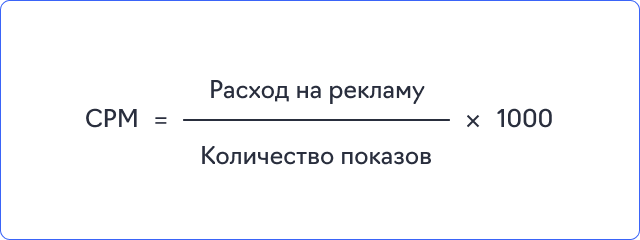
In the CPM formula, costs are the amount you pay to place an ad on the selected platform (for example, Google AdWords). Impressions are data on estimated or actual views of the ad on that resource.
Let’s look at a specific example. Suppose you place a banner on a popular Ukrainian news portal. The cost of placement is 12,000 hryvnia per week, and the site’s traffic for this period is 80,000 users.
Substitute the values into the formula:
(12,000 ÷ 80,000) × 1,000 = 150 UAH.
It turns out that a thousand impressions of your ad on this platform will cost 150 hryvnia.
Knowing this indicator, you can compare different placement options. For example, another site offers advertising for 8,000 UAH per week with 40,000 visitors:
(8,000 ÷ 40,000) × 1,000 = 200 UAH.
Although the absolute cost is lower, the CPM is higher here, which means that the first platform is more profitable in terms of price per impression.
What determines the CPM indicator in advertising?
The cost of impressions is influenced by many factors. Some of them are beyond the advertiser’s control, while others can be adjusted to their advantage. Let’s take a look at the main ones:
- Geographic targeting. Advertising in Kyiv is traditionally more expensive than in regional centers or small towns. The reason is simple: the audience has higher purchasing power, and more competitors are fighting for its attention. If your business operates throughout Ukraine, it makes sense to divide your campaigns by region and compare the CPM in advertising for each of them.
- Targeting accuracy. The better you define your target audience, the more effectively your budget will be spent. Conduct A/B testing of different segments to find the user groups with the best response and reduce the cost of impressions.
- Site theme. Niches with a solvent audience are more expensive. Advertising on Ukrainian business portals or financial resources will cost several times more than on hobby or gardening websites. The logic is simple: readers of business publications are more likely to make decisions about large purchases.
- Ad format. Video ads cost more than static banners because they grab attention better. Location also plays a role: banners at the top of the page immediately catch the eye, so more is charged for this placement.
- Seasonality. In winter, air conditioner ads will show a low CPM, but before summer, the price will rise along with demand. Keep this in mind when planning your campaigns—sometimes it’s more profitable to launch a little earlier than the season.
- Competitor activity. More advertisers on the platform means higher bids for impressions. Keep an eye on your competitors and choose periods when they are less active. Launching a campaign before the main wave of competitive activity often yields better results at a lower cost.