ROAS is perhaps the most popular metric among online store owners. They look at it first, discuss it with contractors, and build team KPIs based on it. But what if blind faith in it prevents you from making money?
Let’s analyze the most common misconceptions about ROAS and discuss why in certain cases it makes sense to consciously “sacrifice” this coefficient for real profit.
Why is ROAS so beloved in e-commerce?
ROAS (Return on Ad Spend) — the profitability of marketing expenses. A metric that answers the question: how much revenue did we get from our advertising investments. The formula is incredibly simple: revenue divided by ad spend. Spent 10,000 UAH, received 40,000 UAH in revenue — ROAS = 4 (400%).
This metric is loved for its speed and clarity. Launch a Google Ads campaign — within two weeks it becomes clear whether it will pay off. No need to wait for the accounting department to prepare a quarterly report. No need to collect data from departments. Just look at the numbers in the ad account — and it’s already clear which direction to move.
That’s why Target ROAS is a very popular bidding strategy in Google Ads, and owners of online stores on Shopify, WooCommerce, and similar platforms monitor this metric daily in dashboards. The logic is clear: high value — the campaign brings money, low ROAS — look for and fix problems.
Only this logic is often wrong.
Why ROAS is not the main metric for a small online store?

Imagine the following situation: ROAS = 5. Every hryvnia invested pays back fivefold. You open a bottle of champagne. Then you sit down to calculate — and it turns out the business is in the red.
ROAS only considers revenue. Not the cost of goods, operational expenses, salaries, warehouse rent, packaging, delivery, returns. It sees “X UAH received into the account” — and doesn’t care that the real profit is pennies. Or that there is none at all.
Let’s look at a clear example from the unit economics of an online store. Product price — 2,000 UAH. Cost price — 1,200 UAH. That leaves 800 UAH gross profit. Subtract operational costs — about 200. That leaves 600. Now we’re ready to spend 400 UAH on marketing. Net profit — 200 UAH. Ten percent. Not much, but workable.
Now imagine that CPA (customer acquisition cost) turned out to be not 400, but 600. Profit shrank. To zero. Further — into the red. And ROAS remains “normal” — 3.3. On the dashboard everything looks decent. In reality — you’re working for free.
Important! ROAS does not account for product margin. If the markup is 200% — ROAS = 2 may be enough for profitability. But if the margin is 15% — even ROAS = 7 won’t save you from losses. Before setting a target ROAS in your ad account, calculate your break-even point.
The most common myths about ROAS

A whole set of misconceptions has formed here. Let’s look at the loudest ones.
Myth 1: “The higher the ROAS — the better”
It seems logical. But in practice, maximum ROAS often means you’re selling little. Google Ads algorithms (that same Performance Max) can maintain high ROAS by showing ads to the “hottest” audience — people searching for your product. Yes, all customers pay off excellently. But there are few of them. Plus, competitors take them away, because in Google’s auction, whoever pays more gets more impressions.
Imagine: Store A has ROAS = 10, but only 30 sales per month. Store B has ROAS = 4, but 200 sales. Who has better profit in monetary terms? Almost always — Store B. If, of course, unit economics allows it.
Myth 2: “If ROAS is positive — the campaign is profitable”
A classic trap. Positive ROAS does not equal profit. It only means that revenue exceeds advertising expenses, and this is only a small part of all costs. The rest ROAS doesn’t account for.
A clear example: an online medical equipment store had a ROAS of 147% — at first glance, everything is fine, revenue exceeds expenses. But if you calculate margin, it turns out that ROI is -31% — real losses.
Myth 3: “High lead cost is bad”
This is where it gets interesting. High customer acquisition cost (CAC) can be quite justified — if the customer returns. Cosmetics, household chemicals, pet food, pizza delivery, sushi — niches where the first sale may well be break-even or unprofitable. The money comes from the second, third, fourth and subsequent sales.
Pizzeria owners have long known: you won’t make money on the first two orders. The game starts from the third-fourth. But these orders don’t require marketing — the customer comes in on their own. That’s where the real math begins.
Myth 4: “ROAS is the same for all niches”
No chance. For e-commerce in the product business, the classic break-even point is ROAS within 3-4. B2B and services — 5 and above due to the long sales cycle. Info products — 2-3 may be enough, since margins are high. For streaming services, normal ROAS is 2 (“saved” by subscription bringing regular income).
Myth 5: “ROAS shows the real effectiveness of each channel”
Only partially. A user might see an ad on Google, come through organic search, then compare prices on Rozetka, return through remarketing on Facebook — and make a purchase.
Which channel gets the sale? It’s an attribution question, and ROAS doesn’t answer it. It will show numbers for the channel where the last click was (or first — depending on the model). The real picture is much more complex.
Mistakes in calculating ROAS that lead business to losses
These mistakes are often made by small online stores when evaluating advertising effectiveness. They seem like small things, but because of them the advertising budget gets “burned”.
- Calculating ROAS based on sale price, not margin. You take revenue of 2,000 UAH, divide by 400 advertising costs, get ROAS 5 — and rejoice. But when you subtract 1,200 cost price and 200 UAH operational costs from 2,000, you have 600 UAH left, where 400 went to marketing. Net profit — 200 UAH. In fact, advertising paid off 1.5 times, not 5.
- Not paying attention to conversion tracking failures. Setting up advertising in Google Ads is a delicate matter. If the conversion tag suddenly stops working, call tracking turns off, or Performance Max trains on the wrong goal — ROAS will show incorrect data. And for a long time. And you’ll make decisions based on wrong data.
- Not accounting for the optimization period. The first 14 days of any new advertising campaign is the algorithm’s learning period. During this time, CPA is higher, and ROAS is lower. This is normal. If you turn off the campaign after a week because it’s “performing poorly,” you don’t give the AI system enough data to work correctly.
- Comparing ROAS with a competitor working under different conditions. A major player in the cosmetics niche has an average check of 3,500 UAH and a well-tuned sales funnel. Yours is 1,200 UAH, and you’re just entering the market. Naturally, you can’t afford the same CPA. This isn’t a reason to “give up” — it’s a reason to build your strategy based on your own numbers.
When is high CPA and low ROAS normal?
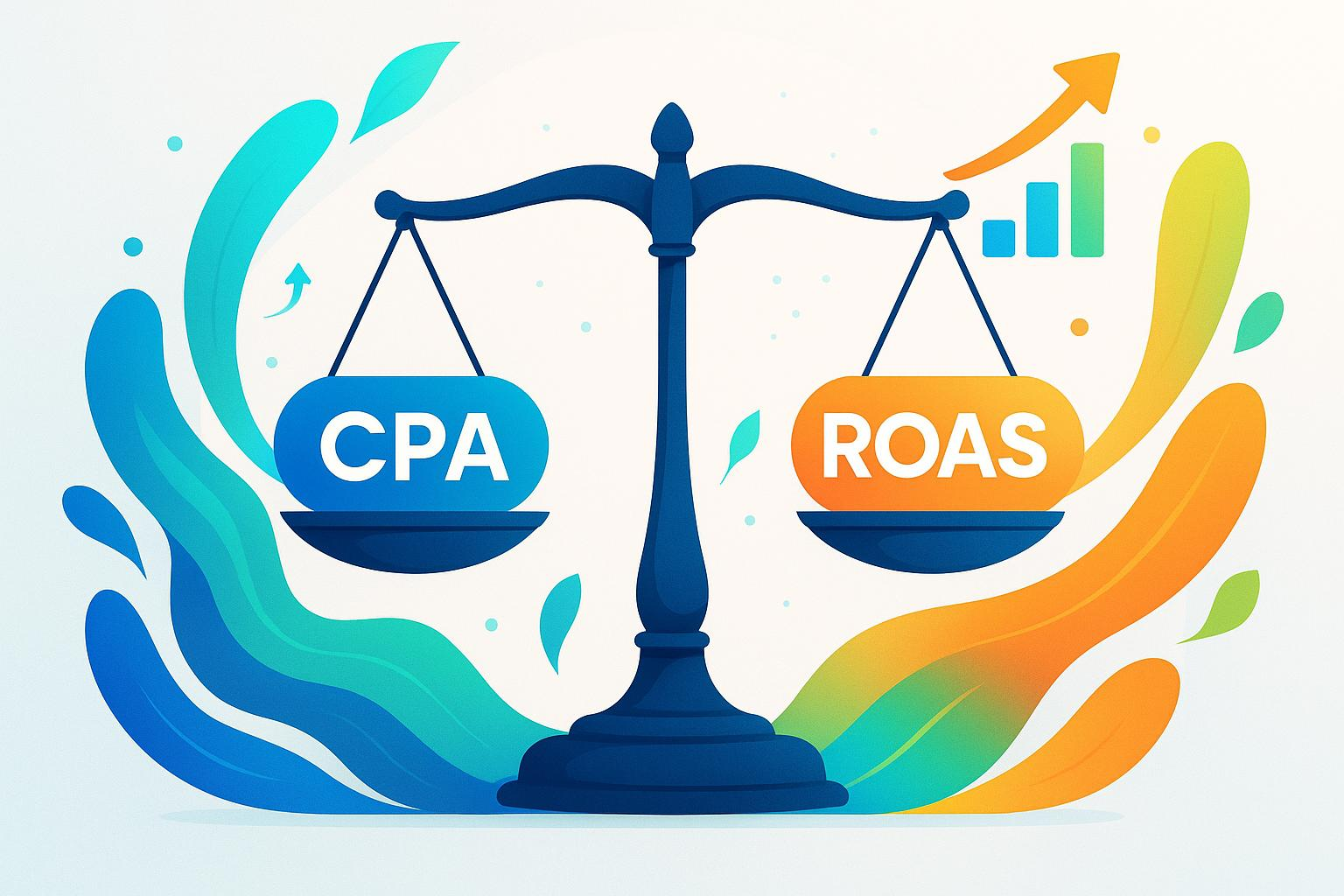
Now let’s move to the most interesting part. There are a number of situations where a small business owner can consciously go for expensive traffic and low ROAS, and it will be the right decision.
- Repeat purchases in the niche. If the product is bought regularly (cosmetics, pet food, household chemicals), focus not on profitability, but on customer LTV for a year or the entire lifecycle. In this logic, a CAC of 600–900 UAH for a 1,500 UAH purchase is quite acceptable if the customer returns 4-5 times a year.
- Optimization period. The first 7-14 days the Google algorithm goes through learning. You consciously pay for a lead, knowing that once the AI collects statistics, CPA will decrease and ROAS will increase. The main thing — the team must understand what technical tasks need to be completed during this period.
- Entering a new niche or new category. You’re a stable business selling products in ten categories, and you’re launching an eleventh. Or you’re a small store just entering the niche. Competitors know how to increase average check, they have upselling in place — your average check is lower. This isn’t a reason to give up. This is a reason to understand that for the first few months CPA will be high, and plan from which sale the customer will start bringing profit.
- Demand spikes and market disruptions. Black Friday, seasonality, power outages, lockdowns — everything affects audience behavior and advertising algorithm performance. During such periods, ROAS may decrease, but this doesn’t mean campaigns are ineffective. It means the market is going through turbulent times, and you need to wait it out.
- Geographic limitations of the business. Imagine a local pizzeria with three locations in Kyiv’s Darnytskyi district. A competitor has 20 locations across all of Kyiv. Thanks to daily audience migration (morning to the right bank, evening — home), the big player covers a wide circle of customers. It’s easier for them to achieve scale effects. The local pizzeria will have to accept that payback won’t come immediately. This isn’t a strategy error, but a feature of geography.
Attention! If you position yourself as a brand occupying your niche, not just as a “store selling something,” short-term ROAS should not become the main KPI. Pay attention to LTV, upsells, market share.
How to calculate ROAS correctly so as not to deceive yourself?
- Calculate ROAS based on margin. This will give a real picture of advertising payback.
- Keep the break-even point in sight — the minimum value at which the campaign doesn’t go into the red. The formula is simple: 100% / margin. If margin is 25% — your break-even ROAS = 4 (or 400%). Anything lower — losses.
- Along with ROAS, pay attention to MER (Marketing Efficiency Ratio) — this is the ratio of total revenue to total marketing costs. This metric gives a realistic picture, as it accounts for all channels together.
- Account for LTV. If your buyers return — calculate payback over three to five deals.
- Monitor ROI — similar to ROAS but accounting for cost price and additional expenses. This is the full picture.
What should ROAS be to avoid going into the red?
Depends on margin. Simple example: if your markup is 100% (i.e., margin 50%) — minimum break-even ROAS = 2. If margin is 33% — ROAS must be at least 3. If 25% — then 4. If 15% — then 7.
Hence a simple formula: target ROAS = (1 / margin) × profitability coefficient. If you want to get 10% from sales with a 25% margin, your target ROAS will be about 4.4-4.5.
But this is only the break-even point of one sale. If you sell a product that people buy repeatedly — add expected LTV to the calculation. Then the numbers look completely different. Perhaps you’re not afraid of ROAS = 2 at all on the first deal — because over a year the person will buy 8,000 worth from you.
Why focusing exclusively on ROAS is dangerous for the Ukrainian market?
Ukraine has its own specifics that cannot be ignored. The rules of the game change quickly: first COVID, then full-scale war, then power outages, then another currency jump. In such conditions, planning 5-10 years ahead is a luxury that most small businesses cannot afford.
Therefore, the Ukrainian entrepreneur wants to see payback quickly: one and a half to two years maximum. This creates pressure on ROAS — everyone wants “advertising to pay off now, not in a year.” And this is understandable. But if you want to build a brand, not just “sell goods” — you’ll have to think in terms of LTV and repeat sales. Otherwise, you’ll lose to those who do.
In Western markets, it’s considered normal when a project pays off in 6, 10, 12 years. Because the situation there is more stable. Here things are different — and that’s why unit economics focused on quick repeat purchases becomes a life preserver.
Why high ROAS doesn’t guarantee profit (and when is this especially noticeable)?
Remember the scene from “Silicon Valley.” One team member is on the phone and joyfully says: “We’re turning a profit!” Another grabs the phone: “No profit! There will be no profit! We can’t afford profit!”
Sounds paradoxical. But the logic is: for a startup, revenue is a sign that there’s nowhere left to grow. If you’re making money — it means aggressive scaling has stopped. And investors need growth, not small income.
The situation with online stores is somewhat different, but there’s a parallel. If your ROAS is off the charts, but turnover is stagnant — perhaps you’re underinvesting in marketing. You could be growing, conquering the market, entering new niches. But you’re afraid to “worsen ROAS” — and miss opportunities.
High ROAS combined with low turnover is often a sign of stagnation, not prosperity. Especially if your competitors work with lower ROAS but have three times the turnover.
How to determine target ROAS for e-commerce?

To not wander in the dark, here’s a calculation algorithm:
- Calculate margin (gross profit / sale price). This is your foundation.
- Determine operational expenses (packaging, delivery, order processing).
- Calculate the minimum profit you want to get from sales (e.g., 10-15%).
- Determine the break-even ROAS point — the minimum value below which promotion becomes unprofitable.
- Add expected LTV for a year here. Your ROAS may be lower if customers return.
- Set ROAS in advertising campaigns (the “Target ROAS” strategy in Google Ads is designed for exactly this).
- Check monthly whether actual data matches the plan.
One practical nuance: if you have a small assortment and are just launching Performance Max — budget for the optimization period. The first 14 days ROAS will be lower. This is normal. Don’t turn off the campaign early, otherwise you “burn” money on algorithm training without results.
Practical example: when low ROAS brought more profit
In conclusion — an example that well illustrates how unit economics with repeat sales works.
Suppose you have a cosmetics store on Shopify. Average check — 1,500. Margin — 40%. You launch Google Ads with ROAS = 4. CPA comes out to about 350 UAH per customer. First profit — about 100 UAH. Not much.
But you know that 60% of your buyers return within a year. They make an average of 2.5 more purchases of 1,500 each. That’s an additional 2,250 UAH revenue per customer — without marketing costs, because the person is already yours. Net profit from repeat sales — about 900 UAH.
Now imagine you consciously lowered ROAS to 3. CPA rose to 500 UAH. Profit — minus 100 UAH. But you attracted 30% more buyers. Over the year, they brought you an additional 900 UAH net profit each. It turns out that by lowering ROAS, you built up your customer base and increased total profit.
Of course, this only works if your product actually makes people return. In one-time purchase niches (e.g., expensive car stereos bought once every 5 years), this strategy is doomed to fail. So before experimenting, study your target audience and unit economics well.
And one more thing. If you’re just starting and don’t yet have LTV data — aim for the upper limit. Set ROAS at the break-even point with a small buffer (10-15%). Collect data for three to six months. Then — revise the strategy based on actual buyer behavior. This is the art of e-commerce — not blindly believing dashboard numbers, but understanding what lies behind them.