A study of 2.28 million search queries in a Google Ads account of a Ukrainian e-commerce (January–April 2026)
Short Conclusion
In the PPC community, there is a widespread thesis: since Performance Max uses the same search queries as regular search campaigns, Search should be minimized, leaving only brand. We tested this thesis on 2.28 million search queries from a multi-category Ukrainian e-commerce account for the period January–April 2026. This is the second study on this topic — the first was conducted back in 2025 on a different account.
The main conclusion remains unchanged: PMax and Search do not compete with each other. They build a hierarchy where each channel wins in its own phase of user intent. The exact overlap figure varies from account to account (49–57% in the first study, 82–97% in the second), but the principle is unchanged: channels work together, not against each other.
New in the second study: breaking down Search by match type showed that 56% of Search clicks are Exact Match with a ROAS 34% higher than PMax. So Search doesn’t just “exist alongside” PMax — it more precisely serves the most valuable queries. The only area where Search truly duplicates PMax is the AI Max function (8% of traffic), which should be strictly filtered.
Key Findings of the Study
- Channel overlap — 82–97% at the query text level. In the first study of 2025, it was 49–57% on a different account. The specific figure depends on the breadth of semantics, but is stable over time.
- Overlap ≠ cannibalization. Search with Exact Match delivers a ROAS of 7.91 vs 5.91 for PMax (+34%) on the same queries. The same query text — different users or different phases of intent.
- The Search/PMax proportion of ≈ 30/70 is normal. Search will always be within 30% of turnover. Even completely turning off PMax won’t allow Search to “catch up” to that turnover — it’s a physical limitation of the channel.
- Search is 3 different sub-channels. Key-based (ROAS 7.22), DSA (5.87), and AI Max (4.25). AI Max is the only function that truly duplicates PMax.
- Channels build a “natural hierarchy.” If you don’t aggressively add negative keywords and don’t exclude Review/Comparison queries from PMax — you get a system where each channel wins in its own phase of intent.
Methodology
Data was collected from one real Google Ads account — a multi-category Ukrainian e-commerce in the health and beauty tech niche with a quarterly turnover of 30+ million UAH. The account simultaneously runs: 8 Performance Max campaigns, 15 search campaigns, 2 DSA campaigns, Demand Gen, Shopping, and Video.
Data and Period
- Period: January 1 – April 21, 2026 (incomplete coverage February 16–28)
- Source: export of the “Search terms” report with daily segmentation
- Volume: 2,280,121 rows of data, 257 thousand unique queries
- Channels in analysis: PMax (150,128 clicks on search queries), Search (38,362 clicks)
Query Classification
Each of the 257 thousand unique queries was automatically classified by four dimensions:
- Brandedness: Brand (client brand) / Competitor (25+ competitor brands) / Generic — via regex on name variations.
- Intent: Transactional / Review-Comparison / Product Generic / Informational / Broad-Other.
- Match type (Search only): Exact, Phrase, Broad, their close variants, AI Max.
- Campaign function: Key-based, DSA, AI Max.
Overlap Formula
Overlap PMax → Search = (PMax clicks on queries that also appeared in Search) / (all PMax clicks)
Overlap Search → PMax = (Search clicks on queries that also appeared in PMax) / (all Search clicks)
Important: overlap is calculated at the QUERY TEXT level, not the user level. The same query text can come to PMax from one user, and to Search from another, or even from the same user but in different phases of intent.
Finding 1: PMax and Search overlap is 82–97% — and this is normal, not cannibalization
Overlap — the share of one channel’s clicks that fell on queries that also appeared in the other channel.
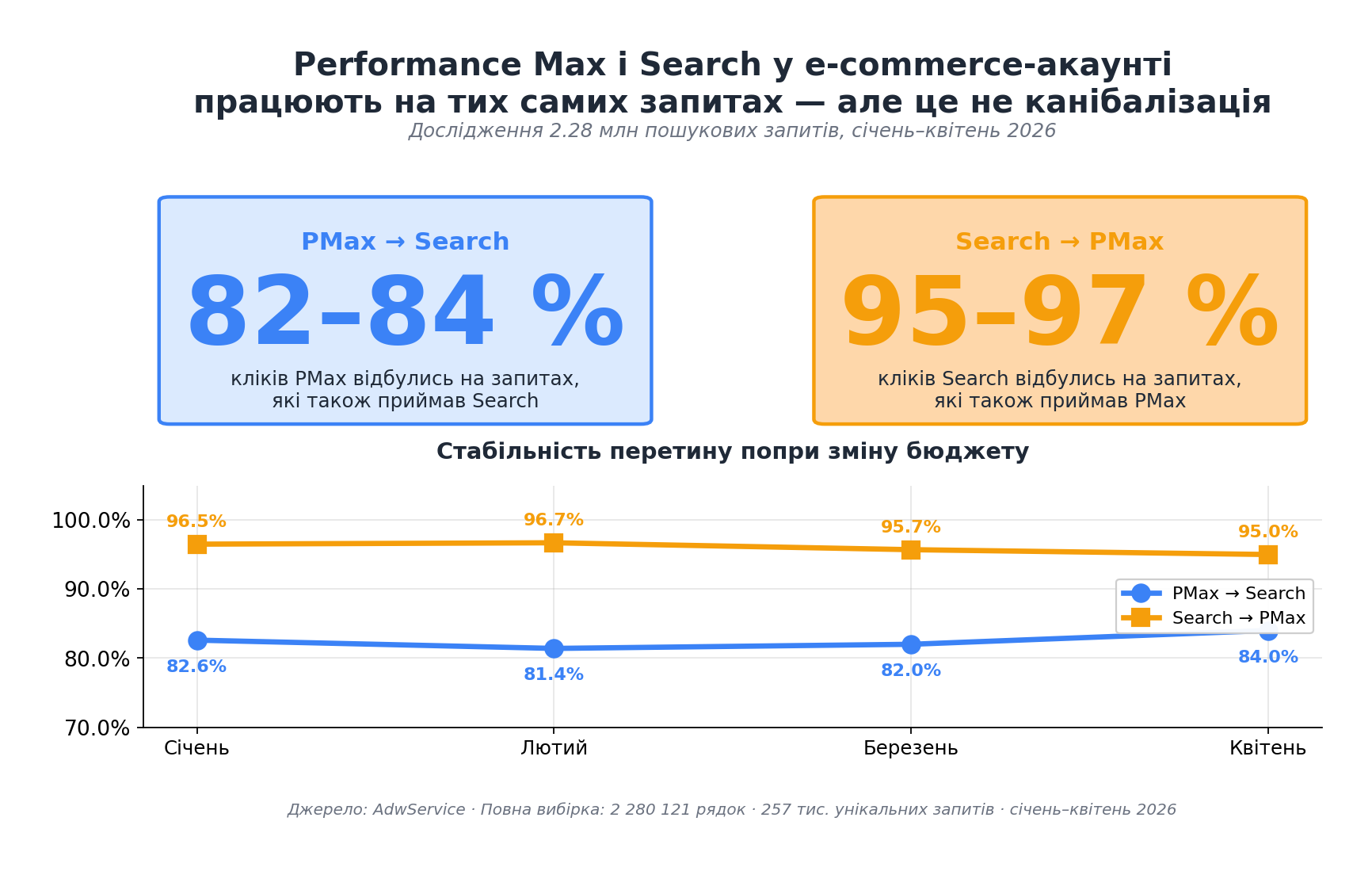
Infographic 1. Share of clicks shared with the other channel, by month
Over the four months of observation, the overlap remained within a narrow range: 82–84% for PMax and 95–97% for Search. Fluctuation — within ±1.5 percentage points. Despite the fact that PMax’s absolute spend changed by 1.5 times over this period, the share of shared queries barely changed. If the channels were actually “stealing” traffic from each other, we would see the opposite correlation.
Stable overlap of 82–97% = channels are not cannibalizing, but are serving the same query field in different modes.
In our previous 2025 study on a different account, the overlap was 49–57%. The difference is explained by the breadth of semantics in Search: there were fewer active campaigns with broad coverage. In both cases, the main principle is the same — channels do not cannibalize. The exact figure depends on account architecture.
Finding 2: different Search match types give different ROAS on the same queries
If PMax and Search work on the same queries, it’s logical to assume that their ROAS should be the same. In reality, it’s not. And the reason is the match type.
Match type — the way Google matches a user’s search query to an ad keyword. Exact — the query almost literally matches the keyword. Phrase — the query contains the keyword in a given order. Broad — Google expands the semantics based on its own relevance assessment. AI Max — expansion through AI models.
We broke down the 38,362 Search clicks by these types and compared each type’s ROAS to PMax ROAS (5.91):
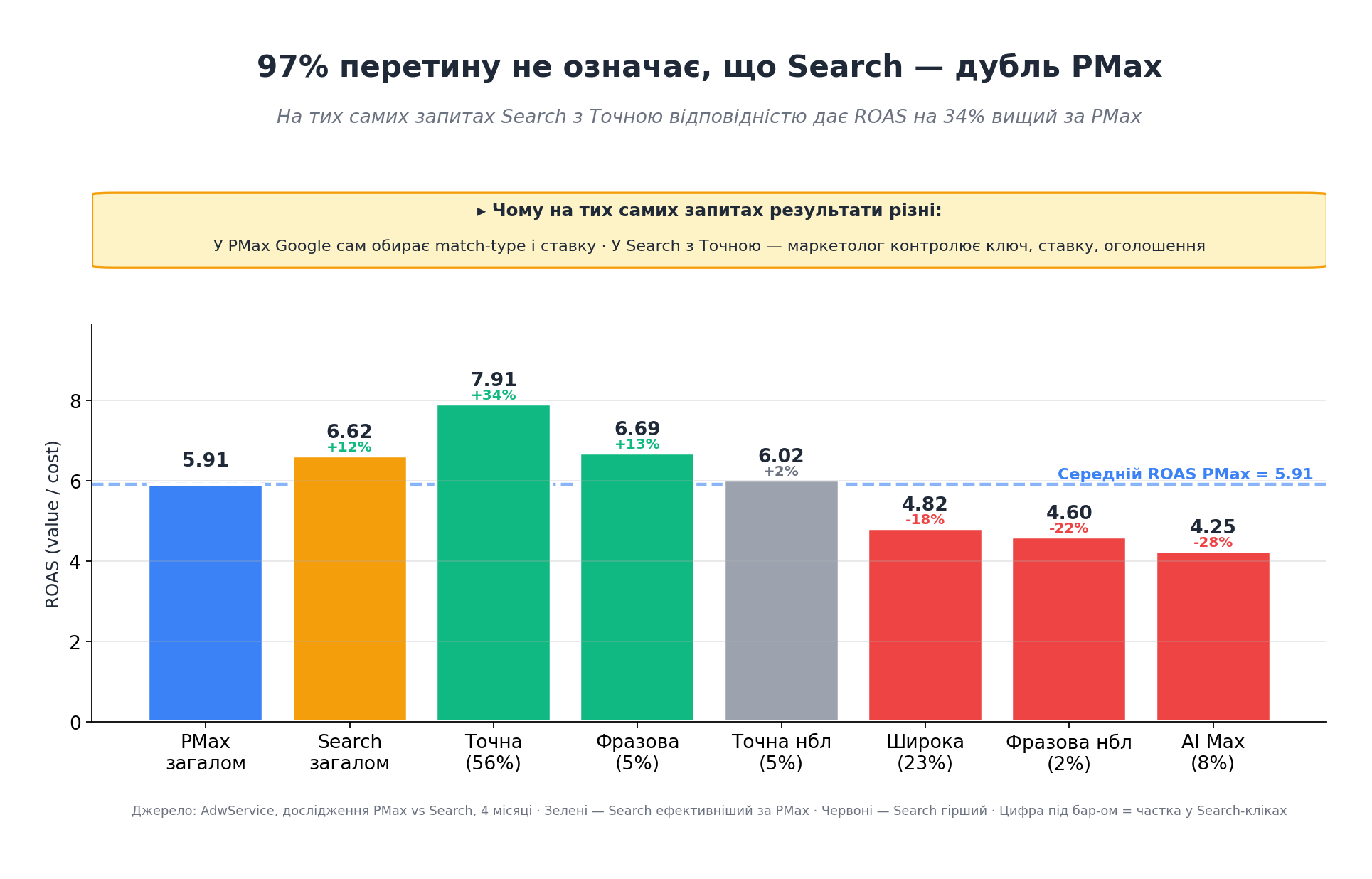
Infographic 2. ROAS by match type. Green bars — Search more effective than PMax, red bars — worse
- Search with Exact Match delivers ROAS 7.91. 34% higher than PMax. This is 56% of all Search clicks.
- Phrase and Close Exact — ROAS 6.02–6.69, 2–13% higher than PMax. Another 10% of Search clicks.
- Broad, Close Phrase, and AI Max — ROAS 4.25–4.82, 18–28% lower than PMax. This is where the real duplication happens.
69% of Search traffic is more effective than PMax on the same queries. This isn’t duplication — it’s a more precise layer of service.
Finding 3: Search campaigns divide into Key-based, DSA, and AI Max — with different effectiveness
Key-based campaigns — classic Search campaigns with keywords added manually by the marketer. In our account, there are 15 of them.
DSA (Dynamic Search Ads) — a type of search campaign where Google itself selects user queries, matching them to the content of your landing pages. The advertiser provides landing pages — Google provides search traffic.
AI Max — a new Google function that can be enabled inside Key-based campaigns. Google expands keyword semantics through AI. This is not a separate campaign, but a toggle in the settings.
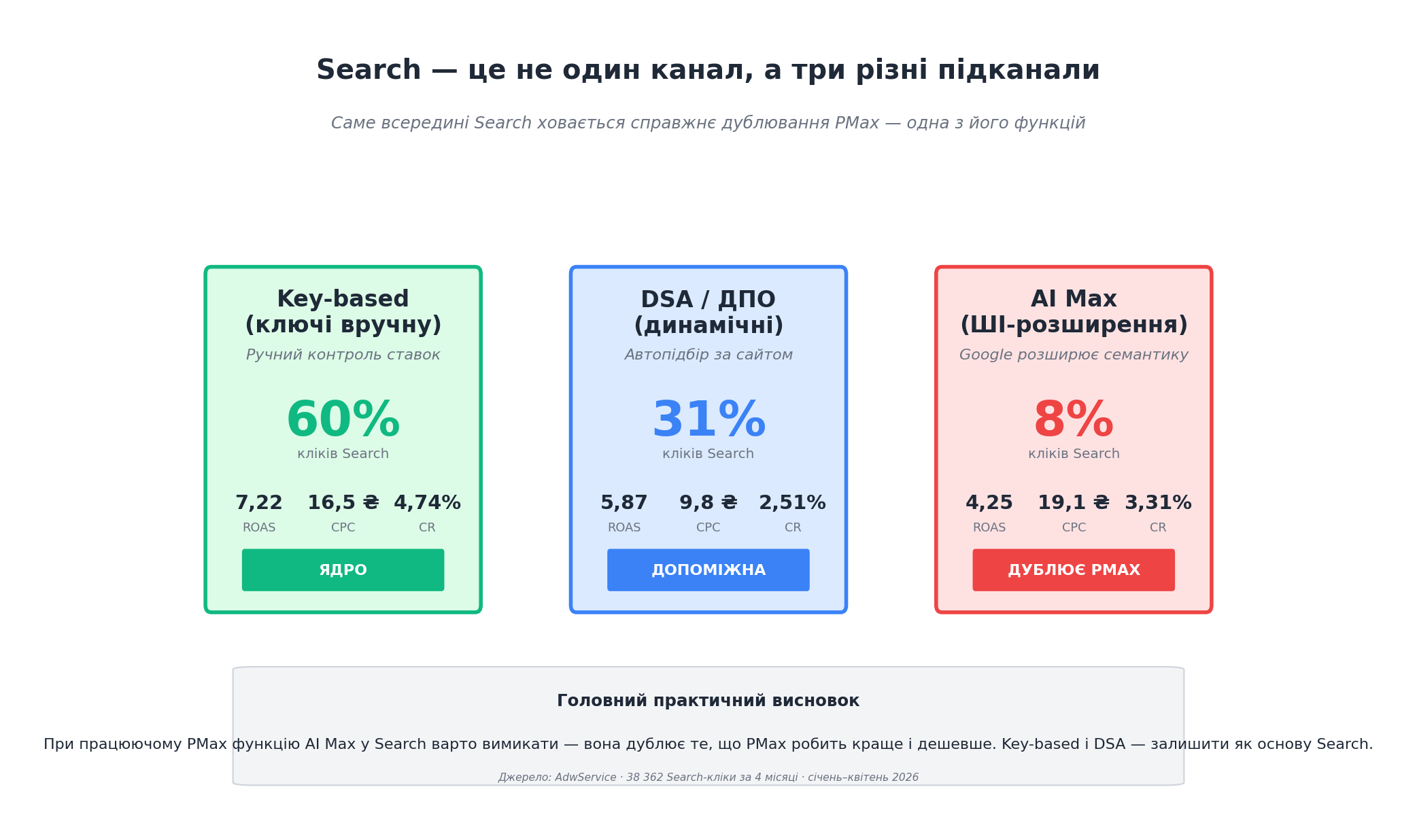
Infographic 3. Distribution of Search traffic by campaign function and their effectiveness
Key-based (manual control) — the core of Search efficiency: ROAS 7.22, CR 4.74%. DSA — an auxiliary automated function with the cheapest CPC (9.8 UAH vs 16.5 in Key-based) and the best quality score. AI Max — the most expensive CPC (19.1 UAH) and the lowest ROAS (4.25).
DSA — the easiest option for e-commerce
DSA is an automated channel that takes the content of your landing pages and finds relevant search queries for it. The quality score there is usually the best among all Search types, because the ad is generated dynamically for the exact user query. That’s why DSA has the lowest CPC — Google rewards relevance.
For multi-category e-commerce, DSA is practically indispensable. You don’t pick keywords, you don’t write ads — you launch a campaign in a few clicks and then just filter the traffic.
AI Max: the second study confirms the same problem
We already studied AI Max on another project in 2025 — there were 5 product categories, different bidding strategies, different budgets. The conclusion is the same: AI Max has the most expensive CPC and the worst CPA of all Search campaign types. DSA in that same comparison had the cheapest CPC, and Keywordik had the best conversion rate.
So this is not a quirk of one account — it’s a stable trend across at least two different niches.
How Performance Max and Search distribute different query types: 5 scenarios
The main thing to understand about the relationship between PMax and Search — they build a natural hierarchy. These are not two competing channels, but a system where each wins in its own phase of user intent.
The same query text in different users — that’s different revenue cycles before purchase. That’s exactly why query overlap does not mean cannibalization.
Distribution by intent type that we saw in the data:
- Transactional (buy, price, delivery, rozetka). Search wins: lower CPA, less noise, more precise ads. PMax’s role here is minimal, auxiliary. This is the zone where properly selected Exact Match keywords work perfectly.
- Review / Comparison (reviews, vs, best). This is PMax’s sweet spot. Google catches the person not at the moment of searching for reviews, but at the moment when they are already ready to buy but have doubts. Often underestimated because specialists habitually add “reviews / reviews / comparisons” as negatives in their Search campaigns. As a result, PMax takes this valuable traffic. Important caveat: do NOT add Review queries as negatives in PMax. This is a common mistake by beginners who transfer negative keyword logic from Search to PMax. In PMax, this “cross-interest” often converts better than direct queries.
- Product Generic (general product names without transactional markers). Ideal zone for collaboration: PMax provides scale, Search with Exact/Phrase match and a limited budget provides bid control. Together they cover the entire query volume more effectively than each separately.
- Informational / How-to (how, instructions, size). PMax wins — ROAS 6.87. This isn’t cannibalization, it’s demand preparation. A person comes in, gets acquainted with the brand, and then comes back to purchase. Search here is usually either expensive or weak.
- Broad / Other (broad queries without clear intent). PMax takes almost everything. This is normal for the algorithm’s learning phase — it’s self-discovering where the sales are. Search here is pointless without strict negative keywords, because at a CPA level this traffic doesn’t pay off on exact keywords.
What is the normal Performance Max to Search budget proportion: why 70/30
From experience working with dozens of e-commerce accounts, we see a stable pattern:
Search will always be within 30% of turnover. Maximum. Even if you completely turn off PMax — Search won’t be able to catch up to that turnover.
In our current study, Search accounts for 12–19% of spend (average ≈ 15%). This is below the approximate 30%, but it’s not a problem — in this niche, PMax has a particularly effective long-tail. In other accounts, Search can reach 25–30%. The key thought: if your search shows 10–30% of turnover — it’s a healthy account.
If you see that after launching PMax, search dropped
This is a variant of conditional normal. Don’t try to artificially rescue search — PMax usually just took the portion of traffic that was weakly convertible in Search due to channel limitations. Your job here is to monitor the feed so that it fits PMax’s broad semantics.
When you actually need to act:
- If search dropped on transactional Exact Match keywords → check Search bids, they may need to be raised;
- If a specific DSA campaign dropped → check whether the URL target list has become too narrow;
- If overall turnover dropped (both search and PMax) → these are external factors (seasonality, demand drop, CPC increase at auction), not cannibalization.
If after launching Search, PMax dropped
This scenario is more complex — scaling PMax is more important than scaling Search. What to do:
- Give PMax 7–14 days to retrain — it looks for new traffic options;
- If the search campaign is on an automated strategy (tROAS, Maximize conv. value) — consider lowering bids in Search so the channels don’t fight over one auction;
- If both Search and PMax are on smart bidding strategies — sooner or later they will independently build a clear hierarchy. Google is well-trained at this.
Study Limitations: what this analysis does not show
What this analysis does not show:
- One niche. Health and beauty tech. In legal services, SaaS, B2B the dynamics may differ. That’s why our second study is important — it confirms that the principles transfer between niches, but the specific numbers don’t.
- Four months is a short sample. Over a year, channel behavior may change. We’re talking about tendencies, not patterns.
- User overlaps were not measured. We calculated overlap by query texts, not by unique users.
- PMax is a black box. Google does not disclose the match type for PMax clicks. We see the result, but not the mechanics.
- Post-click was not accounted for. ROAS was calculated by conversion value in Google Ads. If Search has higher lead quality — this effect is not visible in the analysis.
What to do with Performance Max and Search: 7 practical conclusions
- Do NOT turn off Search because of “overlap with PMax.” This is the most common mistake after watching trending videos. 56% of Search traffic exceeds PMax in ROAS by 34%. Turning off Search = losing the most valuable segment of the account. Overlap at the query text level is a feature of modern Google Ads, not a problem.
- Strictly filter AI Max, but prepare for adaptation. AI Max currently gives the worst ROAS among all Search functions. Technically, it’s disabled via the “Use automatically created assets” checkbox in campaign settings, or through negative keyword filtering. But be realistic: Google is massively removing manual options. Just like they once suddenly shut down Smart Shopping for stores with millions in turnover, there is a risk that in 6–12 months AI Max will become mandatory. Better to prepare for this gradually — strictly filter traffic, study which categories it still works in, rather than hoping to avoid it forever.
- Systematically populate Exact Match Search groups from the PMax report. Keywords added manually to Exact Match deliver ROAS 9.17 — 56% higher than auto-matched variants. This is a direct ROAS improvement tool. Frequency — once every 2 weeks.
- Do NOT add Review / Comparison as negatives in PMax. Standardized negative keyword lists (which “old-timer specialists” carry from account to account) often contain “reviews / comparisons / vs.” In PMax, this is a mistake. These queries are PMax’s “sweet spot,” where Google catches the user at the moment of hesitation and converts through a relevant ad and landing page.
- Do NOT over-negatize PMax in principle. PMax has a different logic for negative keywords than Search. It doesn’t “cut off” queries — it learns from all traffic. Aggressive negative keywords break the algorithm’s learning. Exclude only clearly non-targeted traffic and brand (if you have a separate brand campaign). Everything else — let PMax handle itself.
- Keep DSA as the foundation of Search. DSA delivers 31% of Search clicks with the lowest CPC. It’s an indispensable function for multi-category e-commerce. The quality score in DSA is usually the highest — the ad is generated dynamically for the exact query, Google rewards relevance with lower CPC.
- Build a hierarchy: separate campaigns by intent type. If you have sufficient budget — put transactional, product generic, competitor, and brand queries into separate campaigns. Then each category learns on its own semantics, and filtering traffic is much easier. If the budget is limited — separate at the ad group level within one campaign, but then carefully monitor that each group gets enough budget. Otherwise the test is uneven — one group will take all the budget, others won’t spend.
FAQ: common questions about Performance Max and Search
Direct answers to common questions from PPC practice.
-
No. 69% of Search traffic delivers ROAS higher than PMax on the same queries. Channels don’t compete — they serve the same query field in different modes. Only the AI Max function within Search campaigns should be disabled, and even then through filtering, not complete shutdown.
-
This is a variant of conditional normal. PMax took the portion of traffic that was weakly convertible in Search. Don’t artificially rescue search. Work on the feed so it fits PMax’s broad semantics. Search dropping to 30% of turnover is a healthy indicator.
-
Give PMax 7–14 days to retrain. If the search campaign is on an automated strategy — consider lowering bids in Search. If both channels are on smart bidding strategies — they usually build a hierarchy on their own. PMax is more important to scale than Search — it’s responsible for the main sales volume.
-
There is no clear standard. In our first 2025 study — 49–57%. In the second 2026 study — 82–97%. The difference is explained by the breadth of semantics in Search campaigns and the presence of DSA. What matters is not the value itself, but its stability over time.
-
Yes. AI Max and PMax both automatically expand semantics through AI. When used simultaneously, you pay twice for the same expansion. We studied this on two different accounts — in both, AI Max had the most expensive CPC and the lowest ROAS among all Search types.
-
Technically possible, but strategically unwise. Google is moving toward mandatory automation — similar to how they once suddenly shut down Smart Shopping. The smarter tactic is to strictly filter AI Max with negative keywords, monitor which categories it still works in, and gradually adapt to the new reality.
-
No. This is a common mistake by beginners who transfer negative keyword logic from Search to PMax. In PMax, “cross-interest” (a person searching for competitor reviews) often converts better than direct queries. In our study, PMax on Review/Comparison delivers ROAS 5.98 — higher than on Transactional.
-
No. PMax works on a different principle — it learns from all traffic. Aggressive negative keywords break the algorithm’s learning. Exclude only clearly non-targeted traffic (other niches, geographies) and brand (if you have a separate brand campaign). Everything else — let PMax handle itself.
-
Exact: the query almost literally matches the keyword. Phrase: the query contains the keyword in a given order. Broad: Google decides which queries are relevant. In our study, Exact delivered ROAS 7.91, Phrase — 6.69, Broad — 4.82. So the more precise the keyword control, the higher the ROAS.
-
For multi-category e-commerce — yes. DSA is the easiest type of search campaign: you don’t pick keywords, you don’t write ads. The quality score in DSA is usually the highest among all Search types, because the ad is generated dynamically for the exact query. That’s why DSA has the lowest CPC.
-
Search will always be within 30% of turnover. Maximum. This is related to the physical limitation of the channel — Search cannot collect as broad a range of semantics as PMax. Even if you completely turn off PMax — Search won’t be able to catch up to its turnover. If your Search shows 10–30% of turnover, it’s a healthy account.
-
Full analysis with breakdown by match type and campaign function — once a quarter. Basic monitoring of overlap and ROAS by match type — once a month. With major changes in account structure (adding/removing campaigns, changing budgets by 30%+) — check after 2–3 weeks.
Sources and Materials
- First study by Yana Lyashenko “Performance Max vs Search: do they compete” (AdwService, 2025). Original video with methodology and conclusions on an account with 49–57% overlap. The second 2026 study is an extension of this work to a new account with the addition of monthly dynamics and match type breakdown.
- AI Max study on a multi-category account (AdwService, 2025). Comparison of AI Max / Keywordik / DSA on 4–5 product categories with different bidding strategies. Summary: AI Max has the most expensive CPC and worst CPA, DSA has the cheapest CPC, Keywordik has the best CR.
- Official Google Ads documentation: sections “Search term report”, “Match types for search keywords”, “Performance Max overview”. Separately, see Google’s help on search campaign priority over PMax on exact keyword match (support.google.com/google-ads/answer/10724817).
- Comparative studies in the international market: Adalysis (study on 3,300+ non-retail PMax campaigns, 2.8% overlap at search term level, 67% at campaign level, 2024), Optmyzr (study on 511 accounts, 97.4% of PMax campaigns had overlap with Search, 2025), SearchEngineLand (analysis of Adalysis data in February 2025). Our study on the Ukrainian market adds the perspective of multi-category e-commerce with high overlap (82-97%).
- Current study data: AdwService client account (multi-category Ukrainian e-commerce, health and beauty tech niche). Client name not disclosed under NDA.