The Ukrainian market has shrunk in recent years, but interest in our products in Europe and the States has grown. Vyshyvankas, candles, ceramics, children’s clothing, wooden toys, and cosmetics are all eagerly purchased. The only question is how to sell abroad without getting stuck at customs, losing money on conversion rates, or getting fined by the tax authorities.
Let’s break down the entire journey: from choosing a market and product range to accepting payments, shipping, and advertising. No theory for the sake of theory—only what you will actually need in practice.
Which Products Are Profitable to Export from Ukraine?
When starting cross-border sales through an online store, don’t begin with logistics or your storefront, but with an honest question: what exactly from your inventory would a person in Warsaw, Munich, or Chicago want to buy? And why from you instead of a local seller?
Three categories sell well abroad:
- Products with national flair—embroidery, ethnic jewelry, ceramics, candles, souvenirs. Here, our sellers have no competitors by definition.
- Handmade and small-batch items—jewelry, leather goods, wooden furniture, toys, designer clothing. The audience on Etsy or Instagram pays for uniqueness, not a brand name.
- Anything with a high value per kilogram—cosmetics, jewelry, small electronics, designer clothing. Shipping 300 grams costs the same, but selling them for 15 euros versus 120 euros makes a huge difference.
Heavy and cheap items do poorly. Let’s say you sell ceramic planters for 250 hryvnias. Shipping one to Germany will cost 500–700 hryvnias—more than the planter itself. No one will buy it.
Another filter is profit margin. Calculate not just the cost of goods, but also international shipping packaging, payment gateway fees (2–4%), returns, and advertising. If you’re left with less than 30–35%, the item isn’t suitable for export, no matter how beautiful it is.
How do you check demand? Open Etsy or Amazon, type in the category name in English, and see how many sellers there are, what the prices are, and how many reviews the top sellers have. If there are 20+ competitors with hundreds of reviews, there is demand. If it’s empty, either the niche is wide open, or no one buys there. Double-check using Google Trends.
How to Choose a Market for Cross-Border Sales Through an Online Store?
A common mistake at the start is saying, “We sell worldwide.” In practice, this means “we don’t sell anywhere.” Choose one market, set up your storefront, logistics, and advertising for it, get 50–100 orders, and only then expand.
Criteria for choosing:
- Logistics. Poland, the Czech Republic, Lithuania, Germany—3–7 days and reasonable rates. The States—10–20 days and expensive.
- Presence of the Ukrainian diaspora. Millions of Ukrainians live in Poland, and they eagerly buy what is familiar. This is a ready-made audience for a launch.
- Purchasing power and habits. A German is willing to pay 60 euros for a high-quality linen shirt, while a Pole would likely pay 35. On the other hand, there are lower expectations for customer service and returns are easier.
- Competition and customs rules. More on this below—in some places, duties and VAT eat up half of the price’s appeal.
For most of our stores, the logical progression is: Poland → Germany/Czech Republic → the rest of the EU → the US and the UK. Not because the States aren’t interesting, but because the cost of making a mistake there is higher.
A target market isn’t just a country, but a segment within it. “Young mothers in Poland who buy natural children’s clothing” is a workable phrasing. “All Poles” is not.
How Can E-commerce Sell Abroad Without Getting Fined?
Selling abroad from Ukraine falls under foreign economic activity (FEA). It sounds serious, but you don’t need to register as an “FEA entity” anywhere. Having an active FOP (Sole Proprietorship) or LLC is enough.
Can a Group 2 FOP Receive Payment from Abroad for Goods?
Yes. Group 2 has the right to sell anything to anyone, including non-residents. The restriction applies to services: you are only allowed to provide them to the population of Ukraine and single tax payers. Selling a physical item to a foreigner is not a service, so there are no violations.
Group 1 is not suitable for exporting at all. Group 3 has no restrictions: physical goods, services, and digital products are all allowed. If you sell, say, ceramics and simultaneously host online master classes for foreigners, Group 3 is mandatory.
Keep an eye on the purpose of payment. If a service transfers funds designated as “payment for goods,” everything is fine for Group 2. If “service” or “transfer fee” appears, the tax authorities might interpret this as providing services to a non-resident. In contentious cases, it’s easier to switch to Group 3.
The single tax is paid just like it is for domestic sales: 5% (or 3% with VAT) for Group 3, and a fixed rate for Group 2. There are no additional “export” taxes. Income in foreign currency is converted into hryvnias at the NBU (National Bank of Ukraine) exchange rate on the date the funds are credited.
Which KVED Codes Are Needed to Export Goods Through an Online Store?
There is no separate “export” KVED (business activity code). The same set of codes used for a standard online store will work:
- 47.91 — Retail sale via mail order houses or via Internet (primary);
- 47.99 — Other retail sale not in stores, stalls or markets;
- 46.xx — Wholesale trade of the corresponding product group, if you plan to ship in batches to stores abroad;
- 53.20 — Other postal and courier activities, sometimes useful for shipments.
Check that 47.91 is in your registry extract. Registering a long time ago “just in case” often results in only having 47.71 or a service-related code.
Documents for Exporting Goods
Sole proprietors usually just need three documents:
- Invoice—a bill detailing the seller, recipient, item description, quantity, price, and currency. It’s drafted in English (or the recipient’s language) on the FOP’s letterhead. One copy goes inside the box, and one goes in a clear pouch on the outside.
- Customs declaration CN22 (up to 2 kg and up to 300 SDR, about $400) or CN23 (for anything heavier and more expensive). Filled out by the sender and verified by the carrier.
- Contract or public offer. For bank currency control, the public offer on your website plus the invoice is sufficient. A separate contract for each client is not necessary.
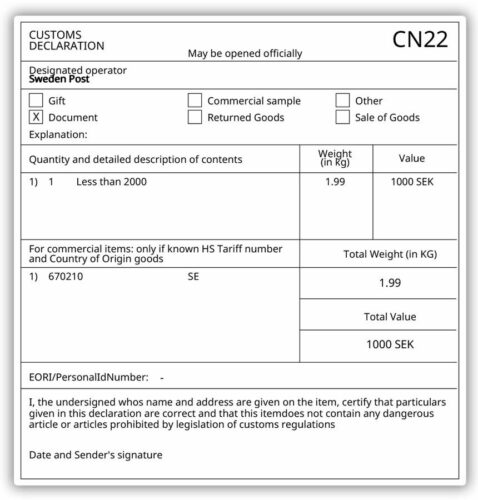
Full clearance with a broker and a cargo declaration is needed when you are shipping wholesale batches or products that require certificates (cosmetics, food, children’s clothing in some countries). For single shipments, Nova Post Global, Ukrposhta, and courier services handle everything themselves based on the invoice data.
Create an invoice template in Google Sheets: plug in the order number, item, and amount, and the document is ready in a minute. Don’t make up descriptions like “Gift” or “Sample.” Write it exactly as it is: “Linen dress, 1 pc, 100% linen.” Otherwise, the box will be detained, and the recipient will be summoned to customs.
How Many Days Are Allowed for the Return of Foreign Currency Earnings to Ukraine?
During the period of martial law, the general settlement period for exports is 180 calendar days. However, for retail, this rule hardly applies: currency supervision does not extend to transactions under the equivalent of 400,000 hryvnias. A single order for 80 euros won’t trigger oversight.
The exception is artificial splitting. If you ship a 20,000 euro batch to one wholesaler and split it into ten invoices of 2,000 euros each, the bank will notice and apply the full 180-day deadline.
In practice, it’s simple: funds arrive in your foreign currency account via a payment system, the bank sees the invoice or public offer, and there are no questions asked. Keep the documents on hand—they might be requested during your first few deposits.
Duty and VAT: Who Pays and How Much
No duty is charged upon export. Exports for VAT payers are taxed at a 0% rate, and a single tax payer without VAT charges nothing at all. All expenses arise on the recipient’s side—upon import into their country.
It’s important to know the current rules, as they changed in 2025–2026:
- European Union. As of July 1, 2026, the duty-free threshold of 150 euros has been abolished. Instead, there is a fixed duty of 3 euros per item (not per shipment!). Three different items in a box equal 9 euros. Plus the recipient country’s VAT (19% in Germany, 23% in Poland) on the total amount including shipping. Anything over 150 euros is subject to the standard tariff duty.
- USA. As of August 29, 2025, the duty-free threshold of $800 has been abolished. Duties are charged based on the tariff for the country of origin.
- United Kingdom. A 20% VAT applies from the first pound, and duties start at 135 pounds.
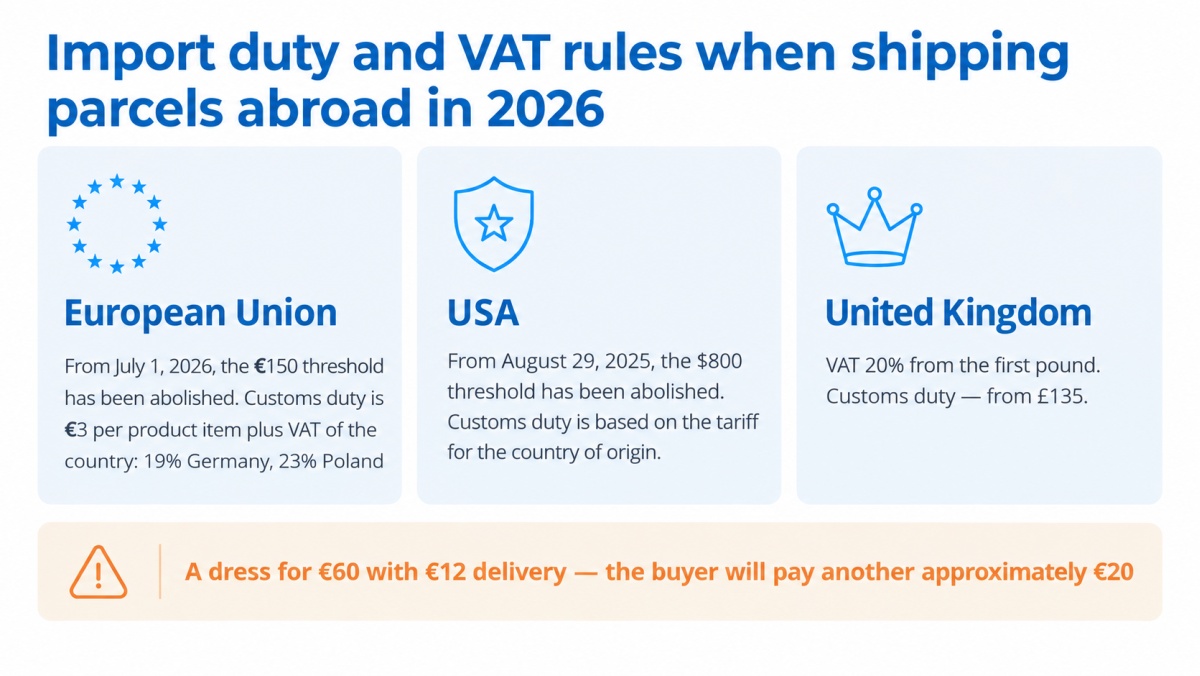
What does this mean in practice? A customer in Germany orders a 60-euro dress from you, with 12 euros for shipping. Upon receipt, they will pay an additional: 3 euros for duty + 19% VAT on the 72 euros (13.68) + the carrier’s clearance fee (3–6 euros). That’s a total of about 20 extra euros. If they didn’t know about this, you’ll get a return and a negative review.
Two ways to solve this problem:
- DDU/DAP—when selling abroad from Ukraine, the recipient pays taxes upon delivery. Be sure to state this clearly and prominently on the shipping page and in the order confirmation email.
- DDP—you include taxes and duties in your storefront prices, and the carrier pays them at the border at your expense. It’s more expensive, but the conversion rate is much higher. For the EU, there is the IOSS system: you register through an intermediary and collect VAT right on the website.
Accepting Payments When Selling Abroad from Ukraine
The question “how to accept card payments from a foreign buyer on a website” is asked more often than any other. The reason is clear: Stripe and PayPal Business, which are standard in Europe, are unavailable for businesses here. PayPal is open only for personal transfers, and Stripe does not register our companies.
But this isn’t a dead end. Below is what actually saves the day.
Ukrainian Acquiring Services
WayForPay, LiqPay, Fondy, and Portmone accept Visa and Mastercard issued anywhere. The client pays in euros or dollars, and you receive hryvnias in your FOP account at the exchange rate. The fee is 2.5–3.5%, setup takes a couple of days, and all our platforms offer integration. For starting out, it’s the easiest route.
The downside is currency conversion. The payment gateway’s exchange rate is 1–2% worse than the official one, and a customer from Germany might look suspiciously at a payment form with an unfamiliar name. This can be resolved by branding the payment page and placing Visa/Mastercard logos in a prominent spot.
Payoneer
The standard for marketplaces. Etsy, Amazon, and eBay pay out to Payoneer, and from there, the funds are withdrawn to the FOP’s foreign currency account. The withdrawal fee is up to 1–2%. It doesn’t work as a standalone payment method on a website, but it’s indispensable on marketplace platforms.
Wise, Revolut Business
These are convenient for accepting transfers from wholesalers and for settling up with foreign contractors (advertising, warehouses, translators). Both offer multi-currency features and bank details in euros/dollars/pounds. The conditions for opening a business account for our residents change periodically—check before registering.
SWIFT to the FOP Foreign Currency Account
For B2B orders of 500–1,000 euros or more. A wholesaler from Poland receives the invoice, pays via SWIFT, and the funds are credited in 1–3 days. The bank might ask for a contract—have it ready.
Do not accept payment for goods on a personal card. This is a violation for both Group 2 and Group 3: income must go to a business account. You risk facing fines plus the chance of being kicked off the single tax system.
A working combination for most: Ukrainian acquiring on the website + Payoneer for marketplaces + a foreign currency account in a local bank for wholesale. Later, when your turnover grows, you can open a company in the EU (e.g., a Polish sp. z o.o. or an Estonian OÜ) and integrate Stripe. But at the start, this is unnecessary.
International Order Delivery for a Ukrainian Online Store
Logistics is the area where money is lost most often. Not because it’s expensive, but because it is calculated incorrectly and presented poorly to the customer.
Which Carriers to Use?
There are four main options, and each plays a specific role:
- Nova Post Global—the optimal choice for Europe. They have their own branches in Poland, Germany, the Czech Republic, Lithuania, Romania, and Italy, offering door-to-door delivery or parcel lockers, handling customs documents on the carrier’s end, and providing decent tracking. Shipping to Poland takes 2–4 days, to Germany 4–7 days. The rest of the world is handled via a partnership with UPS.
- Ukrposhta—the cheapest option for lightweight shipments to distant countries (USA, Canada, Australia) and for inexpensive items. Delivery takes 2–5 weeks, and tracking sometimes “disappears,” but for a 15-euro souvenir, it’s perfectly fine.
- DHL, UPS, FedEx—express delivery in 2–5 days anywhere, full customs support, and the ability to ship DDP. The price tag is 3–5 times higher than postal services. Suitable for expensive orders (from 150–200 euros) and for B2B.
- EU Fulfillment—a warehouse in Poland or Germany where you send a batch, and from there, orders go out to customers like domestic shipments. This makes sense once you consistently hit 100+ orders a month: shipping becomes faster and cheaper, and starting in 2026, it also eliminates the problem of the 3-euro-per-item duty.
For a start, Nova Post Global and Ukrposhta are enough. Add express and warehouses once you understand your volumes.
How to Calculate Shipping Costs to Europe for an Online Store?
Don’t just calculate the carrier’s rate. The total cost of a single shipment consists of:
- the rate based on weight and zone (volumetric weight also applies—a 40×30×20 cm box holding a lightweight blanket will be charged as 5 kg);
- packaging—box, bubble wrap, tape, 30–80 hryvnias;
- insurance, if the order is over 50–100 euros;
- an allowance for returns and losses—budget 3–5% of revenue;
- the manager’s time spent processing the order—yes, that is money too.
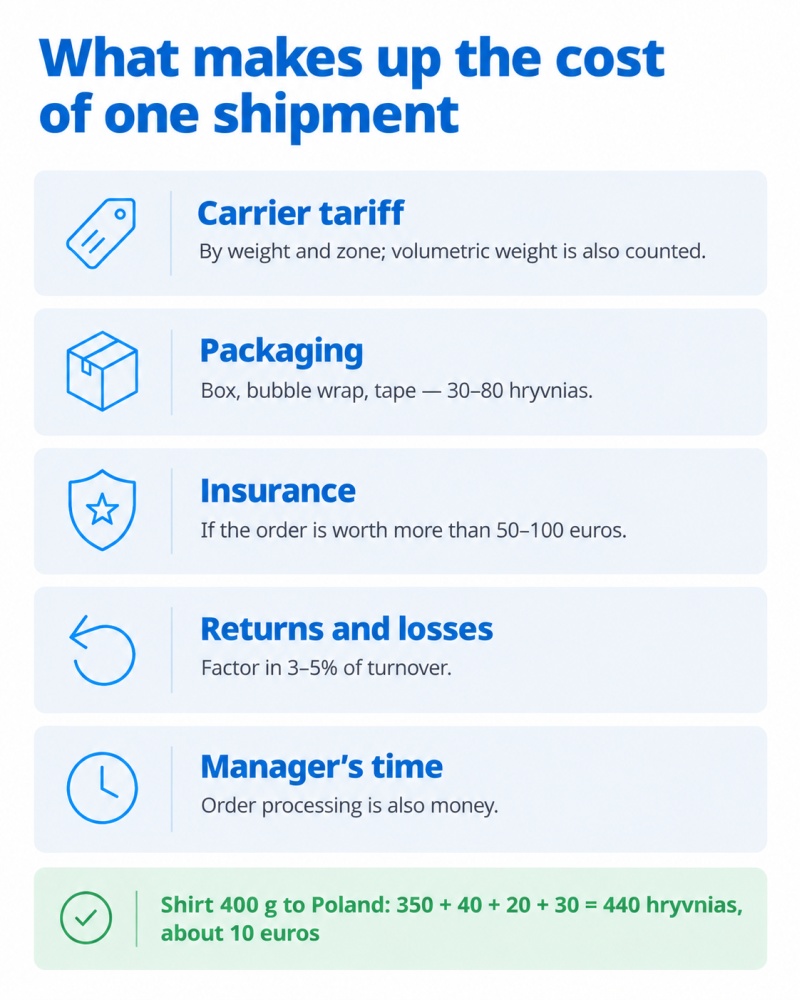
Let’s take an example. A store is shipping 400-gram linen shirts to Poland. The Nova Post Global rate is 350 hryvnias, packaging is 40, insurance is 20, and the return reserve is 30. That totals around 440 hryvnias, or roughly 10 euros. Showing “shipping for 5 euros” on the storefront means operating at a loss. Showing 10 is honest but scares people off. The solution: “free over 70 euros, 9.90 under 70.” The average order value will increase, and the costs will be absorbed into your margins.
Next, set up your shipping zones. First zone—Poland, Czech Republic, Slovakia (cheap and fast). Second zone—Germany, Austria, Benelux, Baltics. Third zone—the rest of the EU. Fourth zone—USA, Canada, UK. Each has its own rate and delivery timeframes displayed right on the product page.
Lifehack! Many platforms allow you to pull real-time carrier rates into the shopping cart via API. If you don’t have that integration, create a “zone × weight bracket” spreadsheet and update it once a quarter. Rates change.
Think about returns separately. Return shipping from Germany will cost the customer 15–25 euros. Many stores opt to issue a refund for inexpensive items without requiring a return—it’s cheaper than dealing with a dispute and a negative review.
Preparing Your Website for Cross-Border Sales
Before figuring out how to take your online store to the international market, you need to ensure that the storefront looks “native” to foreigners. Not just translated—native. The difference is in the details.
You need true multilingualism here, not Google Translate slapped over the Ukrainian version. Machine translation on product pages reveals itself on the first screen, and a reader in Germany or France won’t bother deciphering clumsy text—they will just close the tab. The bare minimum is high-quality English. The ideal is the target market’s language, translated by a native speaker or at least proofread.
Localization goes beyond translation:
- prices in the customer’s currency, with no “≈ 1,850 UAH” next to it;
- sizing charts in local formats (EU/UK/US), with measurement tables in both centimeters and inches;
- address and phone number formats tailored to the country—a “region/oblast” field in Germany will cause confusion;
- local payment methods listed (BLIK in Poland, iDEAL in the Netherlands—even if you haven’t connected them yet, you should know about them);
- delivery timeframes in days for specific countries, not just “5–20 days worldwide.”
A separate domain or subdomain (shop.de, shop.pl, or pl.shop.com) helps with both SEO and trust. If you don’t have the budget for multiple versions, at least set up hreflang tags and proper language detection.
GDPR. If you sell to EU citizens, you are obligated to comply with the European General Data Protection Regulation. In practice: a cookie consent banner with a real option to opt out, a privacy policy in the customer’s language, the right to have data deleted upon request, and no pre-checked “subscribe to newsletter” boxes. Fines for a small shop are unlikely, but in Germany and the Netherlands, they actually do check for this.
Regarding the platform. Shopify is the global standard with hundreds of apps, but it requires a monthly subscription in dollars, and Shopify Payments is unavailable here, so you’ll have to install a third-party gateway. Ukrainian SaaS platforms (Horoshop, Shop-Express, and others) are cheaper, already integrated with local payment gateways and Nova Post, and some offer “export” tiers with multilingual and multi-currency capabilities. For those who first sell locally and then expand outwards, the latter option is much more practical.
Selling Goods Abroad Through Marketplaces
Marketplaces are the fastest way to test demand. The audience is already there, payments are set up, and trust in the platform is higher than in an unfamiliar website. The price for this is a 10–20% fee and strict rules.
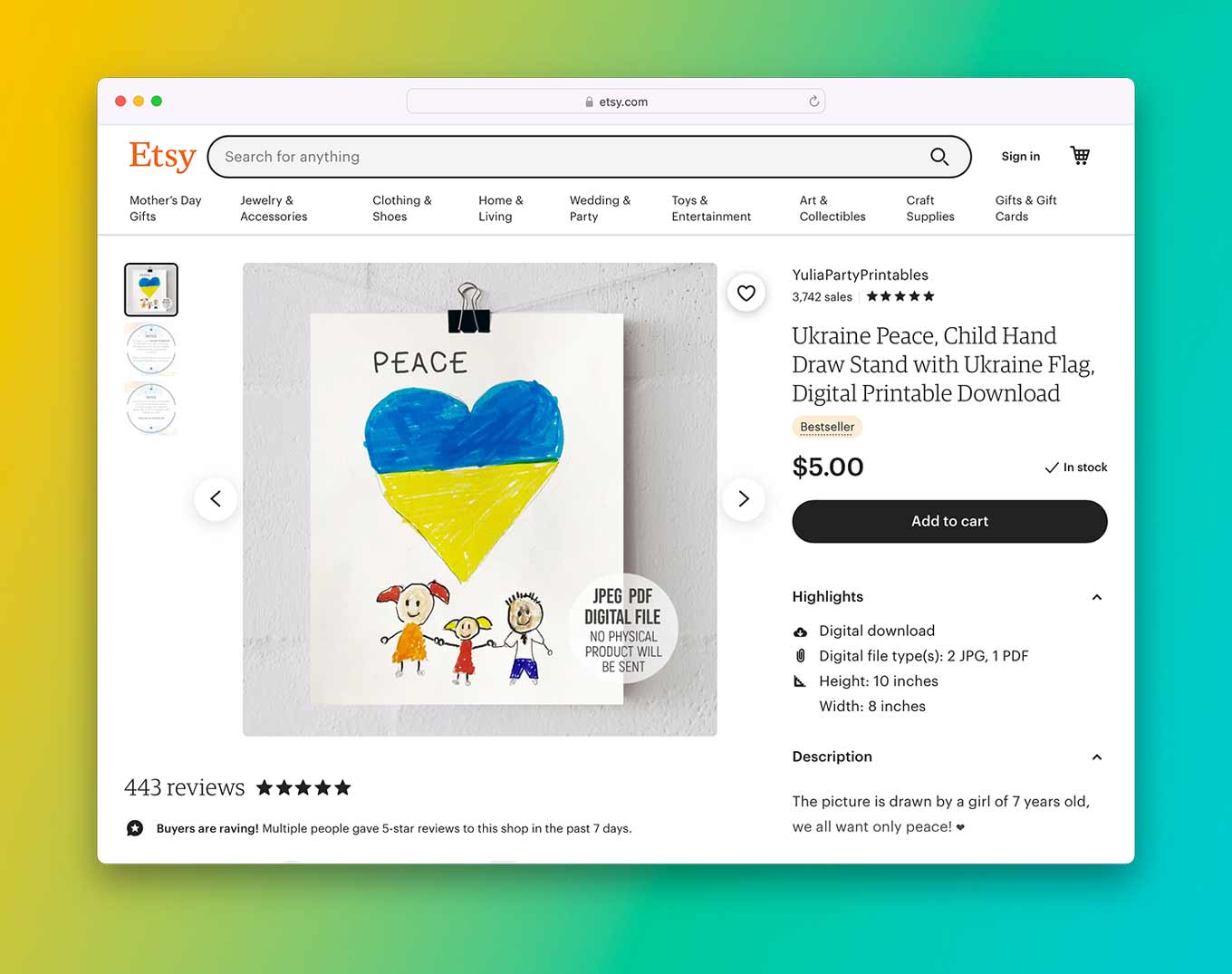
Where Ukrainian sellers should go:
- Etsy—handmade, vintage, arts & crafts, and anything that can be deemed “craft.” Our FOPs can register directly and get payouts via Payoneer. Fees: $0.20 per listing + 6.5% transaction fee + payment processing fee. This is where Ukrainian artisans have built their most resounding success stories.
- Amazon—the largest marketplace in the US and Europe. Ukraine is on the list of approved seller countries. You need a brand, UPC/EAN codes, and ideally FBA (Fulfillment by Amazon), otherwise shipping from home will tank your rating. The barrier to entry is higher, but so is the revenue.
- eBay—a versatile platform with strong positions in the US, Germany, and the UK. Collectibles, spare parts, electronics, and vintage items sell well. You can ship directly.
- Allegro—Poland’s leading marketplace, analogous to Rozetka. Our FOPs can register as sellers, with fees ranging from 5 to 15% depending on the category. For expanding to our neighbors, this is the first candidate.
- Bol.com—the leader in the Netherlands and Belgium. It requires a European VAT number, so it is most often accessed via a company already registered in the EU.
- Vinted and Depop—platforms for clothing and accessories, mostly secondhand and small brands. They operate on a “peer-to-peer” model, and you can’t officially register as a seller from Ukraine. They are suitable only if you have a partner or warehouse in the EU.
The strategy is simple: use marketplaces for early sales and to gauge demand, while running your own website in parallel for returning customers. On a marketplace platform, you rent the customer; on your own website, you own them.
How to Promote a Ukrainian Online Store Abroad?
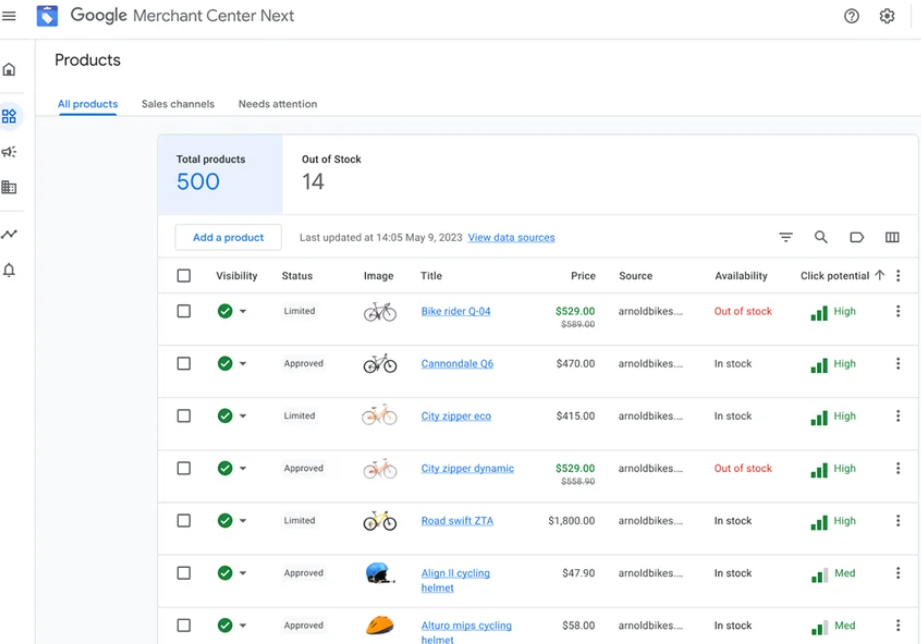
You will have to buy traffic in a new market. Organic search results in Google in German will take at least 8–12 months to appear, and even then, only with consistent content work. Here is what yields faster results:
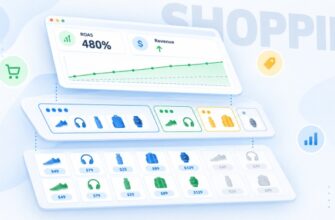
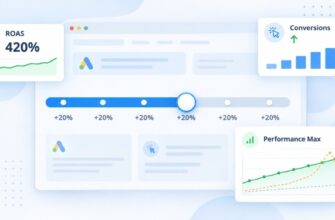
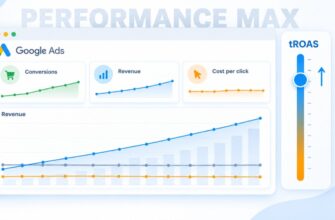
- Google Shopping and Performance Max—the main channels for product-based stores. Set up a Merchant Center with a product feed in the local language and currency, list realistic delivery times and shipping costs by zone (Google verifies this), and add a return policy. Performance Max will automatically distribute the budget across Search, Shopping, YouTube, and Discover. You can start with 10–15 euros a day per market. Keep in mind that the algorithm spends the first two to three weeks learning, so evaluating results before then is pointless.
- Meta (Facebook, Instagram)—for everything visual and for retargeting. You need a dedicated page in the local language, a separate pixel, and a catalog with prices in euros. A Ukrainian page with 30,000 followers won’t help in a new market—a Pole won’t bother trying to decipher captions in a foreign language.
- Pinterest is underrated and barely used back home, but in the US and Germany, it is a massive source of traffic for home decor, clothing, jewelry, and all things handmade.
- Local price aggregators—Ceneo in Poland, idealo in Germany, Heureka in the Czech Republic. These are analogs to our Hotline. People compare prices there, and being listed drives traffic for pennies.
- Influencers and microbloggers. Find 5–10 bloggers with 5,000–30,000 followers in your target market, send them a sample, and ask for an honest review. For Ukrainian brands, this also provides a warm storytelling angle: audiences in Europe react with interest to a “made in Ukraine” backstory.
- Reviews. Connect Trustpilot or Google Reviews and ask for a rating after every order. A foreigner who doesn’t know your brand looks at your rating first and foremost.
Regarding ad language. Even if your website is only in English, run your Polish ads in Polish. Clicks on native-language ads cost less and convert better, and translating five ads is a one-hour job.