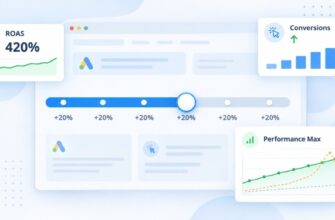
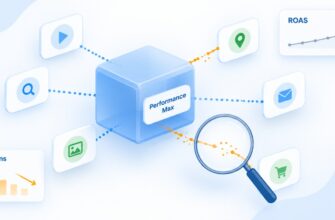
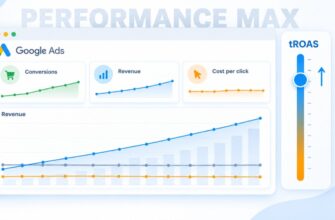
How AI Actually Works in Performance Max in 2026: The Five-Layer Model for E-Commerce Owners. Performance Max judges its own work by two values only: whether a conversion happened, and what it was worth. Margin, cost of goods and break-even do not exist in the model. Your economics reach it through a single channel — the target ROAS number — and actual ROAS moves only about a third of however far you move that target.
By Yana Liashenko , founder of ADW Service and Google Ads AI Architect. ADW Service runs Google Ads for e-commerce across more than 10 countries in Eastern and Western Europe, which is where the data below comes from: a proprietary sample of 201 advertising accounts. This is not official Google documentation — it is a working model built from managing e-commerce accounts since 2014.
The short version
- Performance Max judges its own work by exactly two values: a conversion happened (1) or it didn’t (0), and how much it was worth. Nothing else exists in the model.
- Google does not know your margin, your cost of goods, or your break-even point. Those parameters are physically absent from the system.
- Your economics reach the model through exactly one channel: the target ROAS number.
- The transfer coefficient is roughly ⅓ — actual ROAS moves about a third of however far you move the target. Raise the target 30%, expect around +10% actual.
- Raising budget delivers a median +36–52% in conversion volume for only −6–8% in actual ROAS. Scaling costs far less than most owners fear.
- Hitting “50 conversions a month” does not mean a campaign is mature: 95% of campaigns that reached it still crashed by 50% or more afterwards.
- A new Performance Max campaign does not start blind. Running a Standard Shopping campaign first “to warm it up” is unnecessary.

Definitions
- Performance Max (PMax) — a Google Ads campaign type in which the algorithm distributes budget across Search, Shopping, YouTube, Gmail and Display on its own, based on predicted conversion probability.
- Conversion label — the base unit of learning: 1 if a conversion followed the click, 0 if it did not.
- Value — the numeric amount your site sends to Google Ads alongside a conversion. Usually order revenue, sometimes margin or predicted customer lifetime value.
- Target ROAS — a numeric constraint that forbids the system from buying auctions whose expected return-to-spend ratio falls below the level you set. It is a boundary, not a goal.
- Transfer coefficient — the ratio between a change in target ROAS and the resulting change in actual ROAS. In our data it runs at roughly ⅓.
- Learning period — the phase after launch or a significant change during which predictions are still unstable. Typically 5–14 days, though learning never actually stops.
- Break-even ROAS — the return on ad spend at which an order stops losing money once cost of goods, shipping and returns are accounted for. You calculate it; Google never sees it.
- Merchant Center feed — the structured list of products with attributes (title, price, category, availability, images) that the algorithm treats as the feature set of every product.
Why does Performance Max behave so unpredictably?
Because you and the system judge the same traffic by entirely different criteria, and there is almost no shared vocabulary between you. Below are five complaints I hear from store owners nearly every week. Each has a specific mechanical explanation.
- “It worked for six months and then just stopped. We changed nothing.”
- “We doubled the budget and ROAS collapsed. We cut the budget back and it recovered. So how are we supposed to grow?”
- “We set the target ROAS Google itself recommended and the campaign died in three days.”
- “We run two stores. Same niche, same settings, same products. One prints money, the other burns it.”
- “We set target ROAS at our break-even and the campaign stopped serving entirely.”
The standard answer — “Performance Max is a black box” — helps nobody. It is not a black box. It is a five-layer system, and each layer follows its own logic.
Does Google know your profit margin?
No. Margin, cost of goods and break-even do not exist as parameters inside Performance Max. There is simply no field for them.
The machine that makes millions of decisions per second about your money judges its own work by two values only:
A conversion either happened or it didn’t. One or zero.
If it happened — what value it carried. A number.
That is the entire vocabulary in which the system understands “good” and “bad”. Served an ad → got a zero → drew a conclusion. Served another ad to another person → got a one worth $340 → drew a different conclusion.

Now consider what is missing from that list. Your margin. Your cost of goods. The shipping you subsidise. Your return rate. The fact that one product earns you 40% and another earns you 4%.

This is why the conspiracy theory “Google knows my margin and deliberately eats it” has no basis. Google has promised profit-based optimisation in Performance Max for years and still hasn’t shipped it — precisely because the model is built the way described above.
System labels | Business labels | |
|---|---|---|
What it is | conversion 0/1, value amount | ROAS, CPA, margin, break-even |
Who computes it | the algorithm, automatically | you, by hand or in a spreadsheet |
Where it lives | inside the model | in your head and your reporting |
How it enters the model | directly from tags and GA4 | only through target ROAS / target CPA |
Why Performance Max breaks: tracking is the culprit 4 times out of 10
Tracking is not a technical detail. It is the foundation. If conversions are recorded incorrectly, you are teaching the system a lie, and it will faithfully optimise toward that lie.
Across roughly 90 accounts that came to us for audit, our estimate is that in about 4 cases out of 10 the real cause of a collapse was not the algorithm and not bidding — it was the conversions themselves. Four typical scenarios:
- the wrong conversion action was selected for optimisation (add-to-cart instead of purchase, for instance);
- tracking broke after a site or plugin update;
- tracking was never fully implemented in the first place;
- the consent framework changed and part of the data stopped arriving.
The campaign looks like “the algorithm broke”. The algorithm is fine — it is simply learning from the wrong data.
Test and fraudulent orders should not just be filtered out of your reports. Upload conversion adjustments to the account. Every fake order is a “1” the system recorded as a success and is now hunting more of.
Should you send revenue or margin as value?
Most stores send order revenue, and that is a sensible default. Sending margin also works, but then every target ROAS figure you use means something different and break-even is calculated differently.
The worst case is when the account sends revenue while the owner mentally calculates margin. That guarantees a conflict of expectations between owner and agency.
If you sell by phone or through a sales rep, offline conversion import belongs here too. Without it the system has no idea which clicks turned into real money.
What are the five layers of Performance Max?
They operate simultaneously but answer for different things — and confusing them causes most bad decisions.
Layer 1. Data: zero, one, and an amount
This is the fuel. Everything above it works exactly as well as the fuel you poured in.
Layer 2. What Google already knows about your niche before you launch
A great deal. The global model was trained on billions of auctions, clicks and purchases across countries and verticals, so it knows typical behavioural patterns before it has ever seen your account.
It knows that the path to buying a $90 chair and a $1,800 chair are two different journeys with different visit counts. It knows how a shopper in Germany behaves differently from one in Poland. It knows how traffic behaves on Search versus Shopping versus YouTube.
One clarification, because this gets distorted constantly: that model is built on aggregated, anonymised market data — not on somebody at Google reading your competitor’s account and passing you the contents.
The practical consequence: a new Performance Max campaign does not start blind. It starts from an informed hypothesis about who to show to, where, and against which intents.
This is why the widespread advice “run a Standard Shopping campaign first, gather data, then launch Performance Max” is obsolete. It is a leftover from an era when the algorithms genuinely were primitive.
Layer 3. How the system learns your specific store
Through a continuous loop: predict → observe → reweight. On every impression and click the model predicts conversion probability and expected value, receives the actual outcome, and adjusts the weight of every feature involved.
The features in play: device, hour of day, day of week, city, language, that person’s visit history, the specific product, the specific search intent. Next time, for a similar person, the prediction is a little sharper. Millions of times a day.
Five things owners should understand here.
- The learning period never ends. You see a “learning” status for the first few days after launch, but the process never stops. Every budget change, every target change, every product that goes out of stock is a new input condition.
- There is no undo button. If you spent a week on a suffocating target and the system accumulated a pile of zeros, reverting the setting does not return you to the starting point. The model builds a fresh forecast on a new data mix in which that bad week is already counted.
- But history is not wiped. The scare story that “changing target ROAS burns all your accumulated data” is false. Recent data simply carries more weight than old data.
- The system can credit conversions that haven’t happened yet. It knows the delay distribution in your account and accounts for it probabilistically. Which is why conclusions drawn on day three are drawn from half a picture.
- Part of your budget always funds exploration. The system cannot optimise only what it already knows, or it would never find new buyers. Some of that spend is unprofitable by design.
Layer 4. Why a campaign with a high target gets no impressions
Because a prediction is not an impression. Having calculated what this impression is worth, the system enters an auction where competitors are bidding for the same person, and the winner is not the highest bid but the best combination of bid and quality.

If your target ROAS only lets you afford a bid that almost never wins, you have not blocked yourself from serving — you have simply stopped reaching the auction.
There is a second misconception living here. People often say “the algorithm compares you to your competitor and lowers your bids”. There is no comparison step. Your competitor beats you through user behaviour: better price, clearer title, decent photography, free shipping — so people buy from them. Those zeros land in your model, your predictions drop, and your bids follow.
Layer 5. Why does ROAS drop when you raise the budget?
Because there are only as many highly profitable auctions as there is demand, and they do not multiply because you have more money. But the drop is far smaller than owners fear.

In our study across 201 accounts and roughly 4,000 campaigns (≈40,000 budget changes over 15 months), raising budget produced a median +36–52% in conversion volume at a cost of only −6–8% in actual ROAS.
That is the number every owner afraid of scaling should carry: the trade is lopsided in your favour. You give up a few percent of efficiency and receive an order-of-magnitude larger gain in volume.
One condition, without which none of this holds: the campaign must already be spending close to 100% of its budget. If it is underspending, adding budget changes nothing — the constraint is not money.
The full research is available in our study on target ROAS in Performance Max.
What counts as the “prompt” for Performance Max?
It is a metaphor. Performance Max accepts no instructions in words — your “prompt” is made of numbers and settings: what counts as a conversion, what value you send, which strategy you pick, which target you set, how much you spend per day, how you slice the catalogue.
What owners actually control: feed, geo, structure
Nobody has managed bids for about seven years. These are the three levers that remain.

How much does the Merchant Center feed matter?
Critically — it is half the outcome. Every product in your feed is effectively its own ad, and every product attribute is a feature the system predicts from.
Price, title, description, category, brand, colour, size, availability, image quality. The global model already knows a clear title outperforms a fragment. Locally, in your account, it verifies that against your data.
If your product is listed as “Nebulizer” while your competitor lists “Omron C102 Total Compressor Nebulizer for Children and Adults”, you lost before you configured anything. No creative asset or audience signal will rescue that.
Upload every attribute you have. The advice sounds dull and outperforms most “optimisations”.
Should you split Performance Max campaigns by country?
Not to help the algorithm understand — it learns the differences between cities and countries inside a single campaign perfectly well. Split them to control money.
Different markets mean different targets, different seasonality, different competition, often different currencies and feeds. Inside one campaign you cannot say “put more into Poland, hold Germany back” — the machine decides that for you, based on its zeros and ones rather than your expansion plan.
How many Performance Max campaigns do you need?
As many as the number of independent budgets you want. The campaign is the unit of budget, target and accumulated statistics.
The clearest example of why this matters: if your proven bestsellers sit in the same campaign as products with no history, the system will sensibly hand the budget to the bestsellers, where the forecast is stronger. The new products get no impressions at all and remain “the ones that don’t sell” forever — not because they are bad, but because they were never given a single chance. Splitting them into their own campaign with its own budget is the only way to test them.
What target ROAS should you set in Performance Max?
Start from break-even, not from your account’s historical ROAS. History tells you what happened, not what you need.
Take a worked example. A medical equipment store, 30 days running with no target: $25,000 spend, $150,000 revenue, actual ROAS 600%.

The transfer coefficient: targets do not move one-for-one
The most common mistake with target ROAS is expecting actual ROAS to rise to meet it. It will rise about a third of the way.
From our research (201 accounts, ~4,000 campaigns, ~9,900 target changes over 15 months, median values):
Action | Conversion volume | CPC | Actual ROAS |
|---|---|---|---|
Target raised | −6% | +2% | +5% |
Target lowered | +11% | +6% | −3% |
Target raised sharply (60%+) | −15% | — | +32%, spend −27% |
Target cut sharply (30%+) | unpredictable, variance is enormous |
Transfer coefficient ≈ ⅓. Raise the target by 30% and expect roughly +10% in actual ROAS. If you need substantially more, you have to move sharply — and that costs volume: a quarter of your spend.
Three levels of ROAS worth separating
ROAS level | How it’s calculated | What it’s for |
|---|---|---|
Break-even | 1 ÷ margin after all costs | the floor below which an order loses money |
Comfortable | break-even plus a safety buffer | the working benchmark for stable operation |
Target ROAS | 0.8–0.9 × actual from your own account data | the number you actually enter in the campaign |
Never set the target equal to your break-even. If break-even is 1000% and you enter 1000%, you leave the model zero room to manoeuvre.
Move targets gradually — in steps of 10–20%. A sharp jump re-cuts the entire traffic mix.
Be careful with Google’s own recommendations
Google issues two very different kinds of target recommendation, and conflating them is expensive.
The first kind lowers your existing target, usually by around 20%. In our observation this type virtually never causes spend to collapse.
The second kind introduces a target where none existed — on Maximise Conversions, Maximise Conversion Value and Target CPA strategies. Here the risk is real. Our estimate is that in roughly 8 cases out of 10 the suggested figure lands above what the campaign was actually delivering, and once applied the campaign stops spending its budget.
Important, as of August 2026. From 17 August 2026 Google changes how Smart Bidding behaves in budget-constrained campaigns: previously such campaigns frequently overshot their targets, and now they will hold the stated target literally. This does not make the algorithm worse, but an inflated target will now cost you volume immediately and predictably. If your campaign currently outperforms its target consistently, review that number before the date. (Google’s clarification of the update)
Want these figures for your own vertical? The transfer coefficient, the response to budget changes and the safe step size all differ by industry and market. We calculate them on your own account data — request an account diagnosis or run a first estimate yourself in the ROAS calculator.
Diagnostic table: symptom → cause → first action
What you see | Which layer owns it | What to check first |
|---|---|---|
Campaign “broke for no reason” | Layer 1, data | tracking integrity, tags, consent mode, plugin |
Raised budget, ROAS dropped | Layer 5, budget allocation | nothing is broken; −6–8% for +36–52% volume is normal |
High target set, no impressions | Layer 4, auction | how realistic the target is against actual account data |
Two identical stores, different results | Layer 3, local adaptation | different conversion history, feed, and starting point |
New campaign burns money for two weeks | Layer 3, exploration | don’t intervene; check the constraints aren’t too tight |
A product sold, then stopped | Layer 3 + feed | availability, price against competitors, title changes |
Google’s recommendation killed the campaign | Layer 4 + target | revert the value, then move in 10–20% steps |
New products get no impressions | Structure | move them into a separate campaign with its own budget |
Campaign has 50+ conversions and still crashes | Feed structure | top-3 SKU share, count of SKUs with 3+ conversions |
Seven rules for owners
- Money goes into tracking before it goes into budget. Bad data is systematic training on a lie.
- Never change three things at once. Budget, strategy and target together, and you will never know what worked.
- Give changes time. A week is the minimum before a reaction is visible, adjusted for conversion delay.
- Do not fear scaling. Trading −6–8% efficiency for +36–52% volume is worth it almost every time — provided the campaign is already spending its full budget.
- The feed is not administrative overhead. Titles, categories, attributes, prices, availability — that is literally what the system operates on.
- Split campaigns to control money, not to help the algorithm understand.
- Recalculate break-even quarterly. Supplier prices, shipping rates and return rates move — and so does the number you should be feeding the account.
The core of it
Performance Max is neither a black box nor a primitive tool. It is a powerful prediction machine computing thousands of feature intersections no human could handle manually.
But it has one blind spot that no update will fix.
Google knows probabilities. Google does not know your economics.
It does not know your margin, your cost of goods, your logistics, or your break-even. So it will execute any task you assign with equal precision — including one that loses money.
The specialist’s job today is not adjusting bids. It is translating your economics into a number the machine understands, feeding it clean data, slicing the task so every part of your catalogue gets a chance, and noticing in time when the world has changed.
The machine solves the problem. A human defines it.
Frequently asked questions
-
No. Margin, cost of goods and break-even do not exist as parameters in the Performance Max model. The system works only with the fact of a conversion (0 or 1) and the value amount your site sends. Margin can only reach it indirectly — through the value you pass or through the target ROAS number.
-
By roughly a third of the increase. In our study across 201 accounts, a median target increase produced +5% actual ROAS alongside −6% conversion volume. A sharp increase of 60% or more delivers +32% ROAS but costs 27% of spend and 15% of volume.
-
The number of highly profitable auctions is capped by demand, so extra money flows into weaker auctions. But the loss is modest: our data shows a budget increase yields +36–52% conversion volume for a 6–8% decline in actual ROAS. The condition is that the campaign already spends close to 100% of its budget.
-
No. That benchmark only indicates the algorithm has enough data to learn from, and says nothing about resilience. In our study of 131 Performance Max campaigns over 16 months, of the 62 campaigns that reached 50+ conversions in a month at least once, 95% subsequently crashed by 50% or more.
-
Under our classification of PMax failures, 68% are systemic — the whole account’s volume drops. 20% are structural — the top-3 SKUs disappear from the feed. 4% are contextual — demand vanishes while the catalogue stays live. The remaining 8% are mixed. Most crashes have nothing to do with that campaign’s settings.
-
The formal “learning” status usually lasts 5–14 days after launch or a significant change. But learning never stops — the model reweights on every impression.
-
No. Google’s global model already knows the typical purchase patterns in your category and country, so a new campaign starts from an informed hypothesis rather than random impressions. Warming up with Shopping first wastes weeks and budget.
-
The most common cause is a target ROAS set too high: at that target the system can only afford a bid that almost never wins the auction. The second most common cause is feed or product disapproval issues.
-
It depends on the type. A suggestion to lower your current target by around 20% is almost never harmful. A suggestion to introduce a target where none existed — on Maximise Conversions, Maximise Conversion Value or Target CPA — comes in above actual performance roughly 8 times out of 10, and the campaign stops spending.
-
No, accumulated history is not wiped. The campaign re-enters a learning phase, but recent data simply starts carrying more weight. That said, there is no undo button: reverting the value does not restore the prior state.
-
Not for learning purposes — the model works out behavioural differences between countries and cities within a single campaign. Split for budget control, differing targets, and clean per-market reporting.
-
Because the model trains on the conversion history of that specific account. Different feed, different launch timing, a different first product to gain impressions, different on-site behaviour — all of it shapes different predictions. Identical settings do not mean identical data.
What to do next
If you recognised your own account in the diagnostic table, start at Layer 1. A tracking audit takes a few hours and resolves 4 out of every 10 collapses.
If you want an outside read on a specific account, get in touch. We work across EU and US markets and will tell you which of the five layers your problem actually sits in.
About the author
Yana Liashenko — founder of ADW Service and Google Ads AI Architect. Working with Google Ads for e-commerce since 2014.
- Google Premier Partner 2025
- TOP-30 digital agencies in Ukraine (Ringostat, 2025)
- 316 active ad accounts across more than 10 countries
- Combined client revenue exceeding $84M annually
- Average portfolio ROAS: 7.5
- YouTube channel on Google Ads: 34,700+ subscribers
Author of the ADW Bucket Architecture™ methodology and the PMax Crash Classification (PCC). Agency research is based on a proprietary sample of more than 200 advertising accounts.
© ADW Service / Yana Liashenko. The AI-driven Performance Max methodology is protected by copyright. Any use of this material requires attribution to the author.