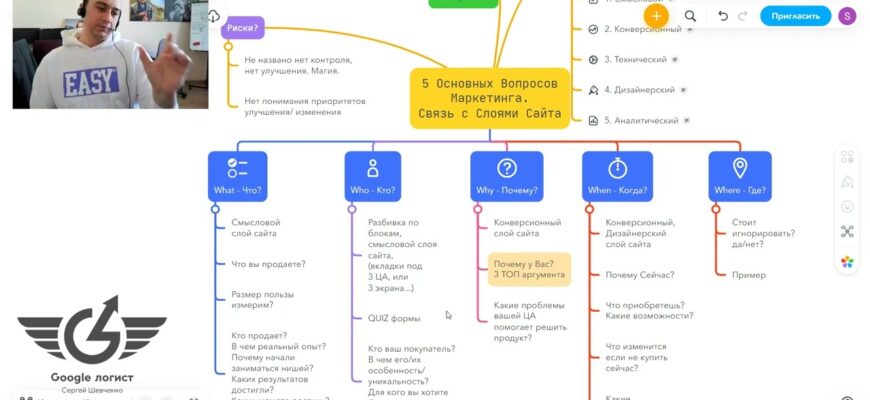
Hello! Today I want to break down a topic that seems basic at first glance, but in practice most projects stumble on it. We’re talking about five key marketing questions and their connection to website layers.
If you’re planning to launch a new online project and intend to promote it through Google Ads — you definitely should dive into this. But the material will also be useful for those whose project has been running for a while. Sometimes it’s helpful to pause, look at the website as a whole — as if “from above” — and discover growth points that previously went unnoticed.
What will we cover?
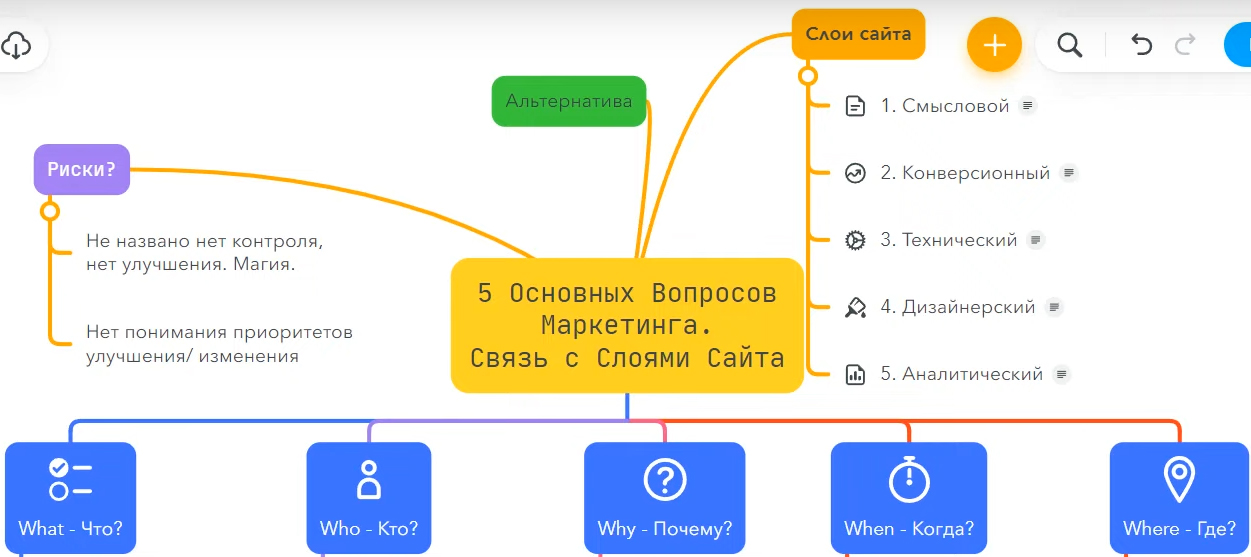
Today’s material is divided into logical sections. First we’ll talk about risks. Then we’ll move to the five key marketing questions and simultaneously explore how they connect to website layers. We’ll touch on alternatives: at what project stage you can afford not to dive deep into this topic, and at what stage you can no longer ignore it.
This material is not the ultimate truth. Supplement and adapt it to your goals. My main task is to set priorities in this broad topic so that launching a new project doesn’t feel overwhelming. When you follow priorities, you can implement the essentials fairly quickly, launch, reach break-even. And then — profitability.
Risks: why bother with this at all
If you can’t understand what drives customers to purchase — you’re working blindly. You have no formula and no control. People come, place orders, but the engine of the whole process is unknown. This is the territory of “magic” where there’s neither the ability to improve the process nor scale the business.
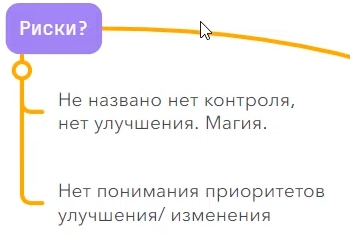
Also, without understanding it’s impossible to set priorities. Where to start? Where to direct team resources? Which points to emphasize first? Sometimes: you strengthen two or three key points that are truly important for the niche and customers — everything else pulls up almost automatically.
5W: Five Marketing Questions
Now to the essence. In English-language literature these questions are known as 5W. But over the last ten to twenty years, with the development of online sales, one of the questions — “Where?” — has been forgotten. And, it seems, wrongly so. The logic is simple: “We sell online, delivery will solve everything.” But in practice, the answer to “Where?” can open additional opportunities for business. We’ll get to that.
First question: “What are we selling?”
What product, service, or goods do you offer? This is handled by the semantic layer of the website. And typically, the business owner sets the main framework — the marketer builds on it in further work.
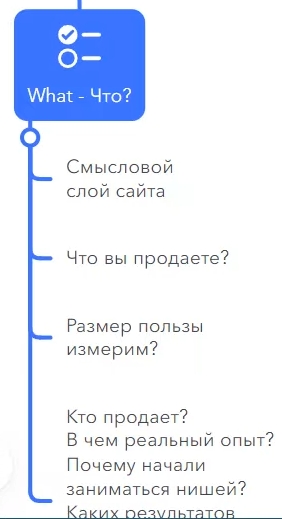
Simple advice: list point by point what constitutes the product or service. For an online store — take information from suppliers, rework it in accessible language, hire a copywriter for rewriting or use free ChatGPT — doesn’t matter. The main thing is the text must sound like you’re telling a friend what you’re selling.
Suppose you offer industrial water filters. Don’t write dryly “water purification system with 500 l/h capacity.” Better explain: “The filter cleans 500 liters of water per hour, enough to supply a small workshop or coffee shop for a day’s operation.”
If possible — indicate the magnitude of benefit. Measurable results work better.
Important: in the customer’s eyes, the product is not a set of characteristics. Especially in B2B, especially if the product is custom or designer. The product has individual facets — functional, emotional. And another point that’s often missed: people want to buy from people. The customer needs to understand who stands behind this business.
The ideal situation — the business owner can record a video, talk about themselves, answer typical questions. Why the owner and not an employee? An employee might leave, build a career separate from the company. But videos with the owner will work on website pages and the YouTube channel 24/7 — for years.
What to reveal:
- Who are you? What is your real experience working with the niche?
- How did you come to the business? Why did you start doing this?
- What do you like about the niche — not at the “sales, markup, profit” level, but emotionally?
- What results have you already achieved? What future do you see for the niche?
This is especially important in B2B. Customers buying goods want to see the future direction through your eyes. They become part of the story by choosing you. By the way, the time spent working out these points will pay back many times over — in sales and profits.
Second question: “Who is buying?”
Now about those you’re selling to. The question “Who?” (Who? in English terminology) — is about portraits of your target audience.
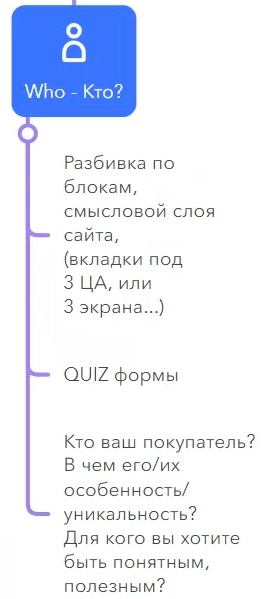
You visit the website — and already on the second screen see a breakdown: three tabs — B2B, B2C, and B2G (government sector). Three basic audience portraits. And everything differs further: offers, formulations, pain points the product solves. The argumentation “Why buy now?” or “Why from us?” — also different for different segments. This directly intersects with the semantic layer of the website.
If you can’t handle everything at once, take one priority target audience portrait. Describe in detail, as if telling a friend about the person, what’s important to them. After a couple of months, add for the second segment. Then — for the third.
It’s better this way with project launch — whether it’s Google advertising, video advertising, SEO, or Facebook — one well-worked audience portrait will give more conversions and calls than three “blurred” ones written in general phrases like everyone else.
Suppose requests come from completely different clients — both entrepreneurs and procurement managers, and government structures. How to quickly figure out who’s in front of you? A reliable working tool is quiz forms. The client answers 5 questions with answer options, and the sales department already understands in 80% of cases: the amount of time needed to process this client, whether to prepare a commercial offer, the callback priority in case of overload.
It’s also important to emphasize on the website that you understand your audience. Talk about the characteristics of people you work for. Show that you see differences between different client categories. This helps the visitor relate themselves to the offer — “yes, this is about me.”
By the way, about reviews. When asking a client for a review — ask them to write one sentence about who they are and from what position they ordered. This way other people reading the review can emotionally attach to the story and, potentially, the brand. Be sure to ask about results: whether they achieved what they wanted.
Compare two options:
- A hundred unclear reviews from unknown sources in the spirit of “5 stars, guys are great.” No specifics, no benefit for the reader.
- Ten worked-out reviews from real clients. All with stories: what they chose, compared, the result achieved, potential for product improvement (and how it was “fixed”). With emotional attachment, with specific numbers.
The second option works many times better. 10 such reviews will outweigh 100 faceless “fives.”
Third question: “Why?”
With the previous ones — “What are we selling?” and “Who is buying?” — businesses usually manage independently without difficulties. Supplier information can be found, as can audience understanding, and service stages can be described quite realistically. But with the question “Why buy specifically from you?” — however much time you invest in improving the answer, it will pay back tenfold.
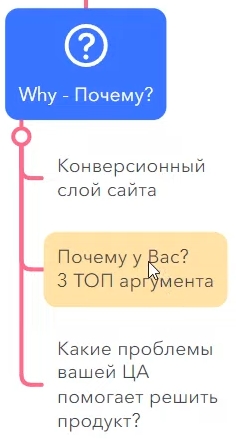
Ideally, you should have at least three strong arguments. If they’re truly convincing, with 80% probability the new project’s conversion will be no worse than competitors’. And possibly higher — especially with a competent team working on advertising.
Here are examples of possible arguments to use:
- You run a YouTube channel. There you break down the topic in detail and show expertise. This is already a serious advantage.
- You run a blog, other players in the market (not competitors — rather “niche neighbors”) order training or consultations from your team. This is powerful proof of expertise. Don’t be shy to write about such things. You’re not afraid to share knowledge, follow new trends in US and European markets, implement them first — tell about this.
- You have a quality control department formed within the company or your own employee motivation system. And bonuses are tied not just to task completion quality, but also to achieving conversions, to result cost. Is this a unique feature? All the more reason to describe it.
Three such arguments, worked out and honest, will more than pay back the time invested in them.
I want to say separately about video. Suppose you have a choice: in three months record 10–15 short videos of 10 minutes each, where the business owner answers the main customer questions. There are usually few such questions. For most businesses, 10–20 questions cover 80% of buyer doubts and clarifications.
Recorded once — spent, conditionally, a week. But the videos work around the clock. The client sees who the owner is, reads values, understands that they care.
Then the load is removed from the sales department. Listening to recordings in call tracking, it’s easy to notice: 50% of conversations are answers to identical basic questions. Videos close them in advance. The average time of manager communication with the client can be reduced from 10 to 3–5 minutes. Department efficiency grows.
Simultaneously you may see a 30–50% increase in the number of inquiries. Site conversion was 0.5% — became 0.8% or 1%. With the same amount of investment, the number of leads noticeably grew. People now have answers to main questions, and they reach out to clarify personally important details.
Allocate time to improve argumentation. Motivate the team to collect selling reviews from clients — this directly strengthens the “Why?” block.
Fourth question: “When to buy?”
I would rephrase the question differently: “Why buy specifically now?” In 95–99% of cases, the business wants the client to buy at the moment of contact, not remember a month later. Even fur coats sell well in summer with a reasonable approach. By the way, the trend for fur coats in Europe and America is fading — this already depends on the market and country.
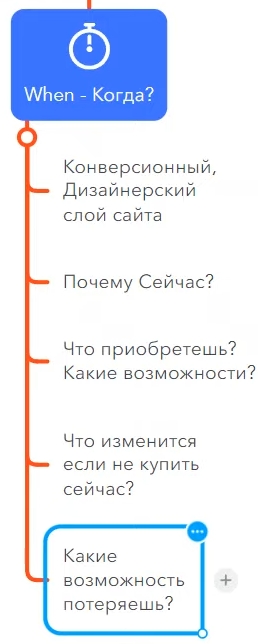
The answer to “Why now?” is placed on the conversion layer of the website. These can be different elements — timer, demand notification, limited offer. Remember Booking: “Today 10 people viewed this room. You might not make it for your selected dates.” The motivation is subtle, subconscious. Three-five-seven small tricks on the website — and they really push toward ordering.
Additionally use positive motivation: show what opportunities the client gets with a quick purchase. “Delay the purchase by six months — risk missing our favorable terms.” Specifics work better than abstract promises.
Add negative motivation too — what the person loses by delaying. But balance is important here. Suppose three positive arguments, one — “what you’ll miss.” Combine these messages on the website, in creatives, in videos.
Important: don’t tie timers to abstract 7 days. Set a countdown for a week, it passes — start again. The client sees this and stops taking it seriously. Better tie to real dates: holidays, professional days, thematic events in your field, fun “international days” — doesn’t matter. The main thing is that a holiday on the 22nd will come again only next year. And the probability that the person will take the “buy now” argumentation seriously increases many times.
Fifth question: “Where to buy?”
For the last 15–20 years the answer seems obvious: “Buy here, right on the website. Course access will come to email instantly, and goods will be delivered within a day or two.” The question “Where?” resolves itself. Actually — no. This is a potential point for project growth.

Here’s a real example. A company sells apartments and houses near Kyiv. Advertising runs all month, accounts work. But once a month, on the first Saturday, they hold an offline event. Invite potential clients — no entry conditions. Just come, walk around, look. They grill sausages and shashlik, children ride and play.
Meanwhile, examples of houses at different construction stages are demonstrated, possible materials. The owner comes, the chief architect, the foreman — and everything is allowed to be touched by hand, ask questions to live people. Plus you see potential neighbors, feel the atmosphere of the area. You emotionally and physically attach to the place.
Key moment: “For those who sign a house contract today — terrace as a gift. We’ll build it for free.” Don’t want to buy — don’t buy. In fact, two-thirds of monthly sales happen at such gatherings.
Or you sell spinning rods. Once a month organize an outdoor trip for the buyer community — contests, communication, invited speakers. This might cost conditionally 5,000–8,000 UAH per event plus two employees’ time for 6–7 hours.
It’s really possible to organize this almost without budget. Invited speakers might pay to participate, since you’ve gathered a concentrated audience. You deal with spinning rods, not air conditioners? Invite a climate equipment company — let them pay for burgers and buns in exchange for access to your audience. Pure profit.
Or tours. Produce premium kitchens near Kyiv? Once a month arrange an open house day at the factory. Organize a minibus from the metro, show production, tell about materials. And give the opportunity to close the deal right on the spot. Prepare contracts in advance, offer a discount with a three-day deadline — so the person has motivation to decide quickly.
“Where?” — not necessarily a physical point. Closed group, Zoom session, exclusive webinar. Give special conditions to those who watched the video to the end. And the video cannot be skipped and cannot be rewatched — the offer is available at the moment of viewing. This format creates a sense of exclusivity and pushes toward action.
Well, that’s it, we’ve gone through the five key marketing questions.
Website Layers
We’ve already touched on how the five marketing questions intersect with website layers. Now let’s examine the layers separately.
1. Semantic Layer
This is handled by the manager or business owner. The marketer helps — pulls out meanings, structures, formats. But the foundation is formed by the person who knows the product from the inside.
What’s important here? Everything we talked about in the “What are we selling?” block. Write in human terms what the service or product includes. Who stands behind the business. What experience. What projects have been implemented.
Simple test: the person closed the website — what remained in their head? If they remember that the company does water purification for industry in Ukraine, the owner is named such-and-such, they have extensive experience, implemented projects in various regions, have licenses, manufacture equipment — then the semantic layer works. Meanings remained in the head after closing the tab.
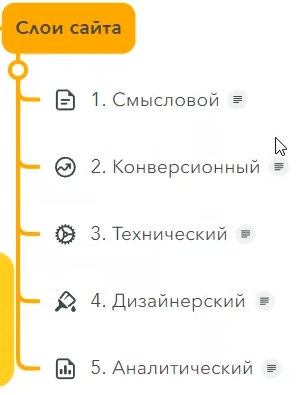
2. Conversion Layer
The main role is played by the marketer. The semantic layer is the foundation, the product is chosen by the owner. Then work begins on three questions: “Who is the target audience?”, “Why buy from you?”, “Why buy now?” The marketer spins these topics, turns them into concrete elements on the website — offers, calls to action, argumentation.
In strong companies this isn’t a one-way street. The sales department and marketers give feedback that influences the product. They see a new season coming — a new need appears that wasn’t there before. Marketers signal: “There will be demand, need to adapt the product.” And the product changes for the target audience, current and future need. If the business works this way — it’s really cool.
3. Technical Layer
This is handled by the programmer. But I’d add here the content manager too — 80% of website loading problems are related to images. Heavy, uncompressed images on product pages — a universal disease. The content manager can monitor what gets uploaded to the website and not overload pages with excessively heavy files. Programmers can also help — set up automatic compression.
Ideally, the client shouldn’t notice the technical layer at all. The website just works — fast, without lags. If loading takes 5 seconds, you risk losing about 20% of visitors. They clicked on the ad, you paid for the click — but the person didn’t wait for loading and closed the tab. At 10 seconds loading, losses are even more serious.
Important: now two-thirds of traffic (and in some niches — up to 80%) comes from mobile devices. And on mobile, website speed is almost at the top. The technical layer — not “for programmers,” this is directly about money.
4. Design Layer
This is handled by the designer — if the website was built from scratch. But in practice, this can also be the platform you use, and the content manager, and the marketer who fills the pages.
By the way, neither designer nor programmer is always needed. There are many ready-made solutions: Shopify for online stores, in Ukraine — Prom, Horoshop and other platforms. They provide ready structure and design. The main thing — don’t overload them with heavy images and bother to describe in human terms what you’re selling.
5. Analytics Layer
Here the key role is with the marketer or analyst. Ideally — check analytics at least once a month, track main indicators. A good option is Data Studio (Looker Studio): via one link you can see 24/7 not only Google advertising indicators, but also website data from other channels, each channel’s share in the overall picture. Simultaneously check against the leads table — what actually reached the sales department.
This is especially important in the first month of an advertising campaign when there’s adjustment happening and you need to understand the margin of error between analytics and actual sales. Conveniently, you can even view from your phone. If you work with clients — give them such an opportunity.
Alternatives: when you can skip spending time on this
Understanding all these blocks is important. But you don’t always need to rush to implement everything at once. Suppose you launched sales through YouTube or Facebook, and requests are pouring in so fast you can’t process them. At this moment, don’t sit down and work out the argumentation “Why buy from you?” Process the sales. When the flow starts to decline — return to this topic.
And then you’ll be able to analyze: why were they buying from you? What was the decisive argument? Add a fourth to the three existing ones — unique specifically for your business. This will increase project conversion. You’ll be able to earn more spending the same money on advertising. Customer acquisition cost will become cheaper, and the Google advertising team will have more opportunities to use additional tools from which it will become profitable to attract clients.
Summary
We’ve covered the main blocks. The topic isn’t difficult — just voluminous. The main thing is to properly build priorities and understand where to start so the website reaches break-even faster.
If you have ideas or additions — write in the comments. Subscribe, share the material with colleagues. Have a good day!