In 2026, Black Friday falls on November 27, and Cyber Monday on the 30th. These are four days during which an online store often generates the revenue of two to three average weeks. And this is exactly when ad money burns the fastest.
PPC advertising for Black Friday operates by different rules than during a quiet month: the auction is overheated, the buyer keeps five tabs open with prices, and Google Ads algorithms don’t always keep up with the spike in demand. Below, we cover timelines, campaign types, ad copy, moderation, bids, and account management after the peak.
What happens to the auction during the sales season?
Seven days before the start, everyone enters the auction: marketplaces with huge budgets, direct competitors, and stores from related niches. Meanwhile, the number of ad slots in the search results doesn’t increase. Hence the rise in cost per click—in electronics, home appliances, and cosmetics, CPC at the end of November often jumps by 20–50%.
The good news: it’s not just the price that increases. People come with the intent to buy, so the click-through rate (CTR) of promotional ads and the conversion rate also go up. A click for 14 UAH instead of the usual 9 UAH pays off if six out of a hundred visitors make a purchase instead of three.
The bad news: advertising on Black Friday does not forgive improvisation. If your ad copy gets stuck in moderation, an old price remains in the feed, or your card hits its limit—the sales peak will pass you by.
How to prepare an ad campaign for Black Friday?
You need to launch PPC advertising before Black Friday earlier than you might think: algorithms need time to learn, ads need time for moderation, and audiences need time to populate. Below is a week-by-week plan.
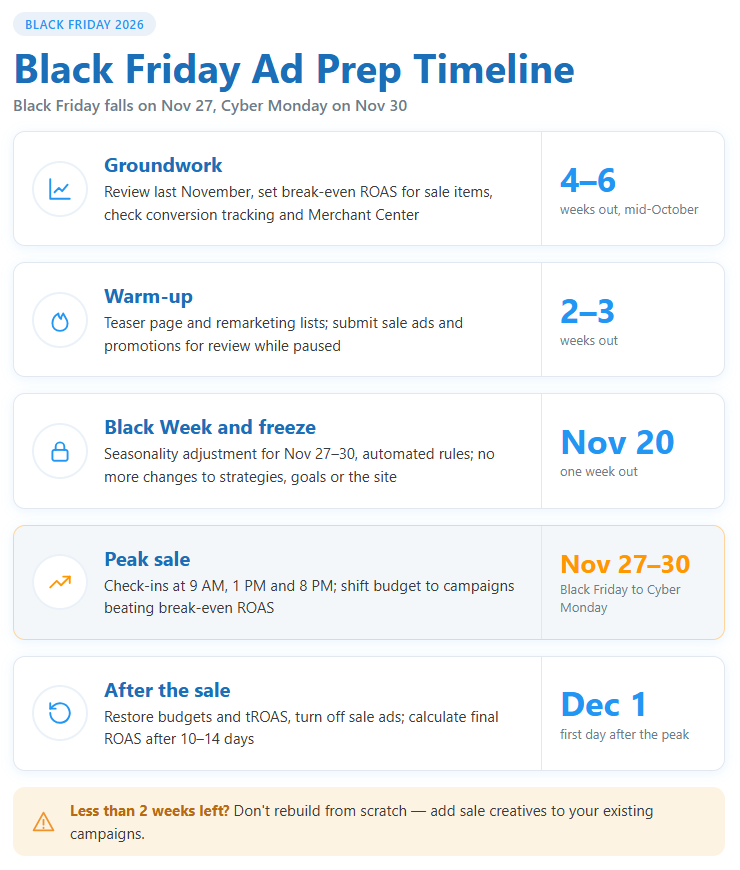
4–6 weeks ahead: preparation phase (mid-October)
Preparing an ad campaign for Black Friday begins not in the ad account, but in a spreadsheet. Open your reports for last November and write down:
- CPC, CTR, and conversion rate during the sale week versus a regular period;
- Ad campaigns and products with the best ROAS;
- search terms that brought in sales, and those that brought nothing;
- days and hours when spending hit the budget limit.
Next, calculate what return on ad spend the discounted product can sustain. Example: A robot vacuum costs 8,000 UAH, the margin is 30%, which is 2,400 UAH. The break-even ROAS without a discount is 8,000 / 2,400 = 333%. With a 15% discount, the price drops to 6,800 UAH, and the margin to 1,200 UAH. The break-even ROAS rises to 6,800 / 1,200 = 567%.
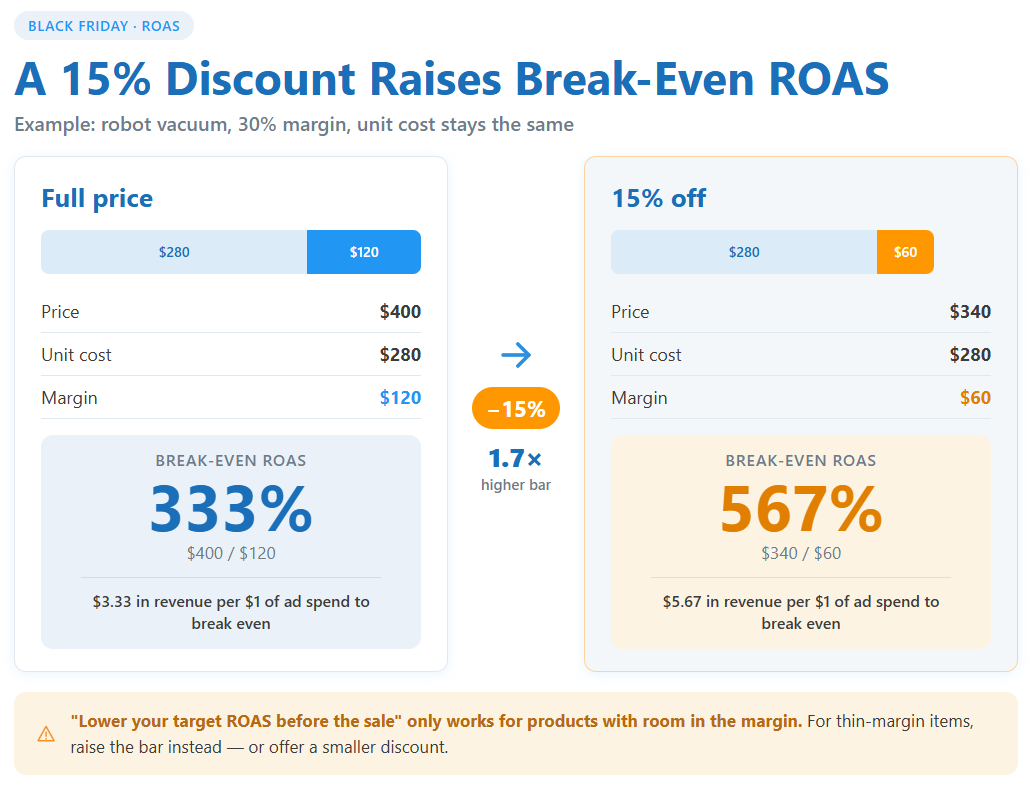
Many people forget this. The standard advice to “lower your target ROAS before a promotion” only works for inventory with a healthy margin. For items with a slim markup, you actually have to raise the bar—or reduce the discount.
At the same time, make sure that conversions are being passed to Google Ads with the correct purchase value, and that there are no disapproved products in the Merchant Center. You have a month to fix things now; later, you’ll only have a few days.
2–3 weeks ahead: launch the warm-up
Warm-up campaigns are those that don’t sell at a discount yet, but gather interested users. Create a teaser page with the start date and an early access subscription form, and drive search and display ads to it. Every visitor gets added to a remarketing list, and by November 27, you will have a warm audience instead of an empty segment.
In parallel, upload your promotional ad copy and promotions for review—let them wait in the wings on pause.
Why can’t you just turn everything on Thursday evening? Automated bidding strategies need time to learn—usually one to two weeks and a few dozen conversions. A fresh ad campaign launched three days before the promotion will be learning on the most expensive traffic of the year.
Attention. If there are less than two weeks left until the sale, do not build a structure from scratch. Work with your active campaigns: supplement them with promotional creatives and assets, add discount prices to the feed, and increase the budget. The accumulated conversion history is more valuable right now than a perfect structure.
1 week ahead: start of Black Week (from November 20)
Many stores kick things off here—not on Friday the 27th, but earlier, in a Black Week format. Queries like “black friday + product” gain significant traction by this point, and people start comparing offers. Decide on your scenario: full discounts for the entire period, or early access for part of the catalog with the main offer dropping on Friday. Your answer will determine the dates for sale_price and your ad countdown timers.
What else to get done before Friday:
- Review the status of everything uploaded earlier: ad copy, promotions, and products in the Merchant Center. Disapproved items can still be fixed.
- Create a seasonality adjustment for November 27–30. It is set in advance and will turn on automatically.
- Set up automated rules: enable promotional creatives at 00:00 on November 27, and disable them at 23:59 on the 30th.
- Attach the audiences gathered during the warm-up and evaluate their size.
- Open the “Auction Insights” report: which competitors have already stepped up? Go through their ads and pricing—this is a reason to tweak your own offer before it’s too late.
- Arrange weekend shifts: who monitors the ad account, who updates inventory, and who is on call for the website.
Starting November 20, a “freeze” begins in the account. Bidding strategies, conversion goals, and structure remain as they are until December. The same goes for the website: ask your developers not to roll out any updates starting Wednesday. Redesigning the shopping cart a day before the peak is a bad idea, even if it’s “almost ready”.
On Thursday evening, do a dry run: the balance is topped up, the peak budget is set, the promotion dates in the feed and creatives match, and a test order has gone through.
November 27–30: the sales peak
The first check is right after midnight. At 00:10 on Friday, make sure: prices on the website and in the feed have switched, promotional creatives are active, and the timer is counting down to the correct date. Check the search results using the “Ad Preview and Diagnosis tool” in Google Ads—this way, your own impressions won’t skew the statistics, and an accidental click won’t cost you money.
After that, the day runs on schedule. Three checkpoints are enough:
- 9:00 AM — status of campaigns and products, overnight spend, first purchases;
- 1:00 PM–2:00 PM — pacing of spend. Has a campaign spent 60% of its daily budget by lunch with a ROAS above target? Increase its budget by 30–40%, otherwise, impressions will stop by evening;
- 8:00 PM–9:00 PM — the evening wave, usually the strongest. Check the inventory of bestsellers and the remaining budget until midnight.
Shift money to where it pays off. Is search for broad queries yielding a 300% ROAS when break-even is 567%? Cut its limit and give it to Shopping ads generating 800%.
Be careful with jumping to conclusions—conversions appear in the statistics with a delay. Let’s say at 11 AM a campaign has spent 1,200 UAH and shows zero sales. Time to panic? Too early. Check your CRM: orders might have already come in, but the ad account just hasn’t registered them yet. Make decisions based on at least half a day’s data, not just the last hour.
There are only a few things you can touch during these days: budget limits, statuses of creatives and items, negative keywords, and bids within a 10–15% range. It’s too late to come up with new ad variations—they will go to moderation and come back when the promotion is over.
Saturday and Sunday are usually quieter than Friday. Use the lull: update inventory, replace sold-out items with alternatives, and reallocate the budget based on the first day’s results. If a bestseller sold out on Saturday morning, remove it from the promotional selection and ads before your advertising drives people to an “out of stock” product page.
November 30 is Cyber Monday and the second wave of demand, traditionally noticeable in electronics and tech. Prepare ad variations with phrases like “Cyber Monday” and “last day of discounts” in advance so they have time to pass review. Let the timer count down to 23:59. And enable remarketing for those who added an item to their cart on November 27–29 but didn’t check out: the last day is a strong reason to return.
How to set up PPC for Black Friday and which campaigns to use?
Google Ads for Black Friday for an online store rests on four pillars: Search, Shopping ads, Performance Max, and Remarketing. The weight of each depends on the niche, but turning one off for the sake of another is risky.
Search campaigns
Leave them running and supplement them with promotional ad copy. Create a separate ad group for queries containing words like “black friday”, “discounts”, “sale”, and “promotion” paired with a category or brand: “black friday laptops”, “black friday dyson”.
Do not turn off your branded campaign. During these days, competitors actively bid on other people’s names, and a click on your own brand for 2–3 UAH is cheaper than a lost customer.
Google Shopping campaigns
Shopping ads show a photo and price even before the click—on days when everyone is comparing offers, this is the main format for e-commerce. Highlight promotional items using the custom_label attribute (for example, the value bf2026) and move them into a separate ad group or campaign with its own budget. This way, the money will go toward the discounted inventory rather than being spread thin across a catalog of 5,000 items.
Performance Max for the sales season
With Performance Max, the rule is: fewer sudden movements. What you should do:
- supplement the active campaign with an asset group containing promotional banners, videos, and headlines;
- set search themes related to the sale;
- filter listing groups using the same custom_label;
- change the budget and target ROAS in increments of 15–20% once every few days.
What you shouldn’t do is rebuild the structure, change the bidding strategy, or alter the conversion goal on the eve of Friday. The campaign will go into a learning phase at the most expensive time.
Remarketing and audiences
The cheapest sale traffic comes from people who are already familiar with the store. Gather them in advance:
- visitors from the last 30–90 days who haven’t made a purchase;
- cart abandoners;
- buyers from last Black Friday (upload a customer list);
- subscribers to early access discounts.
For search remarketing, the list must reach a minimum of 1,000 active users—another reason to launch the warm-up two to three weeks in advance. During the promotion days, show these segments offers with a specific benefit, and immediately exclude those who have made a purchase.
How to write Google Ads copy for Black Friday?
Black Friday advertising on search looks monotonous: ten competitors in a row promise “discounts up to 70% off”. The one who writes more specifically stands out.
What to add to your ad copy?
A few effective techniques:
- State the exact benefit. “3,000 UAH off a robot vacuum” is more convincing than “huge discounts”. For expensive purchases, a specific amount in UAH works better; for inexpensive ones, use a percentage.
- Set a deadline. “Only November 27–30” or a countdown timer.
- Overcome objections: in-stock availability, 1–2 day delivery, installment payments, warranty.
- Repeat words from the search query in the headline. If they search for “black friday espresso machines”—start with exactly that.
Countdown timer
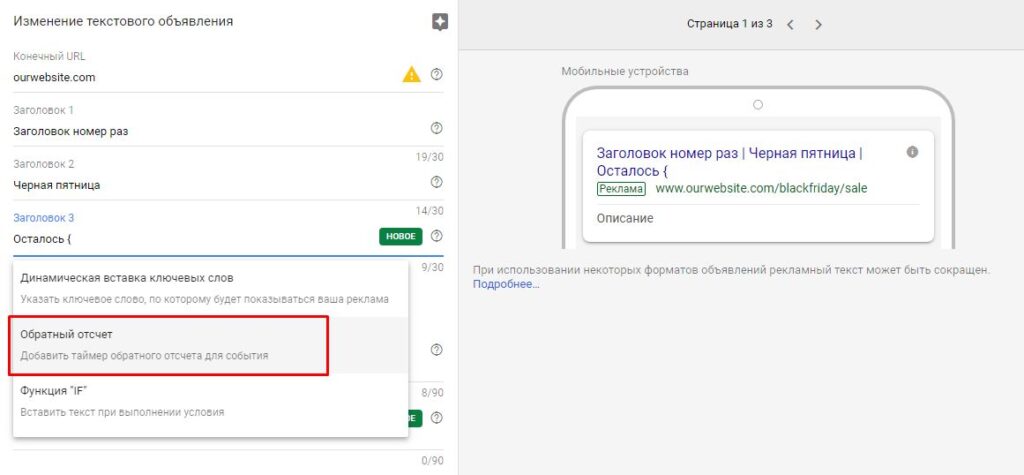
Works in responsive search ads. Type a curly bracket “{” in the headline or description, select “Countdown”, specify the end date and time of the promotion, and how many days before to start showing it. The text updates itself: first “3 days until the end of the sale”, then “5 hours left”. After the specified date, the variation with the timer stops showing—you don’t need to turn it off manually.
Ad extensions
Assets (formerly ad extensions) increase the footprint of your ad block and usually boost the click-through rate. For the sale, update:
- promotion assets—with the occasion “Black Friday”, the discount amount, and a promo code;
- sitelinks to promotional categories;
- callouts (“Discounts until November 30”, “Same-day shipping”);
- prices and images.

Google allows showing a promotion with this occasion from October 15 to December 15; advanced settings help narrow the window to the exact days of the sale. The system likely paused last year’s promotion on its own—six months without edits is its limit. Open it and resave it with the new dates.

How to pass Google Ads moderation for discount ads?
The most frustrating scenario: the ad copy is ready, the promotion has started, but everything is stuck with a “Disapproved” status. When figuring out how to prepare PPC advertising for Black Friday, allocate at least 5–7 days for review—during the season, the queue is longer than usual. Moderation happens even while paused, so upload everything in advance and enable it on the right day manually or via an automated rule.
The most common reasons promotional ads get disapproved:
- exclamation mark in the headline (only one is allowed, and only in the description);
- words in all caps: “DISCOUNTS”, “SALE”;
- repeated punctuation and symbols: “−50%!!!”, “★★★”, emojis;
- a discount in the ad that isn’t on the landing page. If you promised 40% off, the visitor must see 40% off immediately after clicking;
- unsupported superlatives: “best prices in Ukraine”, “#1”;
- a broken or slow landing page.
The Merchant Center has its own requirements. Promo text in the product title (“Sale. Blender…”) and “SALE” overlays on the main image will lead to item disapproval. Show the discount using sale_price, not through the title and image.
Attention. After a bulk upload, check the “Status” column 24 hours later. A disapproved variation is easy to fix 12 days before the promotion, but almost impossible 12 hours before.
How to avoid wasting your PPC budget on Black Friday?
Money is lost on these days for the exact same reasons. Go through this list before launching your PPC for Black Friday:
- Negative keywords. Queries containing “black friday” are half informational: “when”, “what date”, “what is”, “history”, “meme”, “pictures”. Add them to your exclusions in advance, and during the promotion, review the search terms report twice a day.
- Double spend. Google is allowed to spend up to twice your average daily budget in a single day. With a limit of 7,800 UAH, Friday might cost you 15,600 UAH—factor this into your plan.
- Payment. Top up your balance with a buffer or check your card limit. Ads stopping on Friday due to a declined payment is a classic blunder.
- Inventory. A bestseller sells out at 2:00 PM, but the ads run until evening. Update availability in the feed several times a day, and pause ad groups for sold-out items.
- Automated rules. Set up an alert or a pause if a campaign spends, say, 2,000 UAH without a single conversion.
- Tracking. A broken tag after website edits will leave smart bidding strategies without data. Cross-check conversions in the ad account with orders in your CRM at least once a day.
And most importantly—do not touch the structure during peak days. Changing the bidding strategy or merging campaigns on Saturday will send the account back into the learning phase. Only change limits, bids, and statuses.
What to do with your ads after Black Friday and Cyber Monday?
The morning of December 1 is the moment when advertising is most often forgotten. But it shouldn’t be: campaigns continue to spend at a peak pace, even though the customers have already left.
On the very first day:
- return budgets and target ROAS to their previous values;
- turn off promotional ads, promotions, and callouts about markdowns;
- cross-check prices in the feed and on the website—after sale_price ends, discrepancies usually pop up in the morning;
- remove sale banners from landing pages.
With a seasonality adjustment, you won’t have to worry about reverting it: its timeframe has expired, and bids are once again calculated based on the usual, pre-promotion data.
The first week of December almost always looks worse than normal: some of the demand has already been captured, conversion rates drop, and the cost per acquisition rises. Don’t slash campaigns in the heat of the moment—give the algorithms a few days to recover.
Don’t rush with the final results either. Some orders will be placed after the click, while others will be returned or canceled. Calculate your final ROAS after 10–14 days using CRM data, not just the ad account. Analyze which products and search terms brought in profit, what hours sales occurred, and how many buyers turned out to be new.
Don’t abandon your sale audience. In December, show those who bought on Friday related products and New Year’s gifts: for an espresso machine—coffee beans and descaler. For those who added an item to their cart but didn’t check out—run remarketing with a standard offer. In three weeks, the seasonal New Year sales will begin, and you already have a warm base gathered for them.
Write down your conclusions while they’re fresh: what worked, where the budget fell short, and what moderation disapproved. A year from now, this note will save you a week of preparation.