
Hello! I’m Yana Lyashenko, a Google logistician. My job is to help businesses attract the right target audience with specific characteristics. Today, I’m going to address one of the questions I’m asked most often: how do you get those star ratings in product ads?
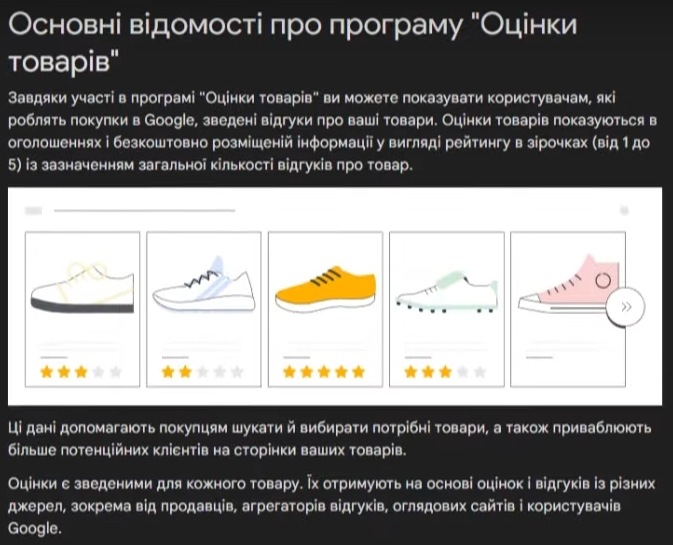
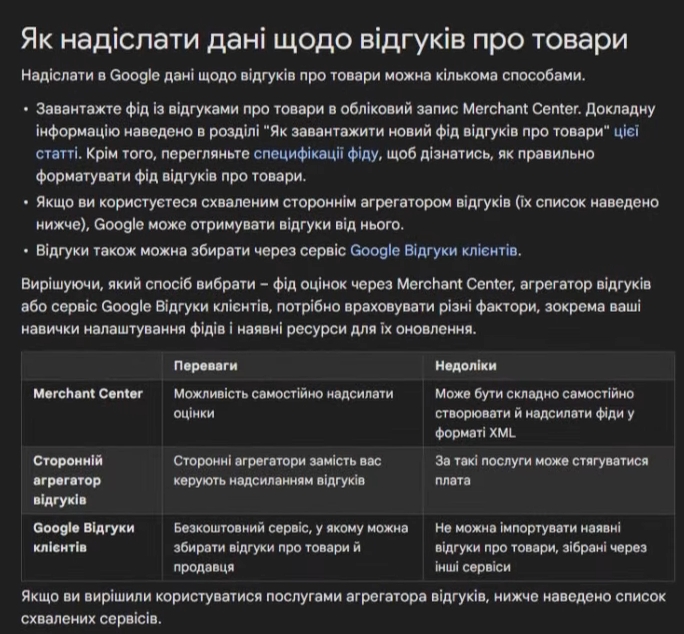
You’ve probably seen ads on Google Shopping where yellow stars with the number of reviews are displayed under the price of the product. Looks attractive, right? Such cards immediately stand out from the competition and inspire more confidence in buyers.

Two programs for earning stars in Merchant Center
Google Merchant Center offers two programs for collecting reviews, which can help your ads earn those coveted stars:
- Seller reviews — ratings of your store as a whole;
- Product reviews — ratings for specific items from your catalog.
Why are these stars necessary? It’s simple: they significantly increase the clickability of ads. When a buyer sees a card with a high rating, they automatically feel confident. Five stars = reliable seller, high-quality product. This works on a subconscious level.
Stars as seller reviews
An interesting point: most buyers perceive stars in advertisements not as an assessment of a specific product, but as a rating of the store as a whole. Therefore, a high rating builds loyalty to you as a seller.
Feedback about the seller is usually collected after the purchase has been made and the order has been paid for. This protects you from fake reviews — only real customers can leave feedback. However, there is a risk: in the event of competitive wars, ill-wishers may try to ruin your reputation. To minimize this threat, set up feedback collection so that the review form is only available after payment confirmation.
Stars as product reviews
With product reviews in Merchant Center, the situation is both simpler and more complicated.
Simpler — because it is the most accessible way to earn stars for most online stores.
It’s more complicated because the quality of reviews is important here. Imagine two identical products in the search results. One has three stars, the other has no stars at all. Which one do you think people will click on? Most likely, the one without a rating! Three stars out of five raise suspicion — it means that something is wrong with the product. The absence of ratings is perceived neutrally.
Therefore, if you decide to add product ratings, make sure you can get enough positive reviews. Otherwise, the effect will be the opposite.
Next, we will take a closer look at the product review program—this is the best option for getting started.
How do I get stars for products?
We figured out why ratings are needed. Now the main question is: how do you add stars to Merchant Center in practice? And is it possible to get them for completely new products that no one has reviewed yet?
Google may display stars in your ad for two reasons.
1. Google’s own initiative
Sometimes the system decides on its own to add ratings or other additional elements to an ad. This happens according to internal algorithms — if Google decides that stars would be appropriate and useful for the user, it will display them. It is not possible to directly influence this decision.
2. Presence of the specified GTIN
But here you can act independently. In order for stars to be displayed in product advertising, one critically important attribute must be filled in the feed: GTIN (Global Trade Item Number). This is an international barcode, a unique identifier for the product from the manufacturer.
Without a GTIN, the chances of seeing stars in your listings are close to zero. Yes, Google mentions in its help section that the system can match reviews to products based on other parameters: item number, page URL, MPN code. But in practice, it is the GTIN that provides the maximum guarantee.
Why is this code so important to Google? It’s all about versatility. GTIN is an international standard. The same number identifies a specific product in any country in the world.
Algorithms find it much easier to work with digital values than with text descriptions in different languages. When the system sees a GTIN, it instantly understands which product the collected reviews, photos, and specifications refer to. That is why filling in this attribute is the first step toward obtaining a product rating on Google Shopping.
Where does Google get its stars?
So, you have GTINs, your products are uploaded — but where do you get the reviews themselves? Google doesn’t generate them out of thin air. The system obtains rating data from external sources, and here you have two options.
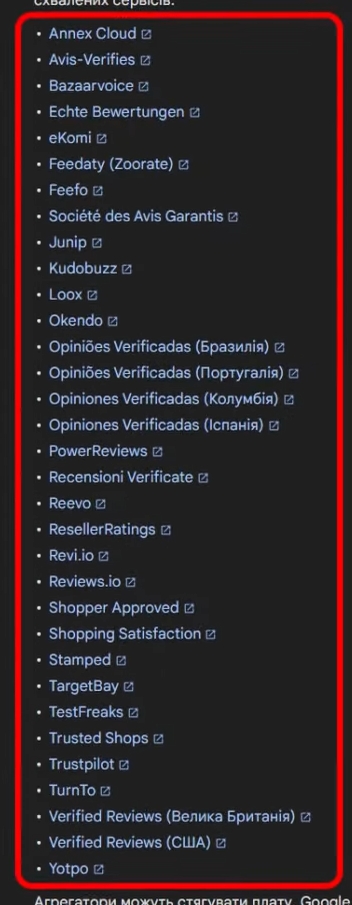
1. Review aggregators
There are special services that automatically transfer reviews to Google Merchant Center. These are official Google partners—you can find a list of them in the help section. Such platforms collect customer ratings and synchronize the data with your account. This is convenient if you have a large catalog and don’t have time to upload reviews manually.
Important note: Google requires all reviews to be submitted, both positive and negative. It is not possible to filter out “inconvenient” ratings.
2. Manual transfer of feedback
If you are launching a new product that does not yet have any reviews, you can upload reviews to Merchant Center yourself. This method is suitable for startups and situations where you want to control the process from the very beginning.
Let’s say you are launching your own product line. The GTIN has already been assigned, the cards in the feed are ready, but there are no stars — there was simply nowhere to collect reviews. In this case, you can get the first ratings from real buyers (friends, acquaintances, test participants) and upload them manually.
Theoretically, this opens up a loophole for cheating. But let’s be honest: Google is not a naive system. Algorithms check the authenticity of reviews. If you decide to cheat, do it wisely: let different people leave reviews at different times over several months. Ten rave reviews in one hour is a red flag. But gradually collecting reviews for Google Shopping over two or three months looks organic and won’t raise suspicion.
How do I manually upload reviews to Merchant Center?
The upload process is not as complicated as it may seem. If you have already worked with a product feed, you will have no problem. The Merchant Center interface is designed for regular advertisers, not programmers — it’s hard to mess things up here. This is not Google Analytics 4, where you can break your leg trying to figure out the settings.
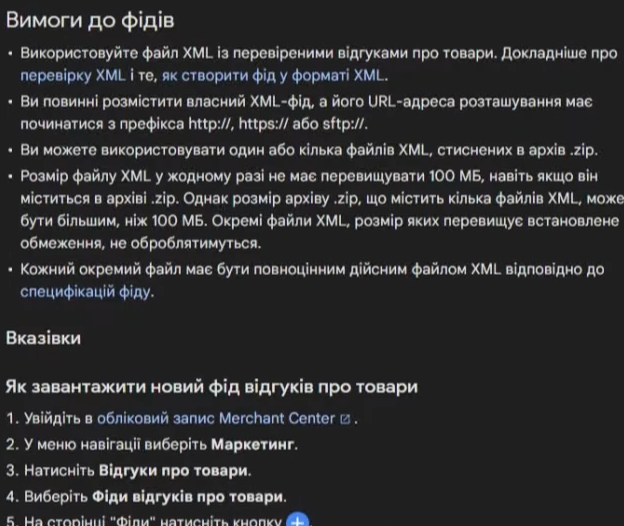
Step-by-step algorithm for loading the feedback feed:
- Go to Merchant Center and find the “Marketing” section;
- Select “Product reviews”;
- Click “Add New Feed”;
- Create a file in XML format (not CSV — this is important);
- Download the file and complete all the setup steps.
Important note: for correct operation, it is desirable to have at least 50 reviews for products. The system may simply ignore fewer reviews.
How does Google verify the review feed?
After uploading, moderation begins. First, the system will check the technical side—whether the file is correctly composed and whether the attributes are in their proper places. If something is wrong, you will immediately see a list of errors with explanations of what exactly needs to be corrected.
But technical verification is only the first step. Next, Google will verify the authenticity of reviews: compare them with the information on your website and check them against the actual products in the feed. One of the key principles of Google advertising is relevance. The system ensures that users receive accurate information rather than inflated ratings.
And you have to admit, you want to see honest reviews too, right? No one likes to be constantly on guard and doubt every review. Unfortunately, not everything on the internet can be trusted these days — and I’m not even talking about ChatGPT.
Manual or automatic loading: which to choose?
Let’s summarize. If you have a new product with no review history, you can submit reviews to Google manually. This is not an obligation, but an option—automatic aggregators remain an alternative.
By the way, most foreign online stores prefer to automatically add reviews through aggregators and don’t bother with manual uploading at all. There are many services on the market, and if you have a specific task, you can write to the support team of a particular aggregator and agree on individual terms for data transfer.
If you do decide to “help” your rating a little, do it carefully. Imagine this situation: you spent time, maybe money, collected reviews, uploaded a feed — and Google rejected everything. Or worse: the system suspected manipulation and now your account is under special surveillance. Merchant Center may well wag its finger and remind you that you are violating the principles and values of the platform.
So my advice is: if you are working on speeding up the collection of reviews, make it look as natural as possible. It’s better to have four honestly earned stars than to have your account blocked for trying to get five.
I will leave a link to the current Google reference on this topic below the article — you can always check the latest requirements there.
I wish you five stars on all products!