Hello! I’m Yana Lyashenko, a Google logistics specialist. Today we’ll break down an unpleasant error in Merchant Center — the “Duplicate Identifiers” status. I’ll tell you about a real example of how we found the cause and what needs to be done to get rid of it.
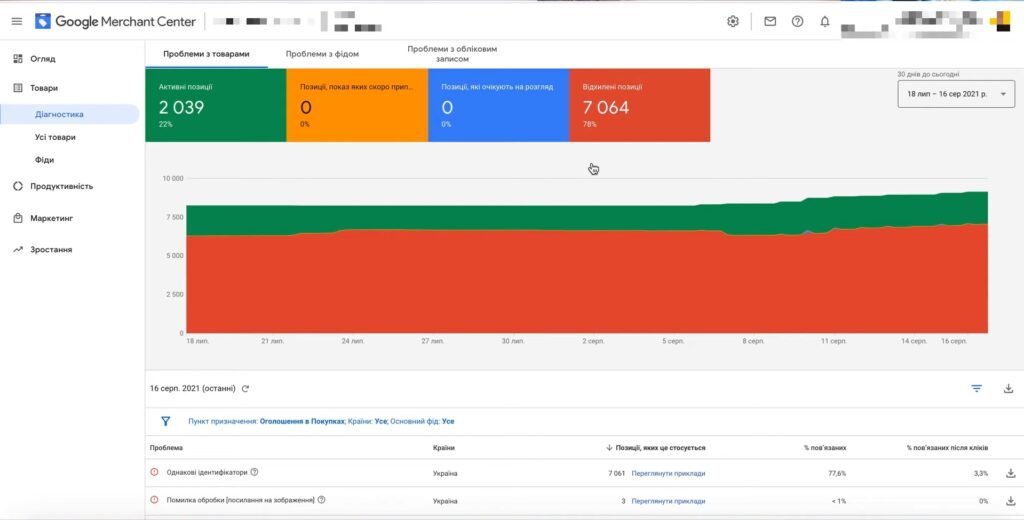
The situation: a client has about seven thousand product positions blocked. All with one status: “Duplicate Identifiers”. The person tried to figure it out themselves, involved Horoshop support — to no avail. No one could find the cause. We found it. The client started making corrections, and I’ll add the unbanning result separately later.
What is the “Duplicate Identifiers” blocking status related to?
Previously, this error concerned the product ID attribute. Now, however, Google pays attention to the following fields:
- GTIN — international product identification code (essentially, a barcode);
- MPN — code assigned by the manufacturer to a specific product.
Both values help the system better understand what is being sold. And the key point: GTIN and MPN must remain unique for individual product positions. When they overlap or are filled in incorrectly — Merchant Center gives the “Duplicate Identifiers” error.
Cause of the “Duplicate Identifiers” error
In our case, everything turned out to be quite simple. MPN and GTIN were duplicated for some products. This was discovered by analyzing the original feed — the file exported by Horoshop before the transformation rules applied by Merchant Center.
In Horoshop, in the product card, there is a separate settings block — “GTIN/MPN and other”. When these fields are empty, the platform automatically substitutes the “identifier exists” attribute in the feed (in Russian — “has identifier”). By the way, this is a really convenient feature. Not all platforms do this. In Shopify, when I last checked the feed export, I had to add everything manually.
Our client ended up with a mess: on some cards “identifier exists” was set automatically, while on others MPN and GTIN were entered manually. Moreover, on some individual cards, the MPN field showed “not specified”, and the brand was “не вказано” (the site is in Ukrainian). “Not specified” is text that someone manually entered directly on the site.
After the corrections, I wrote to the client that we needed to wait about half an hour for the information to update. The client confirmed: false MPNs disappeared, there were no unfilled GTINs left, IDs don’t repeat. Waiting for the final result.
Resolving the duplicate identifiers error
To figure out the situation, I started by checking the feed. Opened the link to it and immediately saw: some product positions were missing brand, MPN, and the required “identifier exists” attribute (also known as “has identifier”).
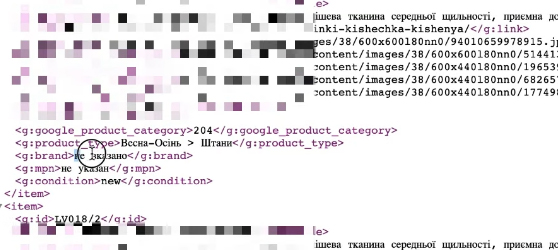
Important! The “identifier exists” attribute is required when MPN and GTIN are not filled in for a product. Without it, Merchant Center simply doesn’t understand how to identify the product — and problems begin.
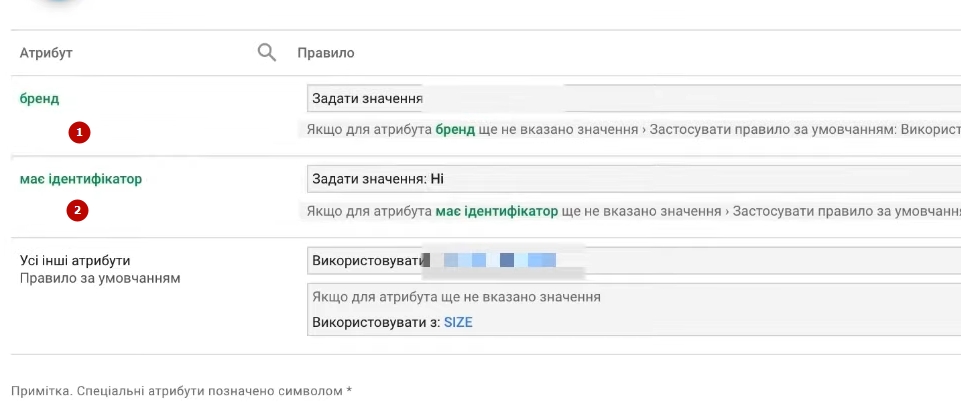
What did I do next? Went into Merchant Center and added transformation rules: one for the brand, the second for the “has identifier” attribute. In the latter, I set the value to “No”. Checked — the attributes were applied. “Has identifier” is now set to “No”, the brand was also pulled in. If I remove the rule — the values disappear. So everything works correctly.
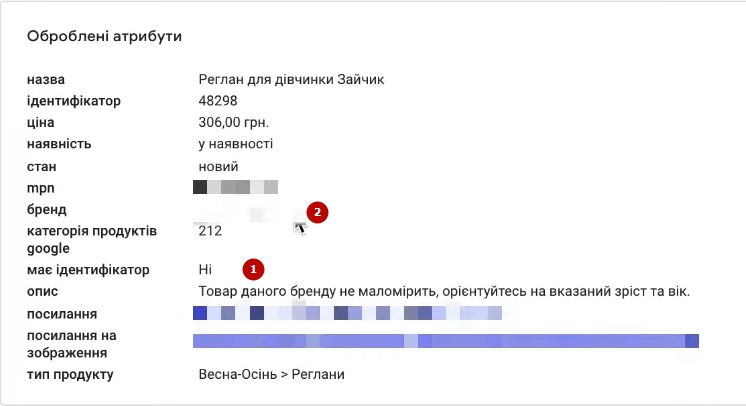
Next — wait. Half an hour passed, I went to check if the product statuses had changed. And here’s the unpleasant moment: all 7,000 positions remained rejected as they were. No movement at all.
And what does this mean? The cause is somewhere deeper, and most likely the client missed something or isn’t telling the whole story. Manually going through the entire feed for duplicate MPNs and brands is, to put it mildly, a tedious task. So I took a different path and used the Merchant Center’s own tools.
Finding the error using Merchant Center
Then I went to the errors section in Merchant Center and started looking for specific product positions. Found, for example, raglans — “Raglan for girl Bunny”. Looking: one raglan with ID 48298, status — rejected, invalid.
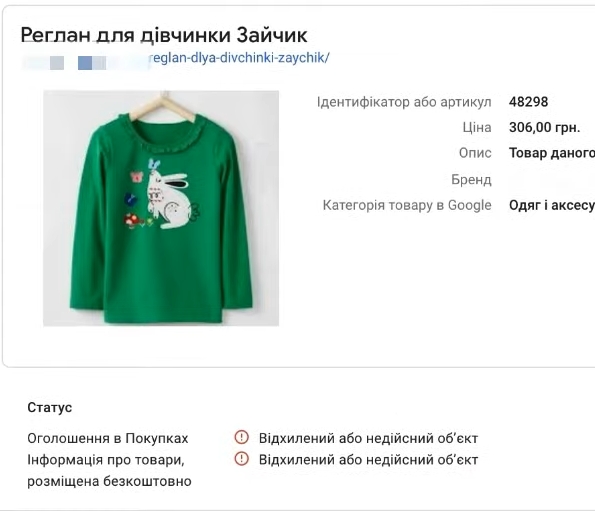
Next to it — a second raglan, also with a bunny. URLs are different, identifiers are different. So formally these are two different product cards — they lead to different pages, IDs don’t match.
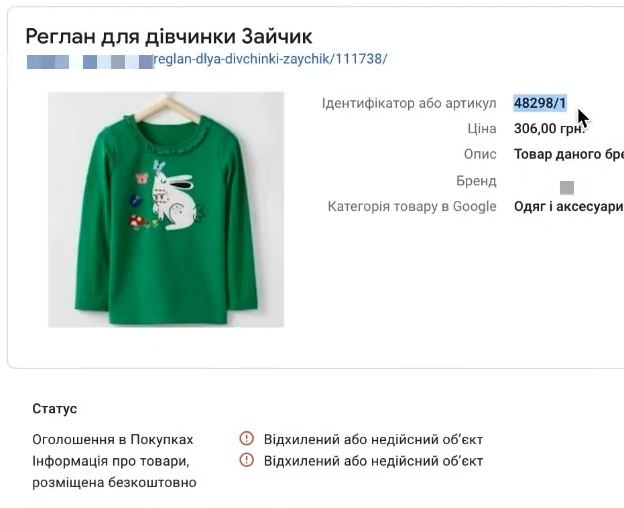
But when I scroll down to the attributes — there it is. Both products have an MPN, but it’s completely wrong.
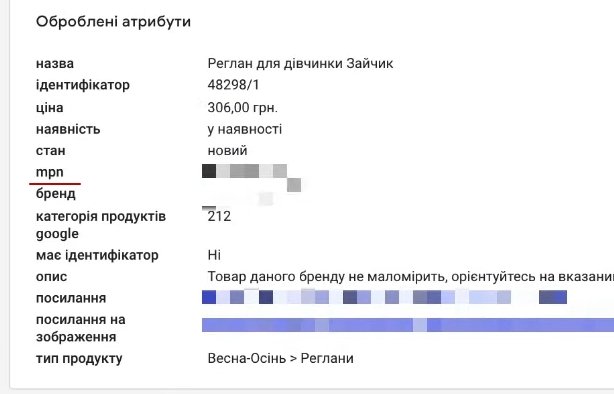
On the first one — Little Maven, and on the second — Little Maven. The same. Someone from the staff (hard to say who exactly) went into the product card on Horoshop and entered the brand name in the MPN field instead of the actual manufacturer code. Simply mixed them up.
Checked a couple more positions. “Raglan for girl Planet and stars” — two variants, IDs 33413 and 33412. They differ only by age. And the same story with MPN.
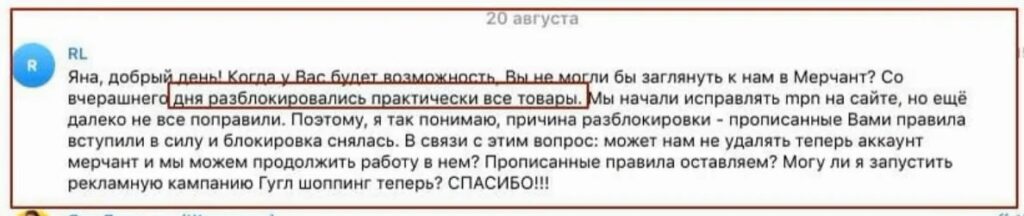
Important! I also recommended the client add additional attributes — age group, gender, etc. When they came with the blocking question, the feed wasn’t checked thoroughly enough. The reason for the ban is that the identifiers for different products are indeed the same — the system didn’t make up the problem, it found it.
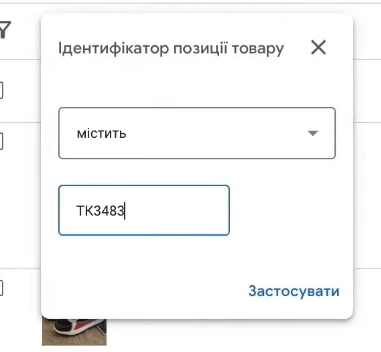
Went further — took another product position. Used the filter by product position identifier, removed extra characters to find all related products. Opened several cards, comparing. URLs differ — good. But in the MPN field it says “not specified”. And here’s the suspicious moment: it seems that “not specified” is not an empty field, but directly entered text. Someone manually typed these words.
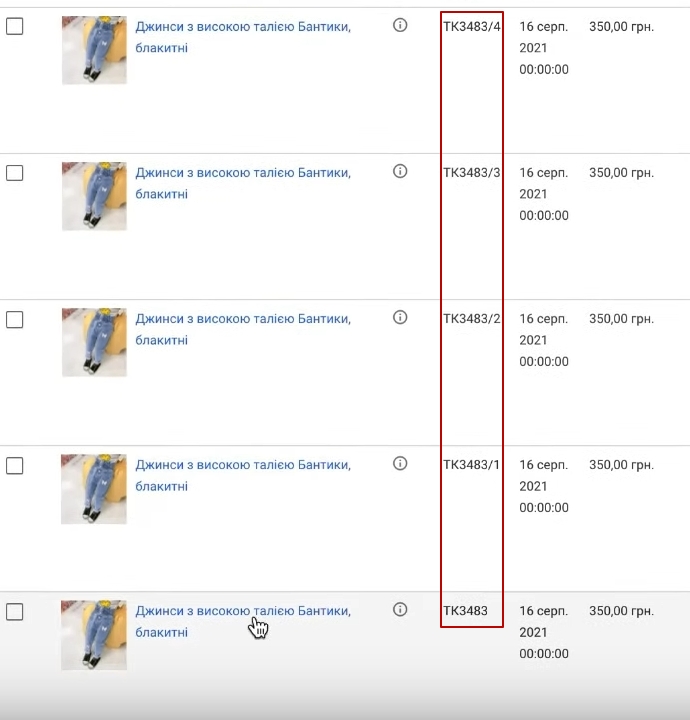
Suppose your MPN field is empty — then it simply doesn’t get exported to the feed. That’s how Horoshop works. GTIN isn’t pulled if not filled, right? But here MPN “not specified” appears precisely because it’s a text value entered on the site. And somewhere it’s written “не указан” in Russian, and somewhere — “не вказано” in Ukrainian. A mess of languages.
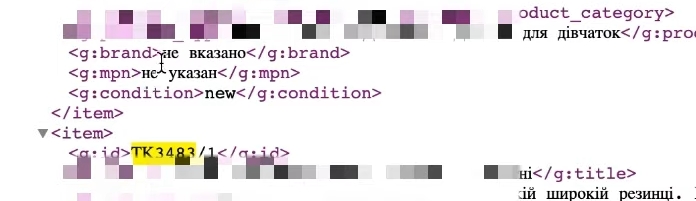
Went back to the feed, removed the transformation rule for the brand and checked the original data from Horoshop. What did I see? On one position MPN — Little Maven, although the brand is actually Little Voguey. Someone simply made a mistake when filling it in. And some products where MPN is entered as “not specified” probably got banned “by association” — the moderator could have blocked them in bulk.
My theory: the problem is related to interface languages and the fact that MPN is filled with text instead of the actual code (or instead of an empty value). There might even be invisible characters hiding there. Waiting half an hour for the data to update, then checking the result.