I am Yana Lyashenko — a Google logistics specialist. My job is to attract a target audience with the right parameters for business. Today I want to thoroughly analyze the topic of Ukrainian-language feeds for online stores operating in Ukraine.
This topic is hot right now. After the language law was passed, websites, customer service, and advertising must be predominantly in Ukrainian. And for many projects, this has become a real challenge.
Is it really that important? The reach, volume of traffic to the site, and sales directly depend on how correctly the Ukrainian-language feed is uploaded. What I see now in the market is, to put it mildly, not ideal. Many make mistakes that prevent advertising campaigns from working at full capacity. This is especially true for Smart Shopping.
Why is a complete site translation important?
Let’s start with the basic but critically important point. To upload a Ukrainian-language version of the feed to Merchant Center, a fully translated version of the site is required — not 70%, not 90%, but completely.
It seems obvious. But in practice, many online store owners upload a Ukrainian-language feed while the site is not yet fully translated. The logic is “let the advertising run for now, and I’ll slowly translate the remaining pages.” The result? Merchant Center blocking.
Usually in such cases, Google assigns two standard statuses — misrepresentation and inappropriate language. Sounds strange, but actually logical. Suppose a moderator goes to a product card — everything is beautifully in Ukrainian. Excellent. Then they click on the “Exchange and Return Conditions” or “Payment and Delivery” page in Russian. Here’s the reason for the blocking.
Important: in Google’s eyes, mixing languages on a site is a signal of non-serious advertiser intentions. It doesn’t matter if it’s Russian with Ukrainian or any other combination.
And it’s not about the translation as such. The translation must remain competent — without typos, errors, or awkward phrasing. By the way, this applies to absolutely any language. My experience passing moderation on different platforms and in different countries confirms one simple rule: text quality matters. Careless translation is a path to blocking.
The conclusion is simple: without a fully translated Ukrainian-language version of the site — don’t rush to upload the feed. It’s better to wait, finish the translation completely, and then launch advertising — you’ll save both time and nerves.
How to properly upload a feed in Ukrainian: option 1
Now let’s figure out how to upload a Ukrainian-language feed to Merchant Center when a Russian-language version is already present. There are many ways, and the first one is the most common. Unfortunately, not the most successful.
The essence of the method: You upload a new feed with the same product identifiers as in the Russian-language one, but apply a transformation rule in Merchant Center. Some letter or numeric value is added to each ID to create a difference in identifiers. In the system, there appear to be two product positions — Russian-language and Ukrainian-language.
This method is currently actively promoted on the internet. Many specialists and agencies recommend it. But I’ll say straight — don’t do this if you use or plan to launch Smart Shopping campaigns.
For Smart Shopping to work correctly, a remarketing list is needed. If you’ve read the campaign launch requirements, you know — for the general list, the system recommends using dynamic remarketing event tags. For these lists to be compiled correctly, the product identifier in the Merchant Center feed must match the identifier on the site.
Suppose your product has ID “12345” on the site. In the Russian-language feed, everything is indicated correctly. But in the Ukrainian-language one with transformations, it becomes, say, “12345_ua”. What happens? The dynamic remarketing system collects data by ID “12345” from the site, but such an identifier doesn’t exist in the Ukrainian-language feed. The data simply doesn’t match.
Important: if the identifiers in the feed and on the site don’t match — dynamic remarketing won’t be able to work correctly. And this directly hits the effectiveness of Smart Shopping campaigns.
I observe this on many projects. Of course, you can’t say this is a rule without exceptions, but in most cases the picture is the same: when dynamic remarketing event tags work correctly and identifiers match — Smart Shopping reaches conversions much more easily. When they don’t match — results are noticeably worse.
How to properly upload a feed in Ukrainian: option 2
The second method — create completely separate identifiers for Ukrainian-language product cards. Many platforms now have this capability. As a result, Merchant Center ends up with two feeds: Russian-language and Ukrainian-language. The products are the same — conditionally, the same vegetable slicer — just in different languages and with different IDs.
Sounds logical, but there’s also a serious drawback here. When you launch Smart Shopping, the campaign actually gets two “different” product positions that essentially describe the same product. At the same time, in Smart Shopping you can’t set the language of displays — there’s no way to separate which product to show in Ukrainian and which in Russian.
And if you try to separate them into two different Smart Shopping campaigns through product filtering? Then these two campaigns will start competing hard with each other for impressions. And when two essentially identical products sit in one campaign — predicting system behavior is difficult. Will there be internal competition? How exactly will Smart distribute impressions? Honestly, expecting stable results with this approach is difficult.
This option is technically possible, but I don’t recommend it either.
Alternative approaches
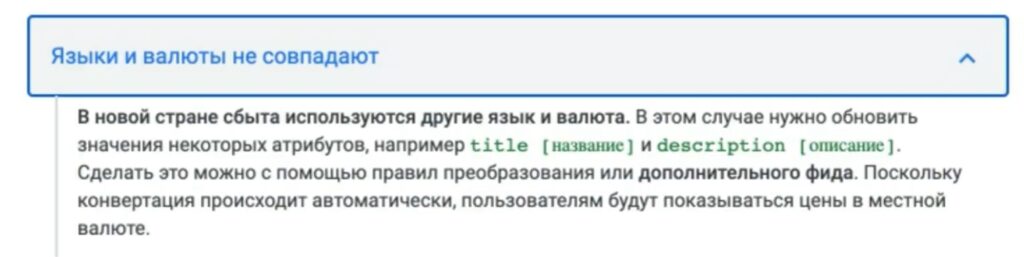
By the way, there’s another method — for those who like to dig through Google’s help documentation. It describes a situation where in the target country the language or currency differs from those specified in the feed. Google suggests using an additional feed or transformation rules to correct the data.
But I’ll be honest — the process is quite tedious. You need to think through how to link feeds together and combine them so that everything actually works. I think this option is more relevant for those entering foreign markets and ready to spend time on setup.
And the most universal method for the Ukrainian market I’ll tell you about further. It’s simple, understandable, and accessible to everyone. Plus we’re currently communicating with Google representatives to find the most correct solution with separate identifiers. As soon as a proper, verified option appears — I’ll definitely post instructions in the blog.
The most optimal way to implement a Ukrainian feed
And now — the simplest and working method that won’t harm Smart Shopping campaign effectiveness, won’t break dynamic remarketing, and at the same time fully complies with Ukrainian legislation.
The solution is this: use the Ukrainian-language feed as the base. Yes, exactly the Ukrainian-language one.
I know, many will now have a question — what about the Russian-language feed? Many perceive it as the foundation, without which nothing will work. But let’s figure out why this is a misconception.
Google in recent years has learned to excellently understand typos, transliteration, as well as the connection between Russian and Ukrainian languages. For the search engine, “Prydbaty ovocherizku” and “Kupit ovoshcherezku” are two identical queries. That simple. It doesn’t matter in which language your feed is uploaded — Google will show products for both Russian-language and Ukrainian-language queries.
Will this cut reach in Smart Shopping? No. And in standard shopping campaigns? Also no. Remember: in shopping advertising campaigns you don’t manually set keywords. The system itself selects search queries and associates them with your products.
It can show your vegetable slicer for the query “What to buy for the kitchen” and for the query “Top kitchen accessories”. Try right now to enter several Ukrainian-language queries into Google — in the shopping results you’ll see a colorful mix: Russian-language and Ukrainian-language feeds alternate with each other.
Important: the common opinion that a Russian-language feed is shown only for Russian queries, and a Ukrainian-language one — only for Ukrainian queries, does not correspond to reality. Re-read Google’s help documentation and check for yourself.
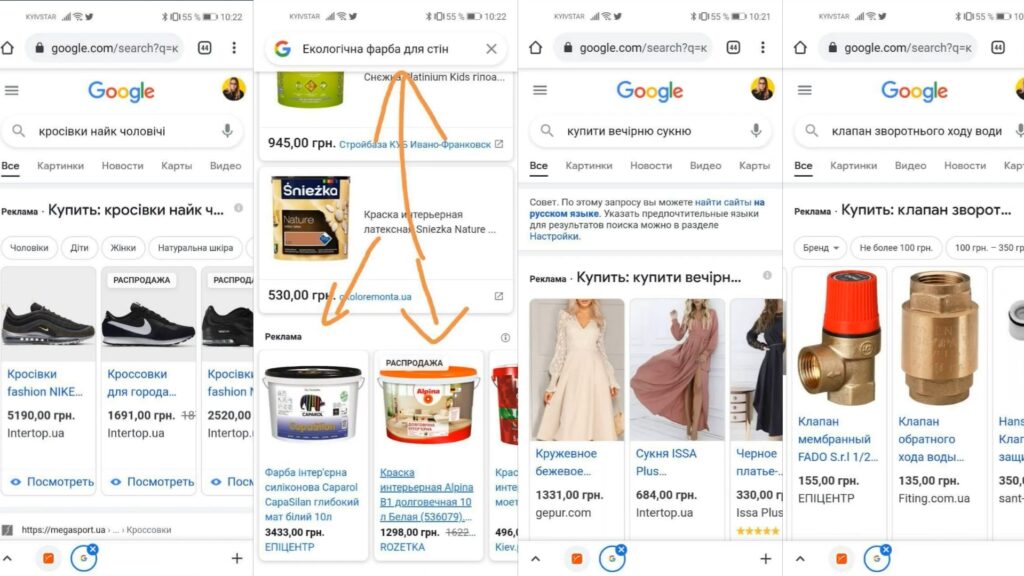
If you use standard shopping campaigns — you can test a Ukrainian-language feed for at least a couple of days. It definitely won’t get worse, and the result will most likely surprise you. With Smart Shopping, though, it won’t work that quickly — it needs more time to learn.
There’s also a strategic argument. The volume of Ukrainian-language search queries is steadily growing. There are already many of them now, and there will be even more. Sooner or later, the Russian-language feed will inevitably fade into the background. Plus — part of the audience principledly ignores Russian-language advertising and doesn’t click on such ads. Using a Ukrainian-language feed, you don’t lose this audience.
And one more point — with a Ukrainian-language feed you definitely won’t violate the legislation. And this is currently quite important.
If you haven’t uploaded a Ukrainian-language feed yet — start with it right away. If you’re already working on Russian-language — don’t panic, nothing terrible. You can transition gradually. The main thing — don’t cling to the familiar scheme just because “that’s how it’s always been done”. In the feed settings you specify language and country — Google has long understood where you are and to whom to show advertising.
As soon as I find a more elegant solution for simultaneously uploading both feed versions — I’ll definitely publish instructions in the blog. But for now — use this method, it’s tested and works.