
Kharkiv is Ukraine’s second most populous city, where business is developing rapidly and in a wide variety of directions. IT companies and educational centers, manufacturing enterprises and retail chains, cafes and car service centers — thousands of organizations compete daily for the attention of the same audience.
And every year, this battle shifts online. Simply creating a website or social media page is no longer enough—it is important to appear in front of potential customers at the exact moment they type “order,” “buy,” or “find nearby” into a search engine.
This is why contextual advertising exists in Kharkiv. A well-designed Google Ads campaign works like a filter: it weeds out random visitors and brings those who are currently interested in your product to your website.
Why do businesses in Kharkiv need contextual advertising services?
The Kharkiv market has its own characteristics. This city of over a million people generates a huge number of search queries every day. For example, Google processes thousands of requests from Kharkiv residents every month on topics such as “apartment renovation” or “food delivery” alone. At the same time, a significant number of local entrepreneurs still rely on recommendations from acquaintances or launch advertising campaigns without a clear strategy — and waste their budget.
Contextual advertising services in Kharkiv, when properly configured with local specifics in mind, provide businesses with several significant advantages:
- Precise targeting. Ads are seen by people in Kharkiv and the surrounding region—or in any other region you need. Let’s say you have a car service in Saltivka: you can set up ads to be shown only to residents of nearby areas so you don’t waste money on clicks from Poltava or Dnipro.
- Instant start. SEO promotion is a long-term game, with results appearing after 3–6 months. Contextual advertising works differently: you launch a campaign in the morning and receive your first inquiries by lunchtime.
- Full budget control. You decide how much to spend per day, week, or month. You only pay for actual visits to your website — ad impressions themselves are free. If your budget for the day is exhausted, advertising is automatically suspended.
- Transparent analytics. Every click, every call, every request—everything is recorded in the reporting system. You can see how much it costs to attract a single customer at any time and assess how effective your advertising is.
Important fact: according to Google, more than 60% of users click on advertising links when searching for goods or services. If your business is not visible in this area, potential buyers will go to those who are already there.
Why is it better to order contextual advertising in Kharkiv from AdwService?
Today, business owners can order contextual advertising in Kharkiv anywhere they want. At first glance, everyone promises roughly the same thing: applications, calls, and increased sales. But when it comes to actual work, the difference becomes noticeable.
Let us tell you what sets us apart and why our customers stay with us for years.
- Experience since 2014. During this time, we have experienced more than one wave of Google Ads updates — from the transition to automatic strategies to the introduction of Performance Max. Algorithms changed, the market fluctuated, entire niches went through crises — but we continued to run campaigns and find approaches that worked.
- Google Certified Partner. It’s not just a badge on our website. Partner status means that our specialists pass Google exams every year, and client accounts are checked for compliance with quality standards. In practice, this gives access to beta features of the platform and priority technical support — something that a regular freelancer does not have.
- We work with all Google Ads formats. Search campaigns, shopping ads for online stores, advertising on Google Discover and Performance Max — we use the entire arsenal of the platform. Let’s say you sell furniture: we will launch a shopping campaign with photos and prices directly in the search results, connect Performance Max to cover YouTube and Gmail, and target the search campaign at those who are looking for specific models. A comprehensive approach works much better than betting on a single format.
- Clear reporting. Once a month (or more often, as agreed), you will receive a report that explains everything in simple language: how many people visited the website, how many of them submitted a request or called, and how much each customer cost. If any indicator has dropped, we explain the reason and offer a plan of action, rather than hiding behind incomprehensible abbreviations.
- Forecast before launch. Before launch, we calculate approximate indicators: expected number of clicks, approximate cost per click, and projected volume of applications. If our portfolio already includes projects from your niche, the forecast will be as close to reality as possible. For example, for dental clinics in Kharkiv, we can rely on accumulated statistics and immediately say what the cost of treatment will be.
Main formats for setting up contextual advertising in Kharkiv
When people say “Google Ads,” most imagine text lines above search results. In reality, when setting up contextual advertising in Kharkiv, an entire ecosystem of advertising tools is used, and each of them fulfills its own task.
We don’t just launch everything “for the sake of it”; we select a combination of formats for each specific business. The logic is simple: the set of tools for an online store selling children’s goods will be completely different from that for a law firm. Below, we analyze each format and explain when it really brings results.
Search advertising
The most direct way to capture a customer is when they have already formulated a query. The mechanics are simple: a person opens Google, types in a query—let’s say, “transmission repair Kharkiv”—and the first thing they see at the top of the search results is your text ad. An important point: this user is not just scrolling through the feed out of boredom. They have already identified a problem and are looking for someone to solve it. All you have to do is present them with a suitable offer.
But there is one important caveat! Search advertising works best where demand already exists. People must actively search for what you offer. Air conditioners in summer, English courses, apartment renovations — thousands of Kharkiv residents search for these things every month.
If your product falls into this category, a search campaign is the first thing you should launch. But if you are bringing something fundamentally new to the market that people don’t know about and aren’t looking for yet, it’s better to start with other tools to generate interest first.
Advertising in the contextual media network (CMN)
Google’s CMS is a huge ecosystem that brings together over two million websites, mobile apps, and video platforms. Unlike search advertising, ads here are not shown in response to a specific query, but during normal surfing. A person reads the news on a Ukrainian portal, browses a cooking blog, or completes a level in a mobile game — and sees your banner or responsive ad.
The main advantage of contextual media networks is their wide reach at a relatively low price. For businesses in Kharkiv, the cost per click in the contextual media network is often 3–5 times cheaper than in search campaigns. For example, a click on the search query “order stretch ceiling Kharkiv” costs 15–20 UAH, while in the media network, you can get several times more clicks for the same budget.
But there is an important point here. A user who sees your banner on a third-party website is not actively searching for a product. They are just “browsing” the internet, so the conversion rate for this type of traffic will be significantly lower than for hot search queries.
Remarketing
It’s a familiar scenario: a visitor comes to your website, browses the catalog, looks at several items, sometimes even adds a product to their cart—and then leaves. The reason is usually trivial: they got a phone call, their attention was diverted, they wanted to compare prices with competitors. It’s nothing personal — it’s just how people behave on the internet. Statistics confirm that 95 to 98% of visitors leave a website without completing the desired action.
Remarketing is designed precisely to bring back these “almost customers.” After leaving your website, people continue to see your ads—on news portals, in YouTube videos, in mobile games, and in apps. It’s a subtle reminder that the choice is not yet final.
We build remarketing not “head-on,” but layer by layer — the content of the ad depends on how far the user has progressed on the site:
- I looked through the catalog, but wasn’t interested in any particular item. We show such visitors large banners with bestsellers or current promotions. The goal is to grab their attention and give them a reason to come back. For example, an online electronics store might show a selection of “Top 5 laptops of the month at a discount.”
- Opened the card for a specific product or service. Here, ads work more precisely: the person sees exactly the product they were looking at, with a short call to return and complete their selection. For example, if a visitor was looking at a specific model of robot vacuum cleaner, the ad will show a photo of that vacuum cleaner, the price, and a “Return to purchase” button.
- Added the product to the cart but did not complete the order. This is the most “warm” audience, and we prepare a personalized reminder for them, often with an additional incentive. This could be free delivery in Kharkiv, a promo code for the first order, or a limited-time discount — something that will push the person to take the final step.
This approach allows you to avoid wasting your budget: each audience segment receives exactly the message that corresponds to its readiness to buy.
Google Shopping (shopping campaigns)
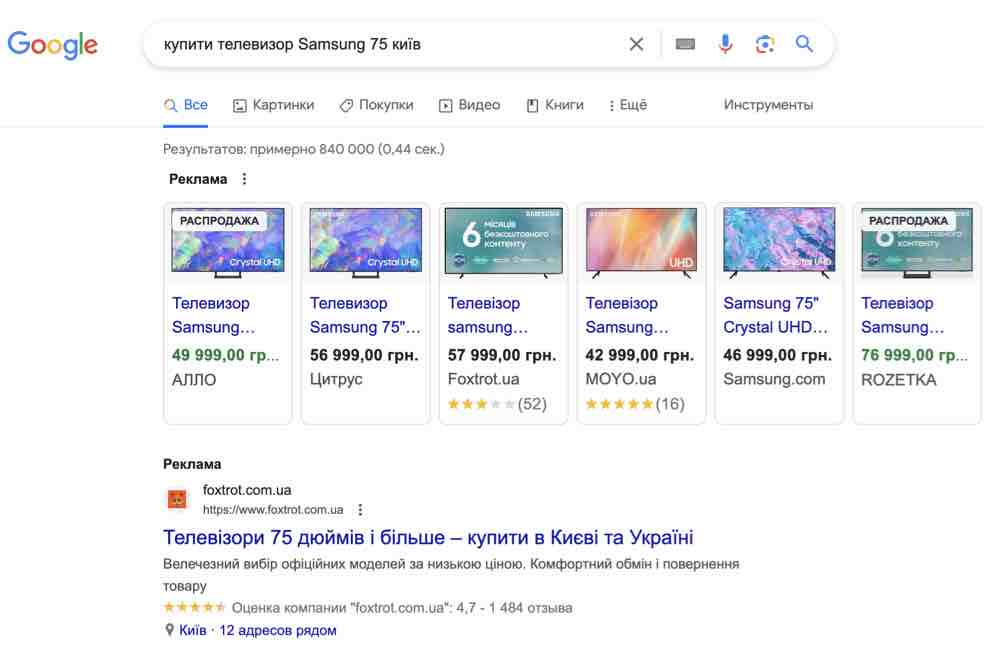
If you have your own online store in Kharkiv, Google Shopping campaigns are the place to start. Why? It’s all about the format. When someone types something like “buy wireless headphones” into Google, they see not just text links at the top of the search results, but full-fledged product cards.
Each one has a photo, price, name of your store, and sometimes even star ratings with reviews. In fact, the buyer makes a preliminary decision even before clicking. They already know what the product looks like and how much it costs. This means that it’s not random onlookers who visit the site, but people with a real intention to buy. The quality of this traffic is significantly higher than that of regular search advertising.
However, launching a Shopping campaign is a little more complicated than a regular search ad. You will need to go through several stages:
- Register an account with Google Merchant Center. This is the platform through which Google receives information about your products. Without it, your shopping ads simply won’t run.
- Compile a product feed. Essentially, this is a table with detailed information about each item: name, description, current price, link to photo, availability status, category. It sounds simple, but in practice, if a store has, say, 800 items, compiling the feed manually becomes a real challenge.
- Link Merchant Center with Google Ads. This link allows data from the feed to be converted into advertising cards in search results.
- Build a campaign structure and set the right bids. It is important not to just launch everything at once, but to divide products into groups and assign each one its own strategy. For example, set higher bids for the flagship line of smartphones with good margins, and more modest bids for cases and screen protectors.
Google Performance Max
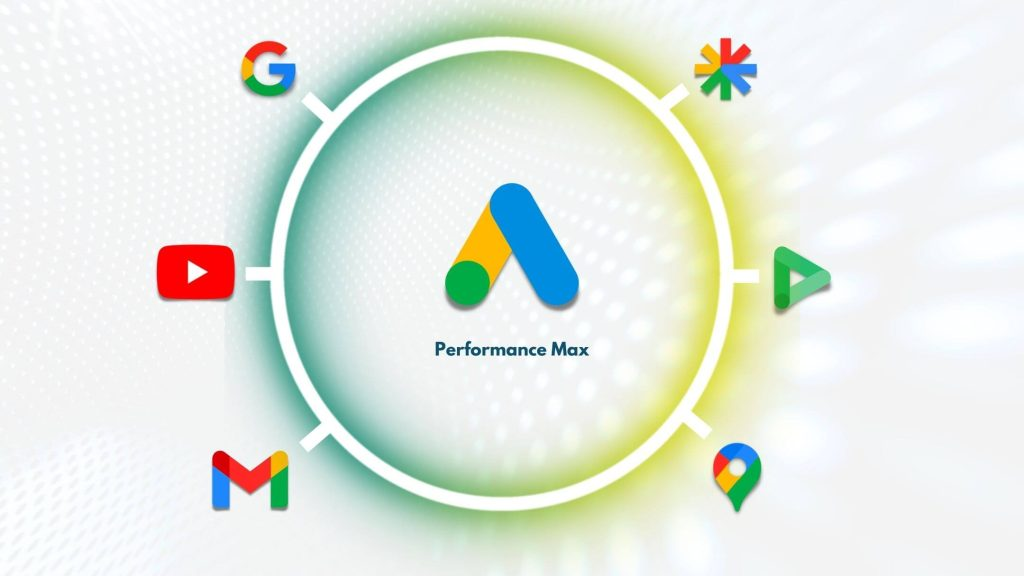
Performance Max (PMax) is a format in which Google takes on the distribution of ads across all of its channels simultaneously: Search, Display Network, YouTube, Gmail, Google Maps, and Discover. You upload a set of resources — texts, images, videos, logos — and machine learning algorithms collect the most effective combinations from them and select platforms for display.
In practice, PMax works particularly well in two cases. The first is online stores with product feeds: the system pulls product data and displays it where the likelihood of purchase is highest. The second is businesses with a physical point of sale in Kharkiv. If you have a showroom, coffee shop, or service center, Performance Max can attract customers through Google Maps by showing ads to people who are currently nearby.
YouTube video advertising
YouTube has long outgrown its status as a regular video hosting site. In fact, it is the second largest search engine on the planet, second only to Google. Millions of Ukrainians visit it every day, including many residents of Kharkiv: some watch reviews before making purchases, others search for recipes or educational videos, and still others simply relax after work.
Now imagine: your advertising message is embedded in this daily stream. And not in the form of dry text, but as a live video—with images, sound, and movement. Video advertising can do what text ads simply cannot. In 15–30 seconds, it can show a product in action, convey the atmosphere, and hook viewers on an emotional level.
Video format works especially well in the B2C segment, where people want to “touch with their eyes” a product or service. A furniture store can show how a set looks in a real interior. A fitness club can convey the energy of a group workout. A travel agency can literally transport the viewer to the ocean shore while they sit at home in Kharkiv and scroll through their feed. In all these cases, a single picture is worth a thousand words, and a live video is worth a thousand pictures.
How much does contextual advertising cost in Kharkiv?
It is impossible to name the exact price of contextual advertising in Kharkiv without details about the project — it is like answering the question “how much does it cost to renovate an apartment?” without seeing the premises. The final amount depends on the niche, the number of competitors in the search results, the product range, the region of display, and what you want to achieve. However, it is possible to outline the general structure of expenses.
Advertising budget
This is money that goes directly to Google for clicks on your ads. For a small local business in Kharkiv with a narrow specialization — say, a watch repair shop or a manicure studio — 5,000–10,000 UAH per month may be enough.
It’s a completely different story if you work in a highly competitive niche. Lawyers, dentists, developers — rates are high here because each client attracted brings in significant income. In such areas, the budget can easily reach 50,000 UAH and above.
Cost of agency services
Payment for specialists who set up campaigns, monitor them, and optimize them regularly. At AdwService, the rate depends on the scale: advertising for a coffee shop with one service and for an online store with 2,000 items are fundamentally different tasks in terms of volume.
If you have already launched advertising and want to understand how effectively your budget is being spent, you can start by auditing your current account. It is often the case that half of the funds are spent on irrelevant queries — and simply cleaning up your campaign frees up resources for real growth.
And the main tip: don’t get hung up on the cost per click as the only benchmark. A click for 3 hryvnia that leads nowhere ends up costing more than a click for 25 hryvnia that results in a person leaving a request.